Cost per lead, per visit, per booking: which number should you track?
By Jayesh G, Founder · 9 min read. Published 29 October 2026.
In short
- Track four costs in a chain: cost per lead, per conversation, per site visit and per booking. Each one answers a different question.
- Judge your spend on cost per booking, every quarter. Watch cost per conversation and cost per site visit every week, because bookings are too few to read monthly.
- Cost per lead only tells you about the ad. It says nothing about whether your team turned the lead into a visit.
On this page
- Each cost answers a different question
- Cost per conversation is the early warning
- A worked month: four costs from one spend
- Find the step where the chain breaks
- Bookings are too few to read every month
- Work out your own numbers
- Which team are you?
- “My agency only reports cost per lead”
- What I’d check this week
- Where software helps
- Questions teams ask
Info Edge, the company behind 99acres (a property portal), billed 16.5% more for 99acres in April to June 2026 than a year before. Is your portal and ad money buying more site visits too?
You can only answer that if you track the right cost. Many ad reports stop at cost per lead. That’s a start. But you don’t earn brokerage on leads. You earn it on bookings, and a lead has three steps to cross before it gets there. For the whole firm’s numbers, see profit per booking. Thinking of buying leads? Here’s what to check first.
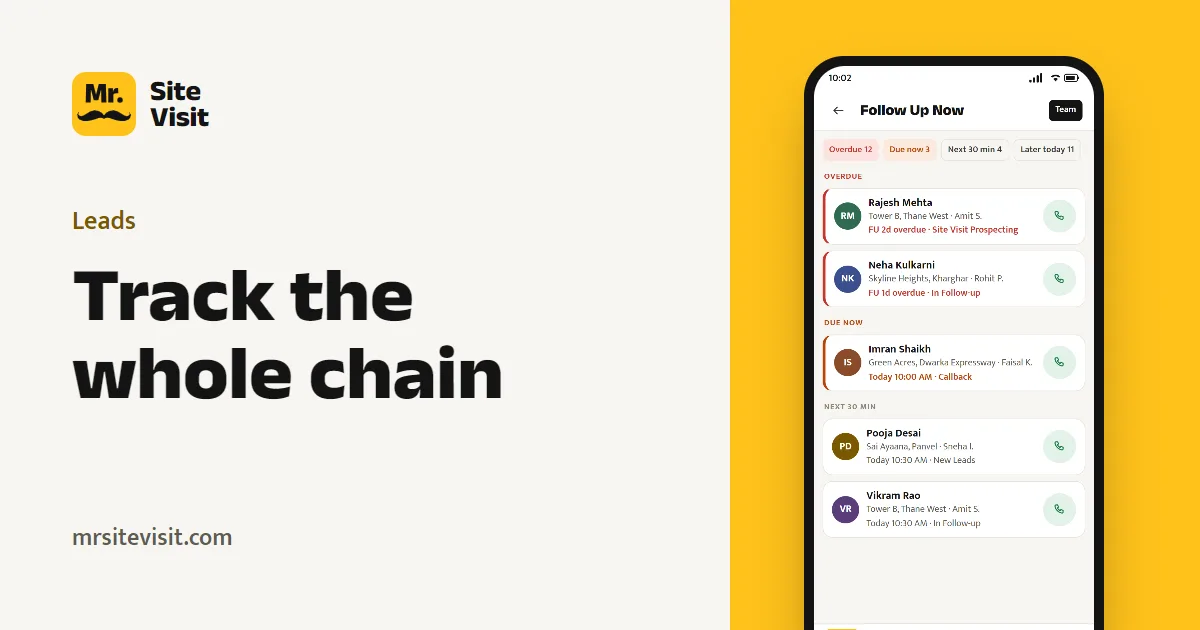
So track the whole chain. Cost per lead tells you about the ad; cost per booking tells you about the business. In between, two more costs show which step leaks. You’ll see each one, a worked month, and which to check weekly.
The simple rule Watch cost per conversation and cost per site visit every week. Judge your spend on cost per booking, every quarter.
Each cost answers a different question
Four costs, one chain. Each one tells you something the others can’t:
| If you track… | It tells you… |
|---|---|
| Cost per lead | Whether the ad or portal brings enquiries cheaply |
| Cost per conversation | Whether those enquiries are reachable, and called in time |
| Cost per site visit | Whether your team turns talks into visits |
| Cost per booking | Whether the whole thing makes money |
Each one has a different owner, too. Your agency or portal owns cost per lead. Your team owns conversations and visits. Bookings depend on your team. They also depend on the project.
Cost per conversation is the early warning
Cost per conversation shows a problem within days, long before bookings do. That’s why it’s worth adding.
- Cost per conversation
- What you spent, divided by the leads your team actually spoke to: connected calls of 2 minutes or more.
Why 2 minutes? A dial count is easy to fake. A 20-second call is rarely a real talk; it’s often a wrong number or a quick no. A real two-minute talk means the buyer picked up and stayed on.
My honest view: if you add only one new number, make it cost per conversation. It moves first, and your team controls it.
If cost per conversation jumps in a week, ask two questions. Did the leads change? Or did the calling slow down? Think of a lead from Saturday night, called on Monday. You’ve often paid for it and lost it.
Compare with your own last four weeks. Is it up by a third or more? Check the source first. Then check the time to first call. Fix one that week. A Harvard Business Review study of 1.25 million US leads, as SmartCompany reported in 2011, found leads contacted within an hour were nearly seven times as likely to qualify as those contacted an hour later. It’s old and from the US, so treat it as a direction, not a promise.
A worked month: four costs from one spend
Here’s an illustrative month for one project. The figures are an example, not a benchmark:
| Step | Count | Cost each |
|---|---|---|
| Spent on ads and portals | ₹1,00,000 | – |
| Leads | 250 | ₹400 per lead |
| Conversations (2 minutes or more) | 75 | ₹1,333 per conversation |
| Site visits done | 15 | ₹6,667 per site visit |
| Bookings | 2 | ₹50,000 per booking |
Same money, four very different numbers. The ad report shows ₹400. The business pays ₹50,000 a booking.
Is ₹50,000 a booking good or bad? That depends on what a booking earns you. If your brokerage (the commission the developer pays you) on it is ₹1,50,000, the spend pays for itself three times. A developer compares it with the margin on a unit instead.
This number leaves things out: salaries, partner brokerage and bookings that cancel. Count only bookings that stay. A developer or mandate company (one that sells a developer’s project) should add partner brokerage to the cost.
Find the step where the chain breaks
Each step’s share tells you where to look. I haven’t found a neutral Indian benchmark for these shares, so compare against your own last three months, not other firms’ numbers:
Each step has its own fix. Weak sources? See how to compare portals on cost per site visit, or run a fair Meta vs Google test. Talks that don’t become visits? The 7 reasons leads don’t become site visits will help. Visits fixed but missed? Read why booked buyers don’t turn up.
Bookings are too few to read every month
A small team can’t judge its spend on one month of bookings. One booking more or less swings the number by half.
There’s a lag, too. A lead from this month may book two or three months later. So use a quarter’s spend and that quarter’s bookings. The lag evens out.
So match each cost to how often it moves:
| Cost | Check it | Why |
|---|---|---|
| Cost per lead | A weekly glance, by source | It tells you about the ad only; don’t act on it alone |
| Cost per conversation | Weekly | It shows reach and calling speed first |
| Cost per site visit | Weekly, over the last 4 weeks | A few visits a week swing it; four weeks show a pattern |
| Cost per booking | Quarterly | Bookings are few, so give them time |
Watch the Saturday site-visit rush. A busy weekend can hide a week of no-shows. A developer’s sales desk with dozens of bookings a month can read cost per booking monthly. Most CP (channel partner) firms of 5 to 10 people should wait for the quarter.
Work out your own numbers
You don’t need software for the arithmetic. To set next year’s spend from these costs, see our 2027 marketing budget. Two free calculators do the rest:
- Use the cost-per-booking calculator on our [free tools page](/tools): put in a month’s or a quarter’s spend, leads, visits and bookings; bookings read best over a quarter
- Use the [booking calculator](/tools/booking-calculator) to see how many leads your bookings target needs
- Write each cost down every Monday, in the same sheet
- Compare each source and each project, not only the total
Which number will surprise you most? In the example above, it’s the gap between cost per lead and cost per site visit.
Which team are you?
The chain is the same for every team. What changes is how much you can read from it, and who watches it:
| Your team | Watch weekly | Judge quarterly |
|---|---|---|
| 3–5 people, the owner sells | Cost per conversation | Cost per booking, all sources together |
| 6–10 people | Cost per conversation and per visit, by source | Cost per booking by source |
| 10–20 people, several projects | Cost per visit by project and source | Cost per booking by project |
| A developer’s or mandate company’s team | Cost per visit, by channel partner too | Cost per booking, monthly if bookings allow |
A developer selling through both channel partners and its own team can also compare cost per booking by channel.
Who shouldn’t bother yet? A team that spends very little on ads and lives on referrals. Count visits and bookings, and skip the costs until the spend is real.
“My agency only reports cost per lead”
That’s normal. An agency sees the ad, not your calls or your site visits. So it reports what it can see. To settle whether it’s the leads or the selling, count four numbers by source.
Ask for the spend by campaign and source, every week. Add your own conversations and visits beside it. Then cost per visit is a number you can share with your agency, and it changes the conversation from “more leads” to “more visits”. When the agency reports ROAS, recount it on the brokerage you keep: here’s what ROAS a CP firm needs.
What I’d check this week
You can do these with your invoices, your ad report and your register. No software? Ask each salesperson to note calls of about 2 minutes or more on the lead’s row. It’s rough, but it works:
- Total last month’s spend by source: ads, the portal package and agency fees
- Count leads, conversations of 2 minutes or more, and visits done, by source
- Split a yearly portal package by month, and across projects by their share of its leads
- Work out cost per conversation and cost per site visit for each source
- Find the step with the lowest share, and pick one fix for it
- For cost per booking, wait for the quarter’s spend and bookings
Where software helps
A sheet works if someone fills in the source, the calls and the visits on every row. That’s the hard part.
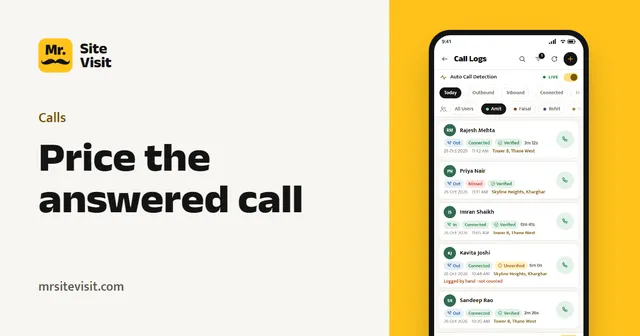
In Mr. Site Visit, leads from 99acres, Housing.com, MagicBricks, Meta and your website arrive with their source. On Android, calls are matched from the phone’s call log and marked Verified, so meaningful calls (2 minutes or more) count per person. iPhone calls aren’t logged.
Visits scheduled and visits done, and bookings, show per person and per project. Ad spend stays in your accounts: the counts by source are in the CRM, and the division is yours.
Starter is ₹423 a user a month, billed yearly, from three users, with no GST on top. There’s a 7-day money-back, and no free trial. See the plans and prices, or how it works for channel partner firms and developers.
Start this Monday. Sit with your team, put last month’s four costs in one sheet, and pick the weakest step to fix first.
Questions teams ask
What is a good cost per booking in real estate?
There’s no single good number. It depends on the project’s price, your brokerage or margin, and the city. Compare it with what a booking earns you: if a booking earns ₹1,50,000 and costs ₹60,000 in ads, the spend pays. Then lower it by fixing the weakest step in the chain, not by buying cheaper leads.
How do you calculate cost per site visit?
Divide what you spent in a period by the site visits done from those leads. Count visits that happened, not visits fixed. If you spent ₹1,00,000 and 15 buyers came to site, your cost per site visit is about ₹6,667.
What is cost per conversation?
What you spent divided by the leads your team actually spoke to, counted as connected calls of 2 minutes or more. It shows within days whether the leads are reachable and whether your team is calling them in time.
Why is cost per lead misleading?
Because a lead isn’t a buyer. A cheap lead that never picks up costs more than an expensive lead that visits. Cost per lead tells you about the ad, not about your sales. Use it only next to cost per conversation and cost per site visit.
How often should I check cost per booking?
Every quarter, for most teams. A 6-person team may book only a few homes a month, so one booking more or less swings the number. Check cost per conversation and cost per site visit every week instead; they move first.
Sources
- Info Edge (India) Ltd, press release on Q1 FY27 results, 10 August 2026: billings for 99acres grew 16.5% year on year in the quarter to 30 June 2026
- Oldroyd, McElheran and Elkington, The Short Life of Online Sales Leads, Harvard Business Review, March 2011 (the study's page; paywalled, figures as reported by SmartCompany)
- SmartCompany, Are you letting online leads go cold? (1 July 2011): 1.25 million leads at 42 US companies; leads contacted within an hour nearly seven times as likely to qualify