Site visit no-shows: why booked buyers don’t turn up
By Jayesh G, Founder · 9 min read. Published 29 October 2026.
In short
- Many no-shows are decided on the booking call, when a buyer gives a soft yes to end the call politely.
- Five questions turn a soft yes into a real visit: who’s coming, from where, which of two slots, what they want to see, and a pin on WhatsApp.
- Count your no-show rate each month, by salesperson and by source, and call every no-show the same day.
On this page
- A soft yes sounds like a visit
- Five questions that make a visit real
- Why booked buyers don’t turn up
- What reminders can do, and what they can’t
- Count your no-show rate
- The same day a buyer doesn’t come
- Which team are you?
- Isn’t this just how buyers are?
- What I’d check this week
- Where software helps
- Questions teams ask
“Yes, I’ll come. Just send the location.” Your salesperson writes the visit in the register. On the day, they wait at the site office, and the buyer’s phone rings out.
Most owners put that down to bad luck, or bad leads. My honest view is that it’s often neither. Many no-shows are decided on the booking call, days before the visit. The buyer said yes to end the call politely, and nobody noticed. That’s a judgement from how visits get booked, not a measured figure.
So the fix starts before any reminder. You’ll learn to spot a soft yes, ask five questions that make a visit real, count your no-show rate, and win back the buyers who didn’t come.
The simple rule A visit isn’t fixed until the buyer says who’s coming and replies to your message. No reply after a second no-show? Back to follow-up.
A soft yes sounds like a visit
A soft yes is a polite way to end a call. It sounds like a booking, so it goes into the register as one.
Listen to how the buyer agreed. A firm yes comes with details. A soft yes comes with “let’s see”:
Firm yes
- Picks one of two slots
- Says who’s coming with them
- Asks about parking or the route
- Replies to your WhatsApp
Soft yes
- “Sunday, I’ll confirm”
- “Let me check at home”
- “Send the location, I’ll come”
- Never replies to the message
A soft yes isn’t a no. It’s a buyer who isn’t ready, or who isn’t the only one deciding. Treat it as a follow-up, not a visit.
Five questions that make a visit real
Ask these on the booking call, in this order. Each one catches a common reason for not coming, and the table below shows which:
- Who’s coming? If the person who decides isn’t coming, fix a time that suits them.
- Where from? A weekday evening trip from far away often doesn’t happen. Suggest a better slot.
- Which of two slots? “Saturday 11 or Sunday 4?” is easier to keep than “whenever you’re free”.
- What do you want to see? A 2 BHK on a high floor, the clubhouse, the sample flat. It gives them a reason to come.
- Can I send the location pin (the map link) on WhatsApp? Then ask them to reply “ok”. A reply is a small promise.
Doesn’t this slow the call down? A little. But a few extra minutes on the call beat a Saturday slot wasted waiting.
If I could change one thing on most teams, it’d be question 1. A visit without the person who decides is often a visit that moves, or doesn’t happen.
Why booked buyers don’t turn up
Each reason has its own fix. Write down the reason for every no-show, and you’ll soon see your top two:
| If the reason was… | Then fix it with… |
|---|---|
| The spouse or parent couldn’t come | Question 1: fix the visit for the person who decides |
| They saw another project first | Call the same day; ask what they liked there |
| It was too far, or they got lost | Questions 2 and 5: a better slot, the pin and the name of the person meeting them |
| They forgot | A reminder the day before and that morning, with a reply asked for |
| The budget or the loan didn’t fit | Share the cost sheet before the visit, and ask if they’ve checked their home-loan eligibility |
| They were never serious | Back to follow-up, with a date; don’t hold weekend slots |
How do you get the reason? Ask kindly, on the call after the no-show. In my view, many buyers will tell you if you don’t sound annoyed.
What reminders can do, and what they can’t
Reminders help, and two help more than one. But they can’t rescue a soft yes.
The evidence I could find comes from hospitals, not real estate. Two studies are worth knowing:
| Study | What it found |
|---|---|
| Review of clinic studies, BMJ Open, 2016 | No-shows of 15% with reminders, against 21% without |
| The same review | Several reminders worked better than one; voice appeared to beat text |
| Hospital trial in Israel, PLoS One, 2020 | With 161,587 patients, changing only the wording of one text cut no-shows from 21.1% to 14.2% |
A property visit is a bigger decision than a clinic slot, so treat those drops as a hint, not a target. And the best message in that trial used guilt, so don’t copy it. Try two wordings of your own for a month.
What does that mean for your team? A message the day before, another that morning, and a call if there’s no reply. Your site visit checklist has the confirmation to copy. Make it specific: the slot, the person meeting them, the pin.
Count your no-show rate
You can’t fix what you don’t count. Your 7-point site visit check has the formula; here it’s by person and by source.
- No-show rate
- Visits fixed minus visits done, divided by visits fixed, for the same period.
Here’s an illustrative month for a 3-person team. The numbers are an example:
| Example salesperson | Visits fixed | Visits done | No-show rate |
|---|---|---|---|
| Salesperson 1 | 12 | 10 | 17% |
| Salesperson 2 | 10 | 7 | 30% |
| Salesperson 3 | 18 | 9 | 50% |
| Team | 40 | 26 | 35% |
Salesperson 3 fixes the most visits, and loses half. That’s often a booking-call habit, not bad luck. Sit in on two of their calls, and listen for question 1, before you judge.
Is 35% bad? I couldn’t find a reliable published no-show rate for Indian real estate; the vendor pages I found quoted figures without a source. So use your own last three months as the yardstick, and judge each month against it.
Each no-show also costs a salesperson, in my estimate, an hour or two of a weekend slot, which could have gone to a buyer who came.
The arithmetic is simple. With 40 visits fixed a month, cutting the no-show rate by 5 points gives you 2 more visits on the same leads.
Count it by lead source too. If one portal or one ad has a much higher no-show rate, its buyers may be earlier in their search. That’s worth knowing before you renew it.
The same day a buyer doesn’t come
The first hour after a missed slot decides whether you get the visit back. Here’s the routine:
- Within 30 minutes Call, kindly. “Is everything ok? We were expecting you at 11.”
- No answer Send a WhatsApp with two new slots.
- Write the reason In the lead’s notes, the same day.
- Second no-show Move them to follow-up, with a date in a week or two.
A message the salesperson can send when the buyer doesn’t pick up:
Don’t chase every day. Two no-shows without a reply is a buyer telling you it’s not now. A dated follow-up keeps the door open without wasting your weekends.
Which team are you?
No-shows hit every team, but the fix sits with different people:
| Your team | Who owns the fix | Start with |
|---|---|---|
| 3–5 people, the owner sells | The owner | The five questions on every booking call |
| 6–10 people | The team leader (TL) | A morning list of today’s visits, marking who has replied |
| 10–20 people | TLs, team by team | No-show rate by salesperson, every week |
| A developer’s or mandate team | The sales head, by project | No-show rate by source and project |
Do channel partners bring buyers to your site? Then the partner who brought each buyer should confirm their slot too. Count the no-show rate by partner firm as well, and call any partner whose buyers keep skipping.
Who shouldn’t bother with all this? A team whose no-show rate has stayed low and steady for three months, against its own yardstick. Keep your routine and spend the time on what happens after the visit.
Isn’t this just how buyers are?
Some buyers will always skip. Weddings, illness and rain are real. You can’t fix those, and you shouldn’t try.
But a no-show rate that changes a lot from one salesperson to the next isn’t the buyers. Neither is one that climbs when you’re short of staff on weekends. Those are habits, and habits can change.
You may be tempted to cut the lead source, overbook Saturday or buy a tool that sends reminders. Each one skips the question of why your buyers didn’t come.
Keep it simple instead. Count one month, note every reason, then fix the top one. Decide on anything bigger after that.
What I’d check this week
You can do all of this without software:
- Count last month’s visits fixed and visits done, for each salesperson
- Work out the no-show rate for each person and for the team
- Write the five questions on a card next to every phone
- Ask the reason for every no-show this week, and note it
- Call every no-show within 30 minutes of the slot
Where software helps
A register shows visits fixed and done if every salesperson fills it in. Software keeps the count without anyone adding it up.
In Mr. Site Visit, each person’s visits scheduled and visits done show side by side. For a finished month, once rescheduled visits are moved, the gap is your no-show count.
Follow-ups come as reminders, with an 8:30 am push for the day’s list, and overdue ones show in red. WhatsApp messages open with the text filled in. The salesperson sends them by hand, so nothing goes out on its own.
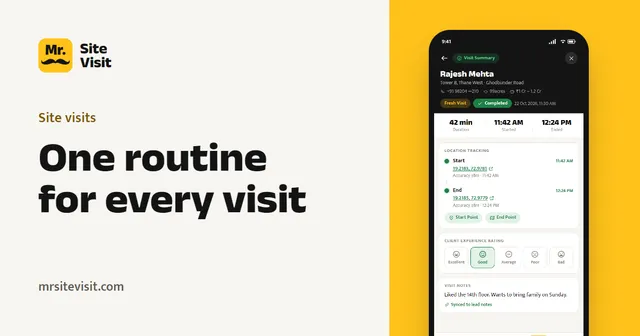
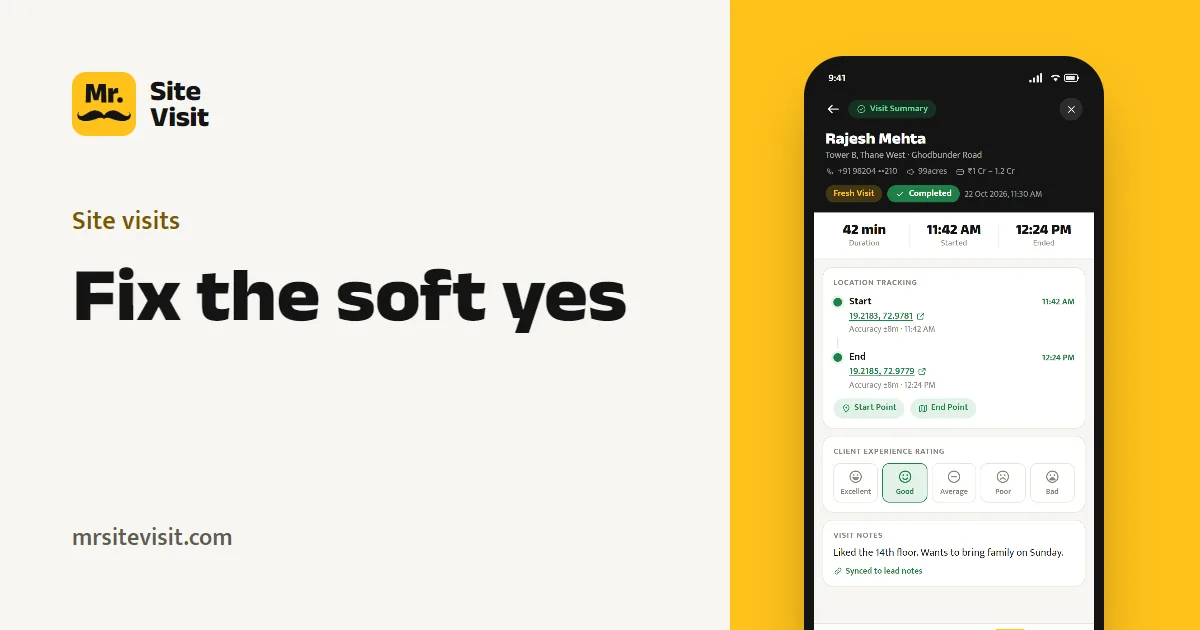
On Growth and Developer, each visit records the time and GPS location at its start and end. It’s a record, not a check against the site, and a salesperson can start a visit without GPS.
Starter is ₹423 a user a month, and Growth is ₹548, both billed yearly, from three users, with no GST on top. There’s a 7-day money-back, and no free trial. See the plans and prices, or how it works for channel partner firms.
Start this week with last month’s count and the card of five questions. Try the card with your team on every booking call, then count again next month.
Questions teams ask
Why do buyers not turn up for site visits?
Often the visit was never firm. The buyer said yes to end the call, the family member who decides wasn’t asked, or they saw another project first. Distance, traffic and a missing location pin come next. Ask five questions on the booking call, and most of these show up before the day.
How do you calculate the site visit no-show rate?
Take the visits fixed for a period, subtract the visits done, and divide by the visits fixed. If 40 visits were fixed and 26 happened, the no-show rate is 14 ÷ 40, or 35%. Count it by salesperson and by lead source.
What should a salesperson do when a buyer doesn’t come for a site visit?
Call within 30 minutes of the slot, kindly, without blame. If there’s no answer, send a WhatsApp offering two new slots. Write down the reason. After a second no-show without a reply, move the buyer back to follow-up with a date.
Do reminder messages reduce site visit no-shows?
Yes, but they’re only part of it. In a 2016 review of clinic studies, no-shows fell from 21% to 15% with reminders, and more than one reminder worked better than one. Reminders can’t fix a visit that was never firm.
Should I overbook site visit slots to cover no-shows?
No. Two families arriving together can lose you both. Fix the booking call and the reminders first. If a buyer has missed twice, offer a weekday slot instead of your Saturday rush.
Sources
- Robotham et al., Using digital notifications to improve attendance in clinic: systematic review and meta-analysis, BMJ Open, 24 October 2016: no-shows 15% with notifications vs 21% without; several notifications beat one; voice appeared better than text
- Berliner Senderey et al., It’s how you say it: Systematic A/B testing of digital messaging cut hospital no-show rates, PLoS One, 23 June 2020: 161,587 patients in Israel; no-shows 21.1% with the standard reminder, 14.2% with the best wording