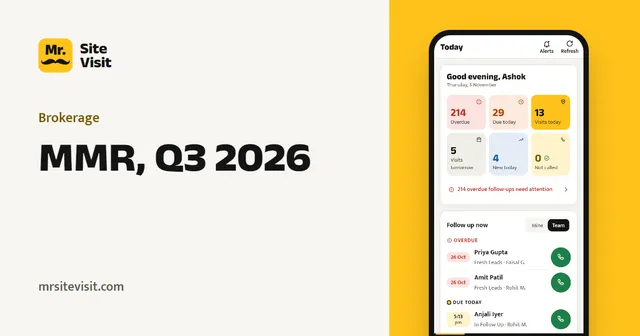
A follow-up system your sales team will actually use
By Jayesh G, Founder · 11 min read. Published 24 October 2026.
In short
- Many leads go cold after the first call or the site visit, when nobody owns the next step.
- Give every open lead one owner and a next-action date. No call ends without one.
- Each morning, clear what's due today and what's overdue, and close a lead as lost only with the owner's approval.
On this page
- Leads go cold between calls, not on the first one
- Every open lead needs one owner and one date
- A follow-up rhythm for each stage
- What to say when you follow up
- After the site visit, the clock starts
- Every morning, clear what’s due and what’s overdue
- Close a lead as lost only with a reason and the owner’s okay
- “My people won’t fill in dates”
- Which team are you?
- A sheet you can copy today
- When a sheet stops being enough
- Questions teams ask
“We’ll think about it.” A family that says it after a site visit is still your buyer, until nobody calls them back.
Has anyone called last weekend’s families? You ask in the WhatsApp group, and nobody’s sure.
That’s where leads often die: in the quiet days after the first call, when nobody owns the next step. (If your leads never get as far as a visit at all, start with why leads don’t become site visits.)
You don’t need software to fix this. The system below runs on a sheet, and plenty of good teams use one. Every open lead gets one owner and a next-action date. And every morning the team clears what’s due.
The simple rule No call ends without a next-action date. No lead is closed as lost without the owner’s approval.
Leads go cold between calls, not on the first one
Teams often lose leads in the gap after the first call, because nobody has written down what happens next.
Calling a new lead fast matters, and our guide to calling every portal lead within an hour covers it. But a fast first call only opens the door. Property buyers often take weeks to decide. They visit two or three projects, talk to family, and check the loan.
So what keeps a lead warm across those weeks? A date. If a lead has no next date, it has no next call. It sits in someone’s phone until the buyer books somewhere else.
- Next-action date
- The day the lead’s owner will next call, message or meet the buyer, written down before the current call ends.
Every open lead needs one owner and one date
The whole system is two fields on every lead: who owns it, and when they’ll act next.
Here’s what happens after each call, depending on whether a date gets written:
That’s why the date matters more than the note. A note tells you what happened. The date makes the next thing happen.
Keep one owner per lead, too. If two people “share” a buyer, each assumes the other called. When someone is on leave, hand their due leads to a named colleague for those days, not to the group.
A follow-up rhythm for each stage
How soon you follow up depends on where the lead is. A buyer who just visited needs a call within days; a buyer planning for next year doesn’t.
Here’s a starting rhythm for a team selling new projects. It’s a sensible default from how buyers move, not a figure from research, so adjust it to your projects:
| Lead stage | First follow-up | Then | Aim of the follow-up |
|---|---|---|---|
| New, not reached yet | Same day, 3 tries spread out | A WhatsApp message with your name | Have the first real conversation |
| Interested, no visit yet | Within 2 days | Every 3 to 4 days | Fix a site visit date |
| Visit fixed | The day before | The morning of the visit | Make sure they come |
| Visited | The same evening | Day 2, then day 5 | Answer their main doubt |
| Negotiating | The date you agreed | Every 2 days | Get to a yes or a no |
| Gone quiet | Day 10 | Day 20 | Get a clear answer, or ask to close |
Two things matter more than the exact days. Every lead has a date, and the date is kept. Is a follow-up on day 5 instead of day 4 a problem? No. A follow-up that never happens is.
What to say when you follow up
Give the buyer something useful each time. “Any update?” gives them nothing.
Each message should carry one new thing: an answer to their question, a floor plan they asked for, a date for the next step. Keep it short enough to read on a phone. Here are three openers your team can adapt:
The last one sounds risky, but it works because it’s honest. A clear “no” lets you close the lead and spend the time on someone who’s buying. Only message people who gave you their number and agreed to hear from you. Send each message from the salesperson’s own phone, never as one message sent to a whole list. Our page on keeping your WhatsApp number safe explains why.
After the site visit, the clock starts
The days after a visit often decide whether a buyer books, so plan them before the buyer leaves the site.
When a buyer says “we’ll think about it”, they’re usually comparing. Your job is to stay the easiest option to say yes to. Here’s a plan your team can run after every visit:
- Before they leave Ask what would stop them booking. Write it down, and set the next date with them.
- Same evening Send one message: thanks, plus the answer to that doubt.
- Day 2 Call. Talk through the doubt, the payment plan or the loan.
- Day 5 Offer the next step: a second visit with family, or a meeting on price.
- Day 10 and day 20 If they’ve gone quiet, use the “still looking?” message.
The Saturday rush is when this breaks. Five buyers visit, the salesperson is tired by evening, and the “same evening” message waits until Monday. So send the evening messages before leaving the site office. It takes ten minutes.
Every morning, clear what’s due and what’s overdue
The system works only if someone looks at the dates every day. That’s a ten-minute habit, not a meeting.
Here’s the routine for each salesperson, first thing in the morning:
- Open your list of leads due today and overdue
- Call the overdue ones first, oldest first
- Work through today’s list before taking new leads
- Set a new date on every lead you touch
- Flag any lead you think is lost, with the reason
And for the owner or sales head: look at one number per person, the count of overdue follow-ups. Did it go up since yesterday? That’s your first conversation of the day, held one to one and calmly. Bring the team totals to the Monday review. My honest view: the owner checking every morning matters more than any tool.
Close a lead as lost only with a reason and the owner’s okay
A lead should leave the follow-up list only when there’s a clear reason, and the owner agrees.
Without that rule, a tired salesperson marks hard leads as “not interested” to clean up their list. You lose buyers you’d still win. Here’s when to close, and when not to:
| If the buyer… | Then… |
|---|---|
| Says no, or booked elsewhere | Close as lost, with that reason |
| Asks you to stop contacting them | Stop at once, and close the lead |
| Is buying in six months, not now | Keep it open, with a date three months out |
| Hasn’t replied for three weeks of calls and messages | Ask the owner to approve closing it |
| Wants a different budget or area | Offer another project before closing |
A request to stop isn’t just good manners. WhatsApp’s business messaging policy says businesses must respect any request to stop their messages. The Digital Personal Data Protection Act, 2023 also lets people withdraw consent at any time. Its Rules bring most duties into force from 13 May 2027, as SCC Online reported. Check with your lawyer which duties apply to your firm, and when.
“My people won’t fill in dates”
The fair objection: “We tried this. They wrote dates for a week, then stopped.”
Usually that’s because the date was extra typing at the end of a long day. So make it part of the call, not a task after it. The call ends, the salesperson picks a date, done. On a sheet, that’s one column next to the call note.
Then check it every morning for the first month. If you look, they’ll keep it up. If you don’t, they’ll know.
Which team are you?
The system is the same for everyone. What changes is who checks it:
| If you are… | Then… |
|---|---|
| 3 to 6 people, the owner still sells | A shared sheet with an owner and a next date per lead can work. The owner checks overdue each morning. |
| 7 to 15 people with a sales head | The sales head checks overdue by person daily; the owner sees the totals weekly. |
| A developer’s team with a site office | Add the post-visit plan to the site office routine, so the evening messages go before staff leave. |
| Working with outside channel partners | Keep each lead’s owner on your side, even when a partner brought the buyer. |
A sheet you can copy today
Five columns are enough: Lead (name and number), Owner, Stage, Next action date, Last note. Add a sixth column with this formula, and filter it each morning:
=IF(D2="","No date",IF(D2<TODAY(),"Overdue",""))
Once a lead is closed, set its Stage to Lost or Booked and clear its date, then filter on “Overdue” and “No date” for open leads only, so closed ones don’t clutter the list. Lost leads aren’t gone for good. Here’s which old leads to call again.
Type real dates in the date column, not words like “Monday”, or the formula can’t read them. Sort by Next action date, oldest first. Want it ready-made? Our lead tracking Excel template has this check built in, with dropdowns and a count of overdue leads for each person.
Who shouldn’t bother yet? If your team has only a few open leads, a notebook and a daily look are enough. Start the sheet when you can’t remember who’s waiting for a call.
A sheet starts to break when one person can’t see everyone’s dates at a glance, or when nobody can tell if a call really happened.
When a sheet stops being enough
We built Mr. Site Visit, a CRM (the software your team logs leads, calls and visits in) for real-estate teams of 3 or more. It supports this system and cuts the typing. It can’t make your team use it, so the morning check stays yours.
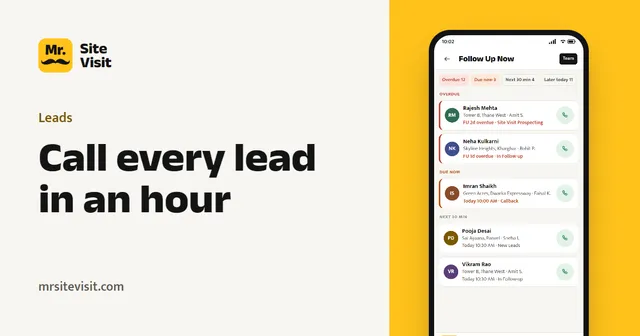
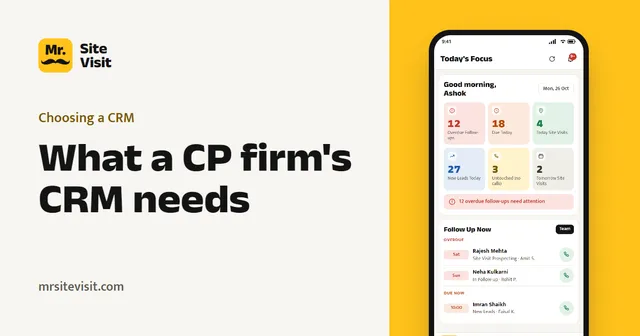
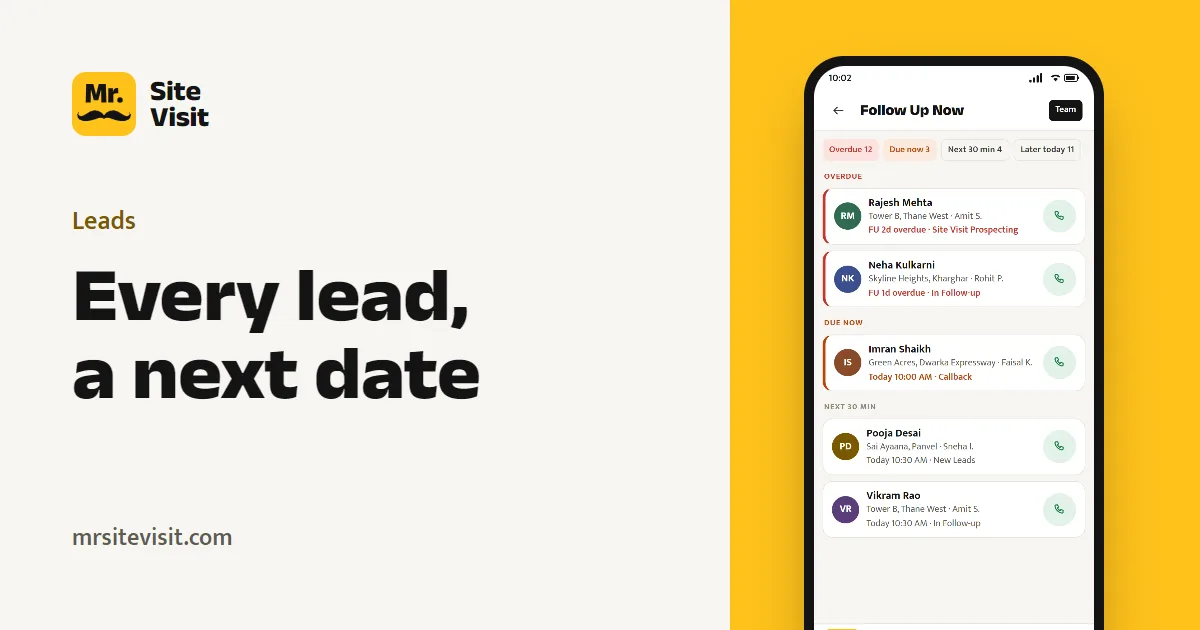
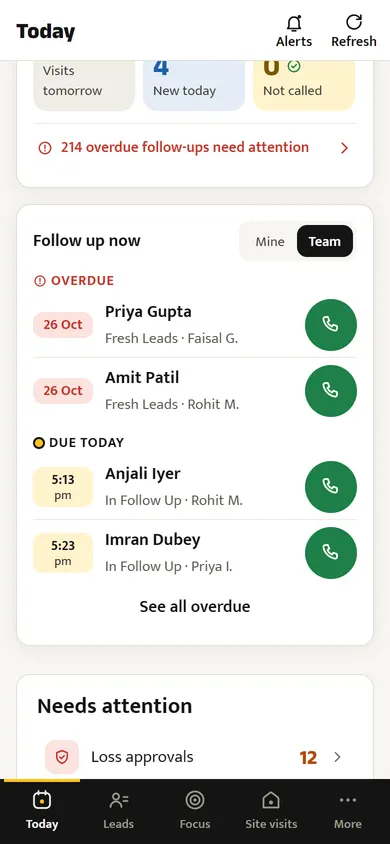
After each call, the app suggests a next follow-up date. The salesperson can change it or clear it; nothing forces one. Calls are matched from each Android phone’s own call log and tagged Verified, so a typed “called” doesn’t count as a call. iPhones aren’t covered. Each morning at 8:30, everyone gets a phone notification listing the follow-ups due today. Overdue ones turn red, for them and for you.
WhatsApp messages open from the lead with the text filled in, and the salesperson sends them from their own phone. Nothing goes out by itself.
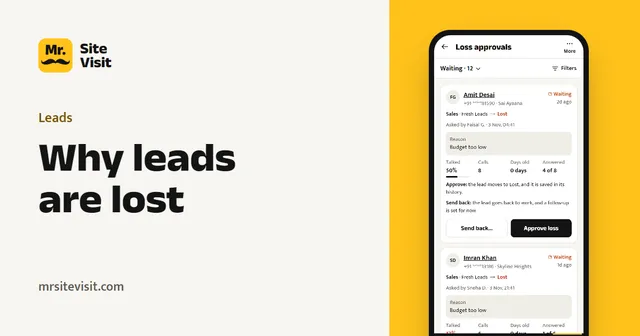
On the Growth and Developer plans, a lead can’t be marked lost without a manager’s approval, and the manager can send it back, hand it to someone else, or pitch another project.
Prices start at ₹423 a user a month on Starter, billed yearly, from 3 users, with no GST on top. Approval before a lead is lost is on Growth (₹548) and Developer (₹1,298). See the plans and prices, or how it works for CP firms and developers.
Whatever you use, a sheet or an app, start on Monday. Ask the team to put a next date on every lead they touch this week, and check the overdue list with them every morning.
Questions teams ask
What is a follow-up system in real estate sales?
It’s a simple rule the whole team follows: every open lead has one owner and a next-action date. Each morning, every salesperson works through what’s due today and what’s overdue, and the owner checks the overdue count. It runs on a sheet or in a CRM.
How many times should you follow up with a property lead?
Until the buyer gives you a clear answer or three weeks pass without any reply. Spread the attempts out, mix calls with a short WhatsApp message, and log each one. After that, ask the owner to approve closing the lead as lost, with a reason.
What should a salesperson do after a site visit?
Message the buyer the same evening with what they saw, call within two days with an answer to their main question, and set the next date before hanging up. Buyers who say they’ll think about it may be comparing projects, so stay in touch on the dates you agreed, not just yours.
Can you send follow-up messages on WhatsApp to every lead?
Only to people who gave you their number and agreed to hear from you. WhatsApp’s business policy also says you must respect any request to stop. Send messages one by one from the salesperson’s phone, never as one message sent to a whole list.
Sources
- WhatsApp Business Messaging Policy, section 1 (last updated 23 September 2026)
- Digital Personal Data Protection Act, 2023 (Act No. 22 of 2023, assented 11 August 2023), India Code
- SCC Online, MeitY notifies the Digital Personal Data Protection Rules, 2025 (14 November 2025): most duties apply from 13 May 2027