Lost leads: what the reasons say about your projects and team
By Jayesh G, Founder · 11 min read. Published 6 November 2026.
In short
- “Not interested” says how a lead ended, not why. Give every lost lead one reason from a short list of real reasons, with the buyer’s own words in a note.
- A manager checks the reason before the lead closes. A buyer who isn’t buying yet gets a follow-up date, not a lost tag.
- Once a month, count the reasons by source, by project and by salesperson. Each pattern goes to a different person: the agency, the developer or the team leader.
On this page
- “Not interested” is how a lead ended, not why
- Eight reasons are enough to start with
- A buyer who isn’t buying yet isn’t lost
- A manager checks the reason before the lead closes
- Read the reasons once a month, three ways
- What each pattern tells you
- Which team are you?
- “My team will just pick any reason”
- What I’d check this week
- Where software helps
- Questions teams ask

“Not interested” isn’t a reason. It tells you how the lead ended, and nothing about why.
Every sales team has a lost pile. Open most lost piles and you’ll find “Not interested”, “Not responding” and “Other”. So you learn nothing from it. Next month’s leads get lost the same way.
Give every lost lead one real reason from a short list, with the buyer’s own words in a note. A manager checks it before the lead closes. Once a month, you count them by source, project and salesperson. Each pattern goes to one person. It might be the agency, the developer or your team leader.
The simple rule If a lost reason would fit any lead, it isn’t a reason. Ask the buyer one more question before you close it, if you can reach them.
“Not interested” is how a lead ended, not why
A reason answers “why did this buyer stop?” An outcome only says that they did.
- Lost reason
- The real cause a buyer stopped, picked from a short fixed list, with the buyer’s own words in a note.
This mix-up isn’t only a real-estate habit. Clozd is a firm that interviews buyers after a sale is won or lost. It compared the records of 1,000 deals with what the buyers said. The records came from each firm’s CRM (the software a sales team logs its leads and calls in).
The reason in the records matched the buyer’s account only 15% of the time. And 44% of the lost reasons were outcomes, not reasons.
Those deals weren’t property sales, and Clozd sells this research. So don’t carry its numbers into your firm. Carry the lesson. The reason your salesperson types isn’t always the buyer’s reason.
Why does it happen? My guess: the salesperson fills in the reason at 9 pm, after the last call. “Not interested” is the fastest pick. It never starts an argument.
Eight reasons are enough to start with
Keep the list short enough to pick from on a phone. This is a working list, not a measured split. These eight suit most CP firms and developer teams. A CP firm is a channel partner firm: it sells developers’ projects for brokerage, a commission on each sale. Each points to the person who can fix it.
| Reason | What it means | Who can fix it |
|---|---|---|
| Budget doesn’t fit | The buyer can’t pay this price or this payment plan | The developer’s pricing, or a cheaper project |
| Wrong location | They want another area | Marketing: who the ads reach |
| Wrong size | They want a 3BHK and you have 2BHKs | The project mix, or another project |
| Bought elsewhere | They booked another project | Sales: how fast and how well you followed up |
| Never reachable | No answer after the full set of call tries | Sales: when and how often you called |
| Not a buyer | A broker, a job seeker, a tenant, a wrong number | Marketing: the form and the targeting |
| Project concern | The builder, the possession date, the approvals | The developer |
| Other | Anything else, with a note that says what | You, once a month |
Two rules make the list work. “Other” always needs a note. And “Bought elsewhere” needs the project’s name, if the buyer will tell you. Ten of those in a month tell you who you’re really competing with.
Expect “Budget doesn’t fit” to be large this year. In ANAROCK’s buyer survey for the first half of 2026, affordability was the biggest challenge for 44% of those delaying or reconsidering a purchase.
So a big budget share may be the market. But check it. It’s also the easiest reason to type.
A buyer who isn’t buying yet isn’t lost
“Next year”, “after Diwali” or “when my FD matures” is a date, not a no. Give that lead a follow-up date and keep it open. Review the “not now” list once a month. A lead that already had its full set of tries, and stays silent after two more follow-ups, closes as “Never reachable”.
Marking them lost throws away a buyer who already knows you. Here’s how to sort the answers you hear most:
| If the buyer says… | Then… |
|---|---|
| “Not now, maybe in six months” | Keep it open with a follow-up date in six months |
| “Too expensive” | Ask what they can pay. Offer another project in that range before you mark it lost |
| “We’re looking in another area” | Ask which area. Move it to a project there if you sell one |
| “Already booked” | Mark it “Bought elsewhere” and ask which project |
| Nothing, after every call try | Mark it “Never reachable”, only after the full set of tries |
How many tries is “the full set”? Our post on how many times to call a lead sets six. They’re spread over about ten days. Use your own number, as long as everyone uses the same one.
A manager checks the reason before the lead closes
A lost lead should need a second pair of eyes. Without that check, the easiest reason wins. A lead that could have booked is gone.
The check is short when the note is clear. The team leader, or the sales manager in a small firm, looks at three things:
- The tries Did the lead get the full set of calls, at different times of day?
- The note Does it hold the buyer’s own words, not the salesperson’s summary?
- Another project Would anything else you sell fit their budget, area or size?
If any check fails, the lead goes back with one line saying why. If all three pass, it closes.
Does this slow the team down? A little, at first. But once a salesperson knows the team leader reads every reason, the notes get better. In my experience, the notes usually get better within a few weeks.
Read the reasons once a month, three ways
Count the month’s lost leads by reason, then split the same list three ways: by source, by project and by salesperson. One split alone hides most of the story.
Here’s an illustrative month for a 10-person CP firm with 140 lost leads. Every figure is an example:
The totals alone say “lots of junk leads”. That’s true, but it isn’t a decision yet. The three splits turn it into one:
| Split | What stood out in the example | Who it goes to |
|---|---|---|
| By source | Meta ads: 28 of its 60 lost leads were “Not a buyer” (47%, against 21% for all sources) | The agency: the form and who it reaches |
| By project | Project B: 22 of its 40 were “Budget doesn’t fit” (55%, against 19% overall) | The developer: price, payment plan, possession date |
| By salesperson | One person: 14 of their 25 were “Never reachable” (56%, against 20% for the team) | The team leader: check that person’s call log |
Look at the last row. Across the team, one lost lead in five was “Never reachable”. For that one person, it was more than half. That person has a calling problem. The totals hide it.
When is a difference real? My rule of thumb: act when a reason’s share is about twice the team’s usual share, on at least 20 leads. Below that, it’s often chance. It’s a judgement, so adjust it to your volume.
What each pattern tells you
Each pattern has one owner. Send it to them with the numbers, not with a complaint.
| If you see… | Then… |
|---|---|
| One source full of “Not a buyer” or “Wrong location” | Ask the agency to change the form or the targeting before next month’s spend |
| One project full of budget or project concerns | Take the count to the developer. Ask about the payment plan, the price or the possession date |
| One person with twice the team’s “Never reachable” | Check their call log for the times and the number of tries |
| “Bought elsewhere” rising, with the same project named | Visit that project. Compare its price and offer with yours |
| “Other” above one in ten | Read the notes and add the reason that keeps coming up to your list |
Going to the agency? Our post on bad leads or bad selling has the four numbers to bring. For the developer talk, site visits but no bookings has the project checks.
And don’t delete the lost pile. A buyer lost on budget in March may fit a new launch in October. Our post on old leads worth calling again shows how to sort them.
Which team are you?
The method is the same at every size. Who checks the reasons, and how often, isn’t.
| Your team | What fits |
|---|---|
| 3–6 people, the owner sells | The owner checks each lost lead on Saturday. One monthly count, by source and project |
| 7–20 people with a team leader | The team leader checks each lost lead the same day. The monthly count adds the salesperson split |
| A developer’s in-house team | Add the project and tower split. Send budget and project concerns to pricing every month |
| A mandate team (selling a developer’s project for it) with outside CPs | Keep outside partners’ lost leads apart, so you see which partner’s leads fail for which reason. Before closing, check no other partner has the same buyer |
What about last year’s pile? Start the new list from today. Reopen only the last 30 days of lost leads and give them real reasons.
Who shouldn’t bother yet? A firm with fewer than about 30 lost leads a month. The counts will be too small to read. Do the manager check, and read the notes instead.
“My team will just pick any reason”
Some will, at first. That’s why the manager’s check matters more than the list.
A salesperson picks the easiest reason when nobody reads it. Send one reason back with a question (“Which area did they want?”). You’ll see the next one written properly. You don’t need a speech about data. You need one returned lead a day for two weeks.
And be fair about it. A high “Budget doesn’t fit” share may really be the market this year. Before you blame the person, check the project. Do the others selling that project show the same high budget share?
What I’d check this week
- Count last month’s lost leads marked “Not interested”, “Other” or blank
- Replace your reason list with the eight above, and make “Other” need a note
- Move every “not now” lead back to open, with a follow-up date
- Name the person who checks each lost lead before it closes
- Put a 30-minute monthly count of reasons on the calendar
Where software helps
You can run all of this on a sheet. Add columns for the reason (a dropdown of the eight), the note, who checked it and the date. Then count it monthly by source, project and owner. It breaks when nobody checks the reason before the lead closes. A sheet can’t stop someone typing “Lost”.
In Mr. Site Visit, marking a lead lost asks for a reason from your own list, set in Settings, with an optional note. The reasons your team uses most come first, so picking one is quick on the phone. On the Growth plan, you can turn on approval before a lead is lost, for each pipeline. The lost lead then waits for a manager to approve or reject it.
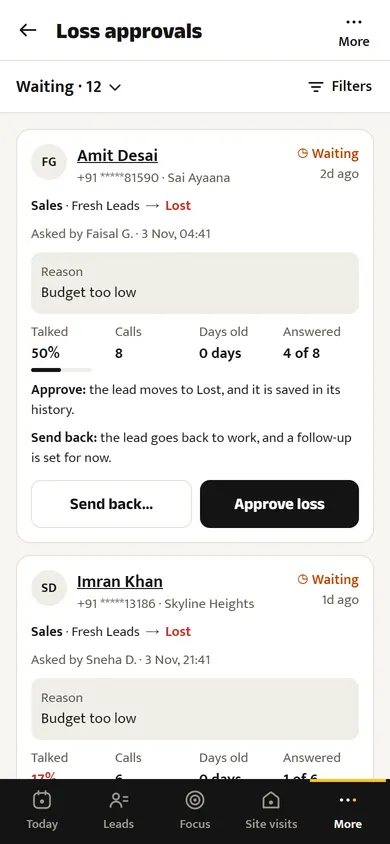
The leads list filters by lost reason, project, source and owner, so the monthly splits take a few taps. The Growth plan is ₹548 per user a month, billed yearly, from three users. See the plans and prices, or how it works for CP firms.
This week, pull ten of last month’s “Not interested” leads and call them back. Ask each buyer one more question, and see how many real reasons you find.
Questions teams ask
What are the main reasons real estate leads are lost?
Eight reasons are enough for most teams to start with. The budget doesn’t fit, the area or the size is wrong, or the buyer bought elsewhere. They were never reachable, weren’t a real buyer, or had a concern about the project. A buyer who simply isn’t buying yet shouldn’t be marked lost at all.
Should “not interested” be a lost reason?
No. “Not interested” is how the lead ended, not why. Ask one more question before you close it: is it the budget, the location, the size, or something about the project? Write the buyer’s answer in their own words.
Who should approve a lost lead?
The team leader or the sales manager. They check three things: the lead had its full set of call tries, the note has the buyer’s own words, and no other project you sell would fit. If any check fails, the lead goes back to the salesperson.
How often should we review lost leads?
Once a month is enough for most teams. Count the reasons by source, by project and by salesperson. Act on any reason that stands out by twice the team’s usual share, and ignore small differences on fewer than 20 leads.
Sources
- Clozd, 5 lies your CRM is telling you about your buyers (Nate Bagley, 21 April 2023, updated 24 October 2025): Clozd compared the CRM data from 1,000 deals with buyer interviews; closed-lost reasons matched the buyers’ accounts 15% of the time, and 44% of closed-lost reasons in the CRM were outcomes, not reasons (the company’s own research, not property sales)
- Construction World, 48% homebuyers prefer 3BHKs, Rs 9–10.5 mn budget leads demand (18 September 2026), on the ANAROCK Consumer Sentiment Survey H1 2026 (January to June 2026, 8,320 respondents, 14 cities): affordability is the biggest challenge for 44% of respondents delaying or reconsidering a purchase