How many times should you call a real estate lead?
By Jayesh G, Founder · 13 min read. Published 26 October 2026.
In short
- Unreached leads can slip after one or two tries. Count yours. One call at 11 am tells you little.
- Our starting rule: try a new lead about six times over seven days, at different times of day. For most portal leads that's calls only, until the buyer agrees to WhatsApp.
- Then stop, mark it unreachable, and check your own call log to see on which try your buyers usually pick up.
On this page
- How many tries did your “not picking” leads get?
- A six-try plan for a lead you haven’t reached
- Spread the tries; don’t stack them
- Too many calls can get your number reported
- When to stop, and what happens to the lead
- Find your own stopping point in last month’s call log
- What one extra try is worth
- “My team doesn’t have time to call six times”
- Which team are you?
- When a sheet stops being enough
- Questions teams ask
How many times was a “called, not picking” lead actually called? Look down today’s 99acres and Housing.com leads and you’ll see those words again and again. Was each one tried once, or many times? Nobody can say. You paid for every one of them.
Call too few times and a paid lead dies after one try. Call too often and the buyer blocks you, or reports your number as spam.
I won’t give you a magic number from a US sales blog. I’ll give you a plan you can run from tomorrow. And a way to find your own stopping point in your call log. The short answer: try a new lead about six times over seven days, at different times. Then stop and mark it. It’s our starting rule; it doesn’t come from research.
The simple rule Six tries over seven days, at different times, then stop and mark it. A lead tried once isn’t lost. It’s untried.
How many tries did your “not picking” leads get?
It’s easy for an unreached lead to get one or two calls and then slip. Nobody decides to drop it. It just stops being anyone’s next call.
US sales blogs often claim most salespeople give up after one or two attempts. I couldn’t trace any of those figures to original data. So I’m not using them. Your own team is easier to check, and it’s the first thing I’d look at. Two terms first:
- Attempt
- One dialled call to a lead you haven’t spoken to yet, whether or not it connects. A switched-off phone or voicemail counts as a try.
- Reached
- The buyer picked up and you had a real conversation, not a hang-up or a wrong number. A WhatsApp reply or a callback counts once you agree a time to talk.
So pull ten leads marked “not picking” from last week. Count the attempts on each from the phone’s call log, not from memory. How many got only one? A wrong number doesn’t need six tries; mark it and move on.
A six-try plan for a lead you haven’t reached
Spread six attempts across a week, each at a different time of day. That’s our starting plan. It’s built on common sense about when people are free, not on research. Adjust it to your own call log.
One caution first. For most portal leads, you won’t have the buyer’s yes to WhatsApp yet, so tries 1 to 6 are calls only. The messages below are for leads who agreed, often from your own forms.
| Try | When | What to do |
|---|---|---|
| 1 | Within an hour of the enquiry | Call. If they agreed to WhatsApp, send the message below. |
| 2 | Same day, 3 to 4 hours later | Call at a different time of day. |
| 3 | Day 2, evening | Call after office hours, when working buyers are free. |
| 4 | Day 3, morning | Call before the workday gets busy. |
| 5 | Day 5, lunch time | Call in the lunch break. |
| 6 | Day 7 (a Saturday or Sunday if it falls there) | Last call. Send the close message only if they agreed to WhatsApp. |
My judgement: a lead that asked for a site visit or a callback deserves all six tries, quickly. A bare price enquiry from a wide ad can stop at six without regret. A Meta form lead may not remember enquiring, so name the ad’s project in your first line.
The first try matters most. Research published in Harvard Business Review in March 2011 compared firms by speed. Those that contacted a lead within an hour were nearly seven times as likely to qualify it as firms that waited an hour longer, as SmartCompany reported the figures; the original is paywalled.
To qualify means a real talk with the person who decides. It’s old research, so treat it as a direction, not a promise. It’s why the plan starts fast. Our guide to calling every portal lead within an hour sets that part up.
For a lead who agreed to WhatsApp, send this after the first missed call, so your next call isn’t from a stranger:
WhatsApp’s business messaging policy says businesses may message people who gave their number and opted in, and must respect requests to stop. A portal enquiry may not count as WhatsApp opt-in.
So get the yes yourself. On your own website and ad forms, add a tick box: “I agree to receive messages about this enquiry on WhatsApp.” For portal leads, ask on the first call that connects. “Can I send you details on WhatsApp?” Note the yes on the lead. Until then, keep to calls.
My advice: no more than three short messages to a lead you haven’t reached, all by hand. That’s the first one, the close message on day 7, and one after a month.
Spread the tries; don’t stack them
A buyer who sees five missed calls from one number in an hour may block it. Six calls across a week, at different times, look like a team that’s trying.
Here’s what happens at each try, whether or not the buyer picks up:
If the buyer calls back a missed number, pick up, log it as reached, and stop counting.
For a lead who agreed to WhatsApp, send the close message on day 7, after the last try:
Once you’ve reached the buyer, stop counting tries. From then on, you call on the dates you agree with them. Our follow-up system covers that part.
Too many calls can get your number reported
Repeated calls carry a real risk: people can report your number as spam.
TRAI (India’s telecom regulator) announced tighter spam rules on 12 February 2025, in its Press Release No. 11 of 2025. We couldn’t open TRAI’s PDF on 26 October 2026, so the figures here are as FoneArena reported them. Check TRAI’s site for changes since.
The report says the lower complaint threshold targets unregistered senders. It doesn’t define the term. For a first violation, it reports that the sender’s outgoing services, on all their telecom resources, are barred for 15 days:
The source doesn’t say how the rules apply to a firm calling people who enquired. That’s a different case from cold calling. But a buyer who forgot they enquired may still press “report spam”.
Check with your lawyer or telecom provider how the rules apply to your team’s calls. Ask them three things. May we call people who enquired from ordinary mobile SIMs? Do we need to register for that? And should we check leads against the Do Not Disturb (DND) list, where people block sales calls, even when they enquired? We haven’t verified the answers.
So protect your numbers. Say your name, your firm and where they enquired in the first line of every call. Keep to working hours. My suggestion is roughly 9 am to 8 pm; that’s my judgement, not a legal rule. Use firm-owned SIMs for team calls. Then the number stays with the firm. And stop the moment someone asks. An enquiry gives you a reason to call, within limits. And we’re not lawyers.
Stop when asked If a buyer asks you not to call, stop at once, note it on the lead, and tell the rest of the team.
When to stop, and what happens to the lead
After the sixth try, a lead leaves the calling list, but it shouldn’t vanish. Here’s what to do with each kind:
| If the lead… | Then… |
|---|---|
| Is a wrong number or not in service | Mark it invalid, with its source, and stop calling |
| Didn’t pick up after six tries | Mark it unreachable; after a month, one “still looking?” message if they agreed to WhatsApp, or one last call |
| Picked up and said “call me later” | It’s reached, so set the date they gave you |
| Said they aren’t interested | Close it as lost, with the reason |
| Asked you to stop calling | Stop now, and record it so nobody calls again |
| Is already with a colleague | Leave it with the first owner, and note the second source |
And look at the unreachable list by source each month. If one portal or ad sends far more wrong or switched-off numbers, that’s a conversation with that portal or agency. Buyer abroad? Try at their hours. Our post on NRI leads has the times.
Find your own stopping point in last month’s call log
Your buyers have their own pattern. Last month’s calls show on which try they usually pick up.
For every lead you reached last month, note on which attempt you first got through. Then count how many leads were first reached on each try. Here’s what that looks like, with illustrative figures for 100 reached leads:
| First reached on try | Leads | Share of all reached | Running total |
|---|---|---|---|
| 1 | 40 | 40% | 40% |
| 2 | 20 | 20% | 60% |
| 3 | 14 | 14% | 74% |
| 4 | 9 | 9% | 83% |
| 5 | 6 | 6% | 89% |
| 6 | 4 | 4% | 93% |
| 7 | 3 | 3% | 96% |
| 8 | 2 | 2% | 98% |
| 9 or more | 2 | 2% | 100% |
A team that stopped after two tries would have missed 40 in every 100. After the sixth, each try adds 2 or 3 in 100.
Stop where the extra buyers no longer justify the call time and the spam risk. For this made-up team, I’d stop near six. Yours may be eight. The table is invented to show the method, not to prove six.
One catch: this only works if your team already makes several tries. If most leads got one or two, run the six-try plan for a month first, then count.
In a sheet, put each reached lead’s first-connect try in column F. The share for try 1 is then:
=COUNTIF(F:F,1)/COUNT(F:F)
Change the 1 to 2, 3 and so on for the other rows. Stop where the next try adds only a few per cent.
What one extra try is worth
A lead you paid for and tried once is money spent on one chance.
Here’s an illustrative example. Say each portal lead costs you ₹400 (use your own figure). And 50 leads last month got only one try:
Say an unanswered call takes about a minute. Time your own. Then 50 more tries is 50 minutes of one person’s day. If that reaches even a few buyers, they’re the cheapest leads you’ll get this month. What’s your cost per lead? Multiply it by your once-tried leads.
“My team doesn’t have time to call six times”
The fair objection: “They’re already busy with buyers who pick up. Six tries for every lead is too much.”
It’s less than it sounds. Only leads that haven’t picked up need extra tries, and most of those calls ring out quickly. Put them in fixed slots: the morning list, a lunch-time list, an evening list. Then nobody has to remember who’s due.
Buyers abroad need calling slots in their evening, not yours. Agree the slot on the first call. New leads still come first. If the day is full, try 5 can wait until tomorrow. What matters is that the six happen at all.
Which team are you?
The plan is the same. Who runs it changes:
| If you are… | Then… |
|---|---|
| 3 to 6 people, and the owner still calls | Keep a “tries” column on the lead sheet; check it every evening |
| 7 to 20 people with a sales head | The sales head checks leads with fewer than three tries each morning |
| A developer’s pre-sales desk | Give callers fixed calling slots, and pass reached buyers to the site team |
| Working with outside channel partners | Agree with each partner who calls their buyers, so nobody calls twice |
Who shouldn’t bother yet? If you get a few leads a week and reach almost all of them, you don’t need an attempt plan. Start one when “not picking” shows up next to many names.
When a sheet stops being enough
A tries column only works if people fill it in. And a busy salesperson forgets to log the calls nobody answered. On a sheet, check it against each phone’s call history once a week.
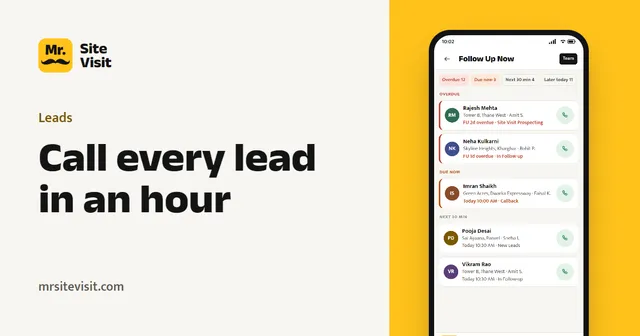
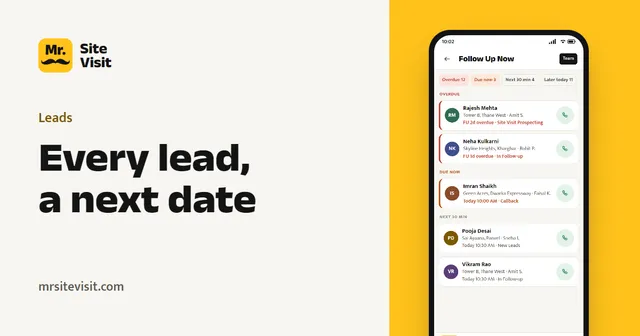
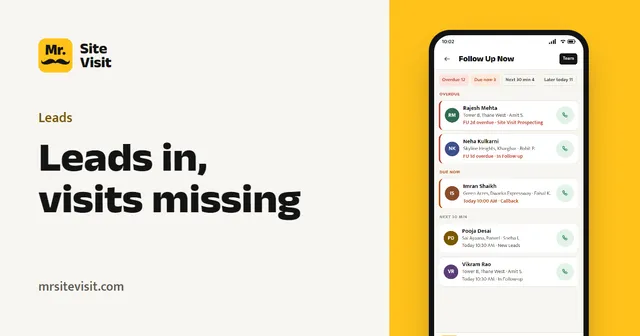
We built Mr. Site Visit, a CRM (the software your team logs leads, calls and visits in) for real-estate teams of 3 or more. Tapping Call opens the phone’s own dialer. When the salesperson comes back to the app, the after-call sheet opens by itself. Saving the result takes three taps.
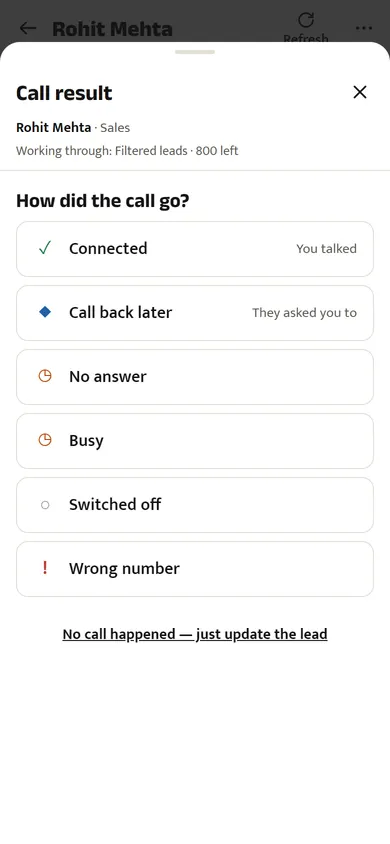
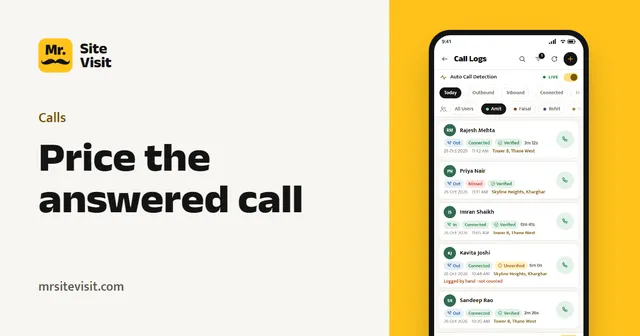
On Android, each call is matched from the phone’s call log and tagged Verified, so you can count tries in the lead’s history. Typed-in calls show as Unverified and are left out of report numbers. There’s no iPhone app.
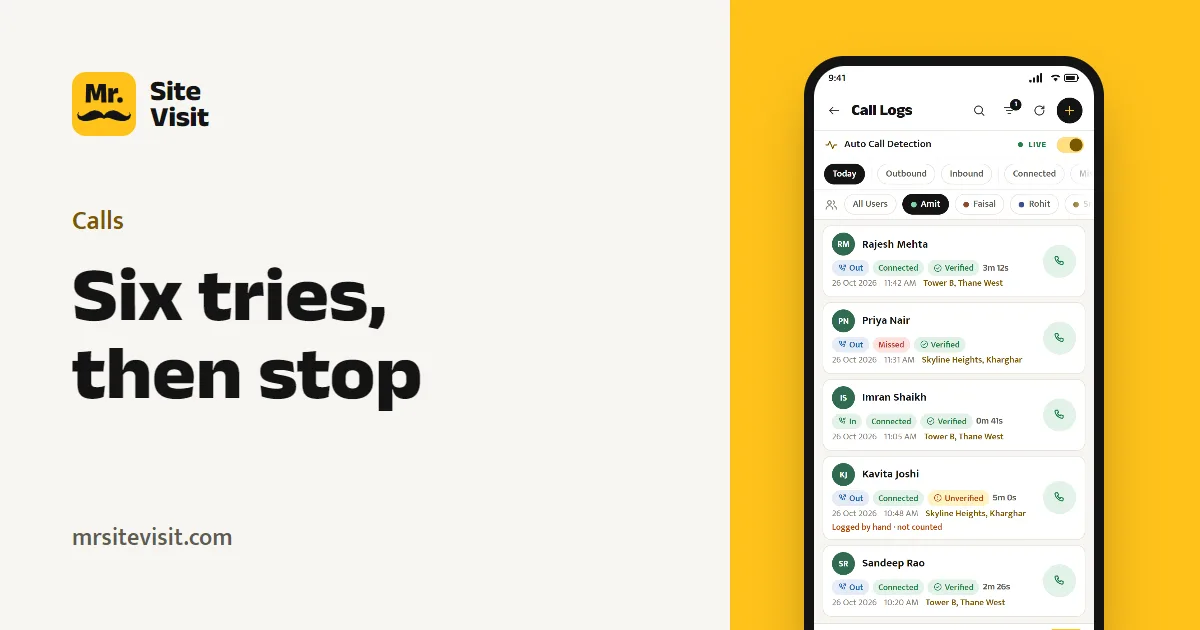
Say a new lead gets no call and no move to the next stage, like Contacted or Visit booked. After the time you set (2 hours by default), it moves to the next person. Its call history moves with it. The Call Logs screen filters by salesperson.
The app doesn’t schedule the six tries for you. It suggests a follow-up date as a reminder, and the plan stays your team’s to run.
Prices start at ₹423 a user a month on Starter, billed yearly, from 3 users, with no GST on top. See the plans and prices, or how it works for channel partner firms and developers.
This week, pull ten “not picking” leads and count their tries with your team. Then agree the six-try plan together, and look at the same ten again next Monday.
Questions teams ask
How many times should you call a real estate lead?
Our starting rule: try a new lead you haven’t reached about six times over seven days, at different times of day. Use calls only until the buyer agrees to WhatsApp. Then stop and mark it unreachable. Once you’ve spoken to the buyer, call on the dates you agree. Your own call log shows the right number.
How many call attempts should you make before giving up on a lead?
Around six attempts spread over a week is a fair default for property leads. In our view, fewer than three tries isn’t a real attempt. Check last month’s call log. If many buyers first picked up on the fifth or sixth try, the plan fits. If many picked up on the seventh or eighth, add a try.
What is the best time to call property buyers?
There’s no single best time, so vary it. Try a morning, a lunch break, an evening and one weekend slot within the first week, and keep to working hours. After a month, your call log will show when your own buyers pick up most often.
Can calling a lead too many times get my number blocked?
Your number can be reported as spam. TRAI’s February 2025 rule changes, as reported at the time, let action against unregistered senders start after five complaints in ten days, with outgoing services reportedly barred for 15 days on a first violation. How this applies to calls to people who enquired isn’t spelled out. Spread your tries, say who you are and where they enquired, and stop when asked.
What should we do with leads we can’t reach?
After the last try, mark the lead unreachable with its source. After a month, send one short message if they agreed to WhatsApp, or make one last call if not. If one source sends many wrong or switched-off numbers, take it up with that portal or ad agency.
Sources
- TRAI Press Release No. 11 of 2025, amendments to the Telecom Commercial Communications Customer Preference Regulations (12 February 2025)
- FoneArena, TRAI amends TCCCPR 2025: tougher rules to curb spam calls and SMS (13 February 2025), the figures as reported
- Oldroyd, McElheran and Elkington, The Short Life of Online Sales Leads, Harvard Business Review, March 2011 (original; paywalled)
- SmartCompany, Are you letting online leads go cold? (1 July 2011), the figures as reported from the Harvard research
- WhatsApp Business Messaging Policy (last updated 23 September 2026)