AI calling for real estate leads in 2027: what it really costs
By Jayesh G, Founder · 14 min read. Facts checked against each company’s own site on 4 November 2026. Spot an error? Tell us and we’ll correct it.
In short
- The two AI calling companies we checked list ₹3.50 and ₹6 a minute. Rounding, the phone line, number rent, setup and GST decide the real bill.
- Price an answered call, then compare it with what a telecaller costs for the same dials. In our example of 2,500 dials, the saving is about ₹4,300 a month. Your own numbers decide.
- The real gain is speed at volume: a first call within a minute, at night or in a launch week. Keep people for the calls that fix a site visit.
On this page
- An AI calling bill has eight lines, not one
- Price the answered call, not the minute
- Compare it with a telecaller on the same dials
- A fast first call is the likely gain
- Where an AI first call fits, and where it doesn’t
- Check the calling rules before the first call
- Which team are you?
- “AI will replace my telecaller”
- What I’d check this week
- What changed when we checked again for 2027
- Where Mr. Site Visit fits
- Questions teams ask
Sarvam lists its AI voice agents at ₹3.50 a minute, before telephony and GST. Next to a telecaller’s salary, that looks almost free. Is it?
You hear the per-minute rate and do a quick sum in your head. The bill that arrives is built differently. Each call is rounded up. Telephony (the phone line) is charged on top. And someone has to set the agent up and connect it to your CRM (the software your team logs leads and calls in).
So price an answered call, not a minute, with every line of the bill in it. Then compare it with what a telecaller costs for the same dials. In our worked example, the saving is small, and a big setup quote erases it. The real gain is speed: a first call within a minute, at any hour.
The simple rule Judge AI calling by the cost of an answered call and the speed of the first call. Keep people for the calls that fix a site visit.
An AI calling bill has eight lines, not one
An AI calling bill has eight lines. The per-minute rate is only one of them. Here’s what three companies published on their own pricing pages on 4 November 2026:
| Line | What it is | What their pages said |
|---|---|---|
| AI minutes | The agent’s talking time | Sarvam ₹3.50 a minute pay as you go; Ringg ₹6 a connected minute |
| Rounding | How each call is counted | Sarvam: rounded up to whole minutes; Ringg: by the second |
| Telephony | The phone line itself | Sarvam ₹0.20 per 30-second pulse, or bring your own provider; Ringg included; Plivo ₹0.38 a minute (line only) |
| Phone number | Rent for the calling number | Sarvam ₹59 per 30 days; Ringg ₹499 a month; Plivo ₹200 a month |
| Monthly minimum | A fee you pay even in a quiet month | Sarvam plans from ₹9,999 a month, returned as credits; none on pay as you go |
| Extras | Reports, tests, calls at the same time | Sarvam ₹2 per test run; Ringg ₹2 a call for advanced analytics, ₹1,995 for each five extra calls at the same time |
| Setup | Writing the script, connecting your CRM | Not stated; ask for a written quote |
| GST | Tax on the bill | Sarvam: prices exclude GST; Ringg: billed amounts may vary with taxes |
Two of those words need a plain meaning:
- Pulse
- The block of time a call is billed in. With a 60-second pulse, a call of 1 minute 10 seconds is billed as 2 minutes.
- Connected minute
- A minute in which the call has picked up. Sarvam doesn’t bill unanswered, busy or failed calls. Ringg bills connected time and doesn’t charge failed calls. Both bill a call that reaches voicemail.
Prices change, so treat the table as a dated snapshot. Ask each vendor for today’s rates in writing before you compare.
Price the answered call, not the minute
Compare the cost of one call a buyer actually answered. Divide everything you pay in a month by those calls.
The formula Cost per answered call = the whole month’s bill, with GST ÷ calls a buyer answered.
Here’s an illustrative month. These are round example numbers, not anyone’s real results. Replace each one with last month’s dials, answered calls and visits:
| The example | Number |
|---|---|
| New leads | 1,000 |
| Dials the AI makes | 2,500 |
| Calls a buyer answers | 700 |
| Average answered call | 2 minutes 20 seconds |
| Rates | Sarvam, pay as you go |
| Setup quote | ₹50,000, spread over a year |
And here’s what that month costs:
| Line | Example month |
|---|---|
| AI minutes: 700 calls × 3 billed minutes × ₹3.50 | ₹7,350 |
| Telephony: 700 calls × 5 pulses × ₹0.20 | ₹700 |
| Number rent | ₹59 |
| Setup: ₹50,000 over 12 months | ₹4,167 |
| GST at 18% | ₹2,210 |
| Total | ₹14,486 |
Both cost-per-visit figures assume the same 40 visits. If AI-fixed visits turn up less often, its cost per visit rises.
Look at your setup line first. It’s the first thing I’d ask a vendor to put in writing. In this example, it’s more than half of the minutes bill. Then look at rounding. A call of 2 minutes 20 seconds is billed as 3 minutes. That adds about 29% to the minutes.
Try the same month on Ringg’s rate, billed by the second with telephony included. It comes to about ₹17,000 with GST. The rate is higher, but there’s no rounding and no separate phone line.
What about a plan with a monthly minimum? At this volume, Sarvam’s ₹3.25 rate gives ₹6,825 of minutes. That’s below the Pro plan’s ₹9,999 minimum. So pay as you go costs less here.
Two inputs move the answer most. Take your pick-up rate from last month’s dials. The setup figures below are placeholders, not market prices:
| If this changes (rest of the example the same) | AI month with GST | Per answered call |
|---|---|---|
| Buyers answer 500 of 2,500 dials | ₹11,772 | ₹23.50 |
| Buyers answer 700 (the example) | ₹14,486 | ₹20.70 |
| Buyers answer 1,000 | ₹18,557 | ₹18.60 |
| Setup quote ₹20,000 instead of ₹50,000 | ₹11,536 | ₹16.50 |
| Setup quote about ₹94,000 instead of ₹50,000 | ₹18,800 | ₹26.90 |
| Setup quote ₹1.5 lakh instead of ₹50,000 | ₹24,319 | ₹34.70 |
Compare it with a telecaller on the same dials
A telecaller who only calls can make about 2,500 tries a month. That’s the same as the AI’s dials in the example, so the comparison is fair.
Here’s how that’s worked out, with example numbers you can change:
| The telecaller | Example |
|---|---|
| Calling time | 300 minutes a day, 25 days a month |
| One try, answered or not | 3 minutes |
| Tries in a month | 300 × 25 ÷ 3 = 2,500 |
| Pay | ₹15,800 a month |
| Incentives, phone, SIM, data | ₹3,000 a month |
| Total | ₹18,800 a month |
The 3 minutes a try covers the dialling, the ringing, a WhatsApp and a note like “Called, not picking”. It’s the same figure our leads-per-salesperson formula uses. The pay is PayScale India’s average for a telemarketer, ₹1.9 lakh a year. A caller in your city may cost more or less. The saving moves rupee for rupee with this figure, so use your own.
So the AI saves about ₹4,300 a month in this example, before one more cost. Your team still calls back the buyers who said yes. Say 150 of them do, at 5 minutes each. That’s 12.5 hours. At the pay above, it’s about ₹1,900 of a telecaller’s month. So the real saving is closer to ₹2,400.
Your telecaller’s month also includes work the AI’s doesn’t. They send the brochure on WhatsApp. They call back when the buyer asked. And they become a voice the buyer knows.
The setup quote can flip the answer. At about ₹94,000 spread over a year, the AI month costs the same as the telecaller, before callbacks. At ₹1.5 lakh, it costs about ₹24,300, well above. Who wrote that quote, and does it include changes to the script?
The sheet counts unanswered, busy and failed dials as free, as Sarvam’s page says. Ringg’s page bills connected time, so ask it about unanswered dials. Calls that reach voicemail are billed by both. Add that time under “Other monthly fees”.
A fast first call is the likely gain
An AI agent can call a lead within a minute of the enquiry, at 11 at night or on a Sunday. No telecaller can do that every time.
Speed matters. A 2011 Harvard study of US web enquiries tested it, as SmartCompany reported. Firms that tried to contact a lead within an hour were nearly seven times as likely to qualify it. That’s compared with firms that tried even an hour later. It’s an old US study about people making contact. We don’t have a study of AI first calls, so treat speed as the likely gain, and test it. Qualify means a real talk with the person who decides.
Volume is the other gain. A launch weekend can bring more enquiries than your team can call in a week. An AI agent can call several leads at the same time. Ringg’s page includes five calls at once and sells more in blocks of five. Ask any vendor how many it makes at once. Then your team calls back the buyers who said yes.
Where an AI first call fits, and where it doesn’t
Use an AI first call where speed or volume is the problem. Keep people wherever the buyer is close to a decision.
| If… | Then… |
|---|---|
| Meta or portal leads arrive at night or on Sundays | An AI first call to check interest and fix a callback time |
| A launch brings more enquiries in a day than you can call in a week | AI first calls, then your team calls everyone who said yes |
| Old leads nobody has called for months | AI to find who still wants to talk; see which old leads are worth calling |
| Your team already calls every lead within the hour | Little to gain; fix the follow-ups first |
| A buyer has visited, or is talking about price | A person, always |
| Most of your buyers come from referrals and walk-ins | Don’t bother |
How does the hand-over work? Decide it before the first call. The AI’s result should land on one person’s list, with a time to call back, the same day.
Check the calling rules before the first call
A machine calling your buyers is still your firm calling them. The rules of TRAI (India’s telecom regulator) are about who sends a commercial call, not what kind of caller it is. So assume they cover your AI calls, and check with the vendor and your telecom provider. On 12 February 2025, TRAI tightened its rules on commercial calls and messages:
- Number series: telemarketing from normal 10-digit numbers is restricted. Promotional calls use the 140 series, and service and transactional calls the 1600 series.
- Robocalls: the use of auto-dialers (software that dials numbers one after another) and robocalls (calls made by a machine) must be disclosed.
- Penalties: the first time a sender crosses the complaint limit, its outgoing calls are barred for 15 days. For a repeat, all its lines are cut for a year, and it’s blacklisted.
A promotional call sells something. A service or transactional call is about something the person already has with you. Which one is a follow-up to an enquiry? Don’t guess. Ask the vendor and your telecom provider in writing.
Before you sign Get four answers in writing. Which number series do the calls go out on? Who is registered with the telecom operator? What hours does it call? How is a buyer who says no taken off the list?
Then ask the rest of your questions before any money changes hands:
- Ask for the rate, the rounding and the telephony in one written quote
- Ask how unanswered and voicemail calls are billed
- Ask for the setup cost, and the cost of each change to the script
- Ask how each result reaches your CRM, and how fast
- Ask for a recording of a real call in the language your buyers speak, and play it to your team
- Ask how buyers are told the call is recorded, who keeps the recordings, and for how long
- Ask how numbers on the DND list (the national do-not-call register) are handled
- Ask where your buyers’ numbers and recordings are stored, and who can see them
- Ask what happens to your numbers and scripts if you stop
Which team are you?
The answer depends on how many leads you get and who calls them today.
| Your team | What fits |
|---|---|
| 3 to 6 people, the owner still selling, a few hundred leads a month | AI saves little. Set a one-hour calling rule and move uncalled leads on |
| 7 to 20 people with a telecaller or pre-sales person | Test AI on night and weekend leads only, for four weeks, and run the sheet |
| A developer’s sales desk at launch | AI first calls for the launch rush; closing managers and partners take over |
| A mandate team working with outside partners | Make sure the AI never calls buyers a partner has registered with you |
A pre-sales team and an AI first call do the same first job. Compare them on the same sheet before you hire either.
“AI will replace my telecaller”
My honest view: it replaces the dialling. The AI can find out who’s interested. A person still has to earn the Saturday visit with the family.
Where it does replace work is the waiting. Your late-night lead gets a call that night, not late the next morning.
Who shouldn’t bother? A team that already calls every lead within the hour, with fewer than a few hundred leads a month. The setup, the rules and the checking will cost you more time than the AI saves.
What I’d check this week
You can answer most of this from last month’s records, before you speak to any vendor:
- Speed: how many leads waited more than an hour for a first call?
- Timing: how many came in after 8 pm or on a Sunday?
- Dials: how many dials did your team make, and how many were answered?
- Quotes: two written quotes, with rounding, telephony, setup and GST.
- The sheet: both columns, with your own numbers.
If late calls are your problem, I’d test an AI first call for four weeks on one lead source. Keep it only if two things hold on the sheet: night leads got a call the same night, and the cost per visit beat your telecaller’s. If they aren’t, fix the follow-ups first.
What changed when we checked again for 2027
We read the three companies’ pages again on 4 November 2026, for teams budgeting 2027. The rates we quote hadn’t changed since 1 November. Before you sign a 2027 contract:
- Ask for the per-minute rate fixed for twelve months, in writing
- Ask how calls are rounded, and whether the phone line is included
- Ask what happens to unused minutes on a monthly minimum
We’ll check these pages again every month, and update this post when something changes.
Where Mr. Site Visit fits
We don’t make AI calls. What a CRM does is make sure every lead has an owner, whoever makes the first call.
Here’s how a lead moves in Mr. Site Visit, whoever calls first:
- It arrives From a portal, a Meta form, your website, or any tool that can send it to a webhook (a link that passes each new lead from one system to another).
- It gets one owner At once, by project, source or area.
- Not called in time? It moves to the next person: two hours by default, and you can change it.
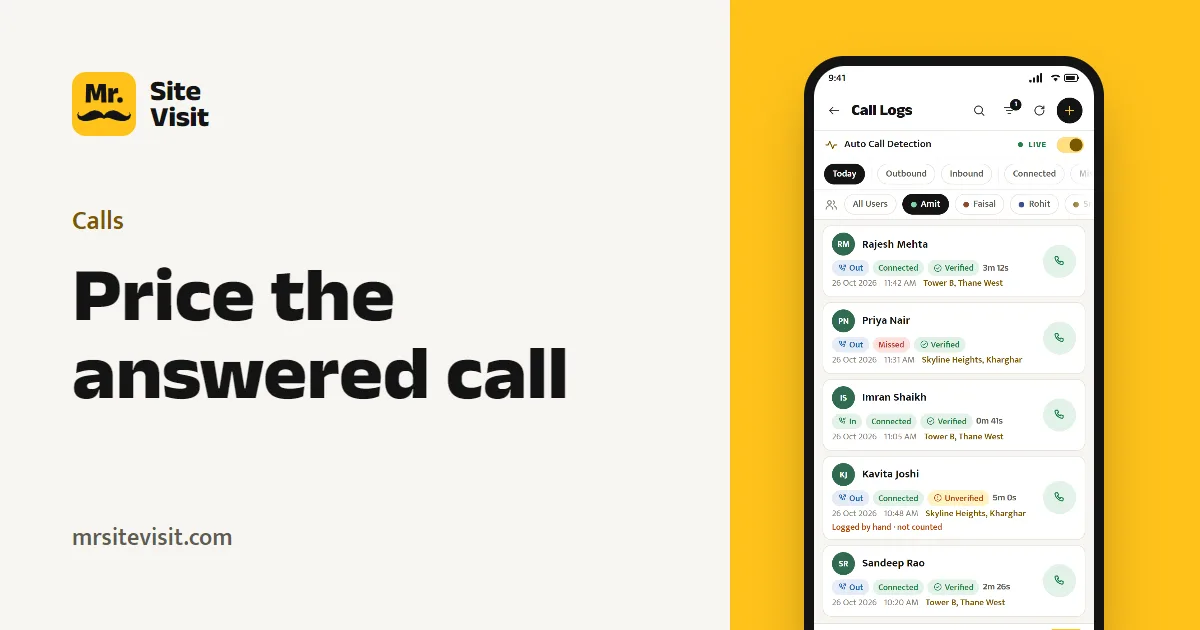
- The call is logged On Android, from the phone’s call log, marked Verified. Calls typed in by hand are left out of reports. iPhone calls aren’t logged.
Starter is ₹423 a user a month, billed yearly, from three users. See the plans and prices, or how it works for channel partner firms and developers.
Pull last month’s dials and answered calls this week, and run both columns of the sheet with your team before anyone signs a quote.
Questions teams ask
How much does AI calling cost for real estate in India?
The two companies we checked list ₹3.50 and ₹6 a minute; quotes elsewhere can be lower or higher. On 4 November 2026, Sarvam listed ₹3.50 a minute pay as you go, plus telephony and GST. Ringg listed ₹6 a connected minute with telephony included. Add rounding, number rent, any monthly minimum and setup, then compare the cost of an answered call.
Is AI calling cheaper than hiring a telecaller?
It depends on your numbers. In our example of 2,500 dials a month, AI first calls came to about ₹14,500 with GST and a telecaller to about ₹18,800. A bigger setup quote can reverse that. And the interested buyers still need a person to call them back.
Is AI calling allowed in India?
TRAI’s rules on commercial calls apply whoever makes the call. Since February 2025 they restrict telemarketing from normal 10-digit numbers, put promotional calls on the 140 series and service calls on the 1600 series, and require auto-dialers and robocalls to be disclosed. Ask the vendor which series and registration your calls use.
Can an AI agent book site visits?
It can ask whether a buyer wants a visit and offer a time, if the vendor sets that up. Whether the buyer turns up is another matter. Have a person confirm every visit the AI fixes, the day before.
Does Mr. Site Visit make AI calls?
No. Mr. Site Visit gives every lead one owner, moves it on if nobody calls in time, and logs your team’s calls from their Android phones. If an AI calling tool can send leads to a webhook, they arrive like any other lead source.
Sources
- Sarvam, Voice Agents pricing: ₹3.50 a minute pay as you go, ₹3.25 to ₹3.00 on plans with monthly minimums from ₹9,999; calls rounded up to whole minutes; telephony ₹0.20 per 30-second pulse; number ₹59 per 30 days; prices exclude GST (checked 4 November 2026)
- Ringg AI, AI voice agent pricing: ₹6 per connected minute in India with telephony included, prorated by the second, failed calls not charged; number ₹499 a month; ₹1,995 per block of five extra parallel calls; page reviewed 23 October 2026 (checked 4 November 2026)
- Plivo, India voice pricing: ₹0.38 a minute for domestic calls, 30-second pulse, number ₹200 a month (checked 4 November 2026)
- TRAI, Press Release No. 11/2025, 12 February 2025: amendments to TCCCPR 2018; 10-digit numbers restricted for telemarketing; 140 series for promotional and 1600 series for service and transactional calls; disclosure of auto-dialers and robocalls; 15-day bar, then one-year disconnection and blacklisting
- PayScale India, telemarketer salary: average ₹1,90,000 a year in 2026 (last updated 10 September 2026)
- SmartCompany, reporting a 2011 Harvard study of 1.25 million web leads at 42 US companies: firms that tried to contact a lead within an hour were nearly seven times as likely to qualify it as those that tried even an hour later (July 2011)