Facebook property leads not booking? Find where the money went
By Jayesh G, Founder · 6 min read. Published 31 October 2026.
In short
- Check in order: how fast leads were called, how the form was set up, whether the ad matched the project, and how the follow-up ran.
- A volume form has no review step before sending, so some people may send it without meaning to. Meta's higher-intent setting adds a step where people review their answers before sending.
- Judge a Meta campaign on cost per site visit done, after fixing the calling, not on cost per lead.
On this page
“I never filled any form.” If your team hears that on Meta leads every day, the problem may not be the ad.
Your Facebook and Instagram lead ads (the forms Meta shows inside its apps) often bring many leads at a low cost per lead. Then your calls start: switched off, not interested, wrong number. You blame the agency. Your agency shows a good cost per lead. And you’re left paying for leads nobody reaches, without knowing if it’s the ads or your team.
Before you stop the ads, check four things in order. How fast were leads called? How was the form set up? Did the ad match? How did the follow-up run? My honest view: the money is often lost in one of those four places. Then judge it on cost per site visit.
The simple rule Fix the calling, then the form, then judge the ad, on cost per site visit done.
Check 1: how fast were the leads called?
A Meta lead may be someone who filled the form at 10 pm while scrolling. By the next afternoon, they may not remember your form at all.
That’s why speed matters here. Check it before anything else.
A 2011 Harvard study, as SmartCompany reported, looked at 1.25 million web leads at 42 US companies. Leads contacted within an hour were nearly seven times as likely to qualify as those contacted an hour later. It’s old and American. But if you’ve called a Meta lead the next day, you know the feeling.
So before judging the ad, count one thing for last month’s Meta leads: how many got a first call within the hour? Take the time on the lead sheet and the first call in the phone’s call log, and count the gaps. If it’s low, fix that first. Our post on calling every lead within an hour shows how.
Check 2: how was the form set up?
Your Meta lead forms have a setting that changes who fills them in. By default, they’re optimised for volume. A higher-intent setting adds a step where people review and confirm their answers before sending.
| Form setting | What you get | When it suits |
|---|---|---|
| More volume (the default) | Built to bring in the most leads, with no review step before sending | You can call fast and in bulk |
| Higher intent | Adds a review step before sending, so you may see fewer leads, each one confirmed | Teams that call by hand |
Add one or two real questions too, like budget and when they plan to buy. Each question may cut your number of leads. It can also cut the people who were never looking. Not sure which setting is on? Ask your agency, or open the form in Ads Manager (the screen where your ads are run).
Check 3: did the ad match the project?
Here’s an example, not a real case. A buyer clicks “2 BHK from ₹45 lakh”, then hears “₹62 lakh all-in” on the call. They’re unlikely to pick up the next time. The ad promised more than the project could give.
- Is the price in the ad the price on the cost sheet?
- Is the location in the ad the one the buyer will drive to?
- Is the offer in the ad still running?
- Does the ad name the project, so the buyer remembers it on the call?
If any answer is no, fix the ad before you blame the leads.
Check 4: how did the follow-up run?
A Meta lead who doesn’t pick up once isn’t dead to you. They may be at work, driving or asleep.
- Within the hour Call. No answer? Send a short WhatsApp saying who you are and which project.
- Same evening Call again.
- Over the week A few more tries, at different hours.
Our post on how many times to call a lead explains the tries in detail. Only after that is a lead “not reachable”.
Then judge the ad, on cost per site visit
After a month of fast calling and clean forms, look at the numbers that pay you. Not cost per lead: cost per site visit done.
- Cost per site visit done
- What you spent on the campaign in a month ÷ the site visits that happened from its leads.
An example, not real numbers: ₹60,000 spent, 300 leads, 6 site visits. That’s ₹10,000 a visit. Another campaign gets 100 leads and 6 visits for the same spend. Its cost per lead is three times higher. Its cost per visit is the same.
A cheap lead that never visits costs more than a dear one that does. Our comparison of Meta and Google ads works it through, and bad leads or bad selling shows how to read the numbers with your agency.
Which team are you?
The checks are the same. Who runs them changes:
| If you are… | Then… |
|---|---|
| A CP firm of 3 to 6 people running your own ads | Switch to the higher-intent form, and put one person on Meta leads within the hour |
| 10 to 20 people with an agency | Share the four checks with the agency every Monday, with cost per visit |
| A mandate company running ads for several developers | Tag each form with its project, and report visits done per developer, not leads |
| A developer running campaigns per project | Compare campaigns on visits done, not leads, and pause the ones with no visits after a month |
Who shouldn’t bother? A team that gets almost no leads from Meta. Fix the source you depend on first.
“Facebook leads are just junk”
Some are. A lead who never asked to be called will never book.
But “junk” is often four smaller problems wearing one name: slow calls, a volume form, an ad that oversold, and a follow-up that stopped after one try. My honest view: fix those four before you cut the source. If it still doesn’t bring visits, then you’ll know it’s the source.
Where Mr. Site Visit fits
We built Mr. Site Visit for real estate sales teams of three or more. It helps with checks 1 and 4.
Leads from Meta forms, and from 99acres, MagicBricks, Housing.com and your website, arrive with their source and one owner.
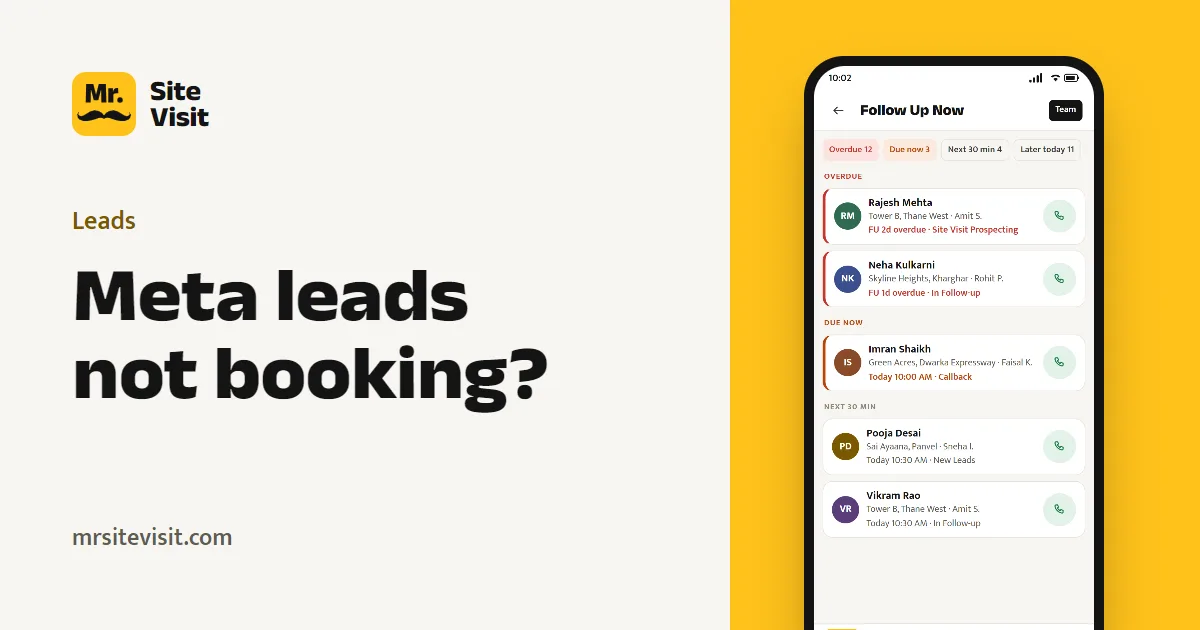
If nobody calls in time, the lead moves to the next person: two hours by default, and you can change it to match your one-hour rule. On Android, calls are matched from the phone’s call log, so tries are counted, not remembered. iPhone calls aren’t logged. Follow-ups come as reminders, with overdue ones in red.
Starter is ₹423 and Growth ₹548 a user a month, billed yearly, from three users, with no GST on top. See the plans and prices.
This week, pick last month’s Meta leads. Check one thing with your team: how many were called within the hour?
Questions teams ask
Why are my Facebook real estate leads not picking up?
Check calling speed first: leads called hours later may not remember filling the form. Then check the form: a volume form has no review step, so some people may send it without meaning to. Then check whether the ad’s promise matches the project, and whether each lead was tried several times at different hours.
How do I get better quality leads from Facebook lead ads?
Use the higher-intent form setting, which adds a review step before people submit, and ask one or two real questions such as budget and timing. You may see fewer leads, and your cost per lead may go up. Judge it on cost per site visit, not cost per lead.
Are Facebook leads worse than portal leads?
Not always. They’re often earlier in their search. Compare each source on cost per site visit done after a month of fast calling, not on how many leads pick up.
How soon should I call a Facebook lead?
Within the hour, and sooner if you can. A buyer who filled a form while scrolling may not remember it by evening. Send a WhatsApp first if the call doesn’t connect.
Sources
- Meta for Developers, Lead Ads: forms and questions (checked 29 October 2026): lead ads are optimised for volume by default; a higher-intent setting adds a step where people review and confirm their answers
- SmartCompany, Are you letting online leads go cold? (1 July 2011): 1.25 million leads at 42 US companies; leads contacted within an hour nearly seven times as likely to qualify as those contacted an hour later