Real estate marketing vs sales: bad leads or bad selling?
By Jayesh G, Founder · 7 min read. Published 31 October 2026.
In short
- “The leads are junk” and “sales can’t close” are both guesses until you count four numbers for each lead source.
- Check calling speed first. If leads were called within the hour and still don’t talk, it’s the leads. If they talk but don’t visit, it’s the selling.
- Visits that don’t book point to the project or the follow-up, not to marketing.
On this page
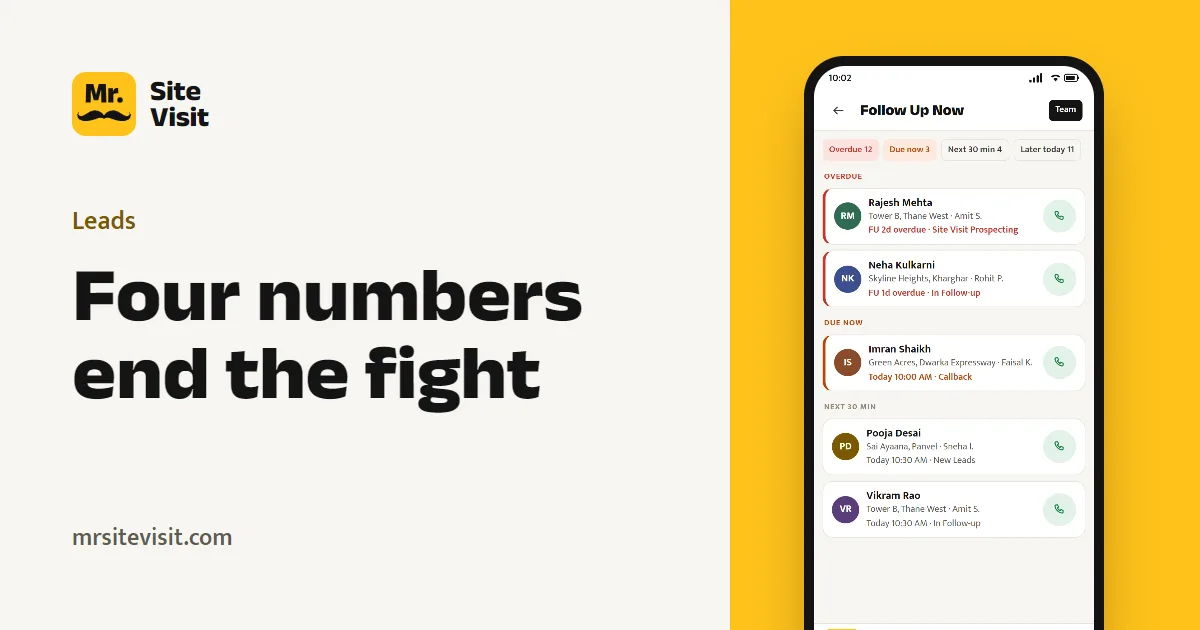
“The leads are junk” and “sales can’t close” are both guesses. Until you count four numbers for each lead source, neither side can prove anything.
You’ve probably heard both in the same week. The weekend’s portal leads sat until Monday. Your agency shows a good cost per lead. Your team leader says nobody picks up. And the bookings stay flat while the two sides argue.
The fight ends when you look at each step of the lead’s journey, by source: who was called in time, who talked, who visited, who booked. Each step has an owner. Find the step that breaks, and you’ve found whose job it is to fix it.
The simple rule Check calling speed first. Leads called within the hour that still don’t talk: the leads. Leads that talk but don’t visit: the selling.
Both sides are usually half right
This fight is old, and it isn’t only in real estate. In 2006, a Harvard Business Review article described the same pattern: when results disappoint, marketing blames the sales team’s execution, and sales blames marketing.
The article noted that each side often undervalues the other’s work. In my view, Indian sales floors are no different. The agency sees ad reports, and the team sees phones that don’t pick up. Nobody sees the whole journey from enquiry to booking.
So stop asking “whose fault?” Ask “which step?”
Four numbers, one owner each
Count these for each lead source, for the same month:
| Number | How to count it | Who owns it |
|---|---|---|
| Called within the hour | Leads with a first call inside 60 minutes ÷ all leads | Sales |
| Real talks | Leads your team spoke to for 2 minutes or more ÷ all leads | Sales if calling was slow; marketing if it was fast |
| Visits done | Leads that came to site ÷ leads you spoke to | Sales |
| Bookings | Bookings ÷ visits done | Project and follow-up |
The order matters. A source can’t be judged on real talks until its leads were called in time, and tried enough. A slow call turns a good lead into a cold one.
And don’t judge on a thin month. With fewer than about 50 leads from a source, or 20 talks for a person, add two or three months together first.
Calling speed decides who’s to blame
A lead called the next day isn’t the same lead any more. So check speed before anything else.
Harvard researchers studied 1.25 million web leads at 42 US companies, none in Indian real estate.
As SmartCompany reported in 2011, leads contacted within an hour were nearly seven times as likely to reach a real conversation with the decision maker as those contacted an hour later. It’s old and from the US, so treat it as a direction.
Tries matter too. A lead called once at 11 am isn’t a lead that didn’t pick up. Our rule is about six tries over seven days, at different hours.
If your team calls half a source’s leads the next morning, its low talk rate is a sales problem first. Fix the speed for a month, then judge the source on fair terms.
A worked month, by source
Here’s an illustrative month for one project. The sources are called A and B; the figures are an example, not real data:
| Step | Source A | Source B |
|---|---|---|
| Leads | 400 | 200 |
| Called within the hour | 45% | 85% |
| Real talks | 22% | 45% |
| Visits done (of real talks) | 25% | 14% |
| Bookings (of visits done) | 10% | 10% |
Source A: slow calling. Judge it again after a month of fast calls. Its talks turn into visits well, so it may be the stronger source once calling is fixed.
Source B: fast calls and good talks, but only 14% of talks become visits. That’s the selling.
Neither is simply “bad leads” or “bad selling”. Each has its own weak step.
Read the numbers like this
| If you see… | Then it’s probably… |
|---|---|
| Slow first calls, low talk rate | Sales: fix the speed before you judge the source |
| Fast first calls, enough tries, low talk rate | Marketing: wrong audience, fake or wrong phone numbers, or a form anyone can fill |
| Good talks, few visits | Sales: the ask, the booking call, the follow-up |
| Good visits, few bookings | The project or the follow-up after the visit |
| Every step low for one salesperson only | That person needs help; first check they got the same mix of sources |
The last step isn’t marketing’s at all. If visits happen and nobody books, read our post on site visits that don’t become bookings. It’s often the project.
One weekly meeting, one sheet
You can fix this with a weekly habit, and no software. Put both sides in front of the same numbers every week:
- Monday sheet Last week’s four numbers, by source and by salesperson.
- Agency in the room Or on the call, with what it spent on each ad.
- One weak step Agree which step is weakest this week, and whose it is.
- One fix each Marketing changes one thing; sales changes one thing.
- Check next Monday Did that step move? Keep it, or try the next fix.
Fifteen minutes is enough. Nobody brings their own report.
Which team are you?
Who sits in the meeting depends on how your marketing runs:
| Your team | Marketing is done by | Who should own the sheet |
|---|---|---|
| 3–5 people, the owner sells | The owner, or a freelancer | The owner, weekly |
| 6–10 people with an agency | An outside agency | The team leader, with the agency on the call |
| 10–20 people, several projects | An agency or an in-house marketer | The sales head, by project |
| A developer’s sales team | An in-house team plus channel partners | The sales head, with partner leads as their own source |
Who shouldn’t bother? A team whose leads come almost all from referrals and walk-ins. There’s no marketing spend to argue about. Watch visits and bookings instead.
“Our agency says the leads are fine”
Many agencies only see the ad. They don’t see your call log or your site-visit register. So their reports often look fine.
Share your four numbers with them, plus spend ÷ visits done for each source: the cost per site visit. Count fake and wrong numbers separately, and raise them with the portal or agency. And ask how they’re paid: a fee per lead rewards volume, not visits.
My honest view: most of these fights are about speed. Check it first, and half the argument goes away.
Choosing a new agency? Here’s how to choose a real estate marketing agency.
What I’d check this week
You can do these with your lead sheet, your call logs and your register. Our free lead tracking Excel template counts leads, calls within an hour and visits by source for you:
- Pick one month and one project
- Count the four numbers for each lead source
- Count them again for each salesperson
- Find the weakest step, and name its owner
- Share the sheet with your agency before the next campaign
Where software helps
The four numbers need the source, the calls and the visit on every lead. On a sheet, someone has to type all of that.
In Mr. Site Visit, leads from 99acres, Housing.com, MagicBricks, Meta and your website arrive with their source. On Android, calls are matched from the phone’s call log and marked Verified, with how long each ran. iPhone calls aren’t logged.
Visits scheduled and visits done, and bookings, show per person and per project. You still work out the four shares from those counts. Calls from a phone that isn’t set up with the app aren’t matched. For Meta leads, you can set a stage, such as a site visit, to send an event back to Meta.
Starter is ₹423 a user a month, billed yearly, from three users, with no GST on top. There’s a 7-day money-back, and no free trial. See the plans and prices, or how it works for channel partner firms and developers.
Start this Monday. Put your team leader and your agency in front of one sheet, and agree the one step you’ll fix first.
Questions teams ask
How do I know if my real estate leads are bad or my sales team is weak?
Count four numbers by lead source. The share called within an hour, and the share your team really spoke to. Then the share of those talks that became site visits, and the share of visits that booked. If fast-called leads don’t talk, it’s the leads. If they talk but don’t visit, it’s the selling.
What is a good lead-to-site-visit rate in real estate?
There’s no neutral Indian benchmark we could find. Compare each source and each salesperson against your own last three months. A source or a person far below your own average is the place to look first.
Should the marketing agency be paid per lead?
A fee per lead rewards volume, not visits. Where you can, agree a target on site visits done or on cost per site visit, and share your visit numbers with the agency every week so it can see what the leads became.
Who should own lead quality, marketing or sales?
Both, at different steps. Marketing owns whether leads are real and reachable. Sales owns calling them fast and turning talks into visits. The project, the price and the follow-up decide whether visits book.
Sources
- Kotler, Rackham and Krishnaswamy, Ending the War Between Sales and Marketing, Harvard Business Review, July–August 2006 (opening section; full article paywalled)
- SmartCompany, Are you letting online leads go cold? (1 July 2011): Harvard research on 1.25 million leads at 42 US companies; leads contacted within an hour nearly seven times as likely to qualify