How many leads do you need to hit your booking target?
By Jayesh G, Founder · 8 min read. Published 29 October 2026.
In short
- Work your target backwards: bookings ÷ visit-to-booking rate = visits done, then fixed visits, leads worked and calls.
- With our planning defaults, 6 bookings a month takes about 60 visits done, 430 leads worked and about 776 new leads a month for a 4-person team.
- If the leads needed are more than your team can hold, up to about 150 a person in the calculator, you need more people or better rates, not just more leads.
On this page
- Work the target backwards, one step at a time
- Then work out the new leads a month
- When the target is bigger than the team
- Better rates can beat more leads
- Use the calculator for your own numbers
- Which team are you?
- “Targets are just motivation”
- What I’d check this week
- Where software helps
- Questions teams ask
“Sir, next month we’ll do ten bookings.” It’s a good target. But how many leads does it need? And can your team even work that many?
In my view, many targets are set from last month’s bookings plus a hopeful number. The leads and calls behind them are guessed. The weekend portal leads wait till Monday, the Saturday visits are fixed loosely, and by the 20th the team is chasing. Then the month ends short, and nobody can say which step fell behind.
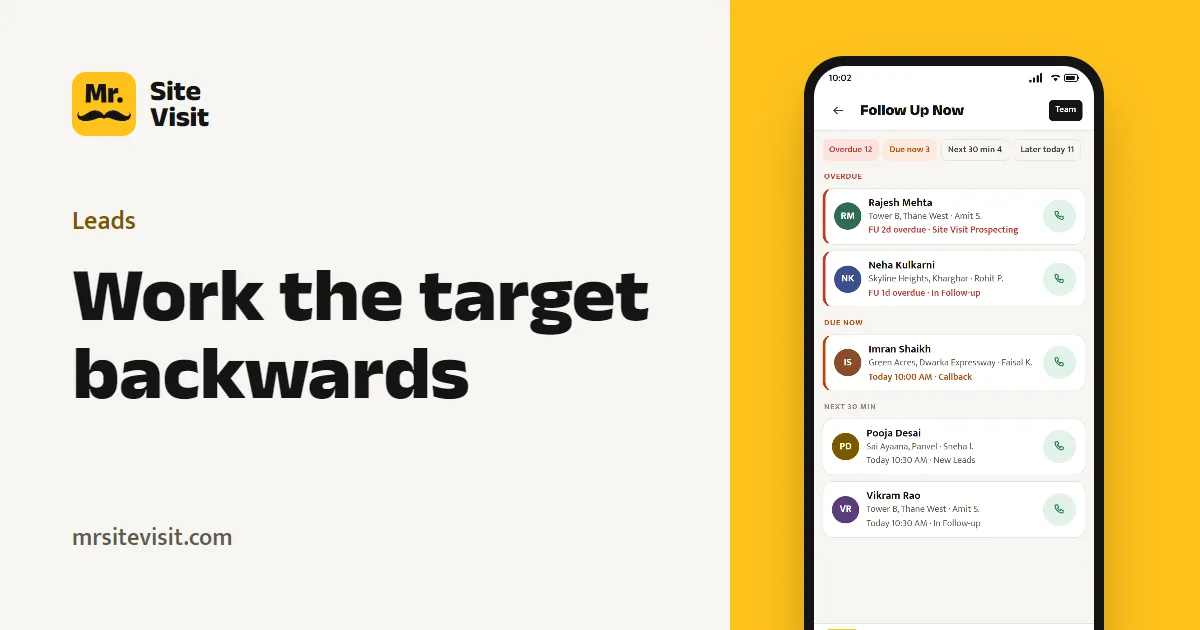
So set the target from the bookings, backwards. Bookings ÷ your visit-to-booking rate gives the visits you need; keep dividing, step by step, until you reach the new leads.
I’ll work it through for a smaller and a bigger target. You’ll see where a team runs out of room, and get a free calculator that does the sums.
The simple rule Work the target backwards from bookings to leads. If the leads needed are more than your team can hold, add a person or fix a rate first.
Work the target backwards, one step at a time
Each step divides by the share that makes it to the next. Here’s the chain for 6 bookings a month, with our planning defaults:
- 6 bookings The target for the month.
- 60 visits done At 1 booking in 10 visits.
- 214 visits fixed Because only 28% of fixed visits happen.
- 429 leads worked Because half of worked leads fix a visit.
- About 860 meaningful calls A meaningful call is a connected call of 2 minutes or more; a worked lead needs about 2.
These defaults are planning figures, not measured averages. I couldn’t find a neutral Indian benchmark for these rates, so I don’t quote one. Your own will differ, and that’s the point: put yours in.
Open the calculator with the same defaults and you’ll see slightly bigger numbers: 437 leads worked and about 870 calls. It works from the whole team’s 480 leads, so it shows 6.1 bookings, a little spare over the target.
- Worked lead
- A lead your team has really spoken to this month: at least one connected call of 2 minutes or more.
Then work out the new leads a month
Leads worked aren’t new leads. Your team works leads it already has, and some go cold every day. New leads have to replace them.
Take a 4-person team holding about 120 leads each, 480 in all. Leads go cold every day. Only some new leads are genuine buyers. The defaults are below. Put together, that team needs about 776 new leads a month to stay full.
| Planning default | Value |
|---|---|
| Leads that go cold each day | 2.75% |
| New leads that are genuine buyers | 30% |
Here’s the working, in three lines:
| Step | Result |
|---|---|
| 480 leads × 2.75% going cold a day × 30 days | About 396 places to refill |
| ÷ 30% genuine new leads | About 1,320 new leads, if each goes to one person |
| ÷ 1.7, because a reassigned lead is worked by about 1.7 people | About 776 new leads |
Think of the 1,320 as slots to fill. One fresh lead can fill about 1.7 of them, as it moves from person to person. If your leads never move, plan for the 1,320.
Why so many? Most new leads aren’t genuine buyers, and leads in hand keep going cold. The new-lead number is where those two leaks add up. What do those leads cost? Our post on cost per lead, per visit and per booking works that out.
When the target is bigger than the team
Ten bookings isn’t just more leads. Past a point, your team can’t hold them.
The calculator plans with up to 150 leads in hand per person. Above that, leads go cold uncalled, however many you buy. Our post on how many leads one salesperson can handle works out your own limit from calling time. It counts only buyers in active follow-up, so its numbers are smaller.
Here’s what 10 bookings takes, with the same defaults:
| Bookings a month | Leads in hand needed | Salespeople (up to 150 each) | New leads a month |
|---|---|---|---|
| 6 | 480 | 4 | 776 |
| 10 | 785 | 6 | 1,270 |
So a 4-person team can’t reach 10 on these rates. It tops out near 600 leads in hand, about 7.6 bookings. The choice is two more people, or better rates. Weigh two salaries against what it takes to lift a rate, with your own figures.
Is the target bigger than the units you have to sell? That’s a different problem. If the bookings you need are more than the unsold units, change the target before you change the team.
Better rates can beat more leads
Every rate in the chain is a step you can improve. That’s often cheaper than buying more leads, but check your own costs. Here’s what each change does for the same 4-person team, in the calculator:
| If you improve… | Then, for 4 people… |
|---|---|
| Fixed visits that happen, from 28% to 40% | The most they can book rises from about 7.6 to 10.9 a month, with no new hire |
| Visits that book, from 10% to 12% | The most they can book rises to about 9.2 a month |
| Genuine new leads, from 30% to 40% | About 582 new leads a month for 6 bookings, not 776 |
| Leads that go cold, from 2.75% to 2% a day | About 565 new leads a month for 6 bookings, not 776 |
These rates come from our defaults; yours will differ. In my view, the share of fixed visits that happen is often the easiest to move. In a 2016 review of clinic studies, no-shows fell to 15% with reminders, against 21% without, and several reminders beat one. That’s hospitals, not site visits, so treat it as a hint. Our post on why booked buyers don’t turn up covers the booking call too.
Capacity is a ratio as well. In a 2022 survey, Salesforce found reps spend just 28% of their week actually selling. That figure is for sales reps worldwide, and covers selling in general, not calls. Still, if your team’s calling time is squeezed the same way, freeing some may let the same people hold more leads.
Use the calculator for your own numbers
You don’t have to do these sums by hand. To look forwards instead, our post on forecasting next month’s bookings uses your own rates. The free booking calculator works them out as you move each slider:
- Set your team size and your bookings target
- Drag each rate to your own last three months
- Read the verdict: covered, more leads, or more people
- Note the daily calls and weekly visits it says you need
Use a two- or three-month average, not one month: a lead from this month may book next month or later. The weekly numbers are the useful part. A monthly target is hard to chase; “50 visits fixed this week” is something a team leader can check every Monday.
Which team are you?
The chain is the same for everyone. What changes is how you use it:
| Your team | Set the target by | Watch weekly |
|---|---|---|
| 3–5 people, the owner sells | The owner, from last quarter’s ratios | Visits fixed and done |
| 6–10 people | The team leader, per person | Meaningful calls and visits per person |
| 10–20 people, several projects | Per project, then added up | Visits by project |
| A developer’s or mandate team | Per project and per channel | Visits by source, channel partners included |
Who shouldn’t bother? A team without three months of visit and booking counts. Start counting first; any target before that is a guess.
“Targets are just motivation”
Partly, yes. A stretch target can push a team. But a target the team can’t reach with its leads and its hours isn’t a stretch. It’s a month that ends in blame.
Working it backwards turns the target into weekly numbers everyone can see. If the month falls short, you’ll know which step fell behind, and whose job it was to fix it.
Next, split the firm’s number between your people. Our post on sales targets per salesperson shows how.
What I’d check this week
You can do these with your register and your call logs:
- Count last quarter’s bookings, visits done and visits fixed
- Work out your three rates: visits that book, fixed visits that happen, worked leads that fix a visit
- Put them and your team size into the booking calculator
- Turn the result into a weekly visits number for each person
Where software helps
The chain only works with true numbers: real calls, real visits, real bookings. That’s the part software keeps.
In Mr. Site Visit, on Android, calls are matched from the phone’s call log and marked Verified, so meaningful calls (2 minutes or more) count per person. iPhone calls aren’t logged. Visits scheduled and visits done, and bookings, show per person and per project.
Overdue follow-ups show in red, and a lead nobody calls in time moves to the next person; the default is 2 hours. Late calls are one reason leads go cold, the leak the calculator counts. Moving the lead on is how we try to cut it.
Starter is ₹423 a user a month, billed yearly, from three users, with no GST on top. There’s a 7-day money-back, and no free trial. See the plans and prices, or how it works for channel partner firms and developers.
Start with last quarter’s numbers this week. Sit with your team, put them in the calculator together, and agree next month’s weekly visits before you agree the target.
Questions teams ask
How many leads do I need for 10 bookings a month?
With our planning defaults, 10 bookings a month takes about 100 visits done and about 1,270 new leads a month. That needs about 785 leads in hand, so 6 salespeople at up to 150 each. The defaults: half of worked leads fix a visit, 28% of fixed visits happen, and 1 in 10 visits books.
How do I calculate leads needed from a bookings target?
Work backwards. Divide the bookings target by your visit-to-booking rate to get visits done. Divide that by your show-up rate to get visits fixed, and by your visit-fixing rate to get leads worked. Then allow for leads that go cold, which sets the new leads you need.
What is a good lead-to-booking ratio in real estate?
There’s no single good ratio; it depends on the project, the price and how well leads are worked. With our planning defaults, about 1 booking comes from every 127 new leads. Use your own last three months instead of anyone’s benchmark.
Should I buy more leads or hire another salesperson to hit my target?
Look at capacity first. If each person already holds about 150 leads, more leads go cold uncalled, so you need another person. If they hold fewer, more leads with the same team can work. Better rates can beat both: lifting the share of fixed visits that happen from 28% to 40% lets 4 people reach about 10.9 bookings.
How many site visits do I need for one booking?
At a 10% visit-to-booking rate, ten visits done for one booking. Fixed visits are more, because not every fixed visit happens: at a 28% show-up rate, about 36 fixed visits give ten that happen.
Sources
- Robotham et al., Using digital notifications to improve attendance in clinic: systematic review and meta-analysis, BMJ Open, 24 October 2016: no-shows 15% with notifications vs 21% without; several notifications beat one
- Salesforce, State of Sales research (5th edition), 8 December 2022: reps spend 28% of their week actually selling