Real estate sales targets: set them per person, track them weekly
By Jayesh G, Founder · 13 min read. Published 2 November 2026.
In short
- Don't give everyone the same booking target. Set each person's from their own last three months: bookings a month, and site visits per booking.
- Turn each booking target into weekly site visits and meaningful calls (connected calls of 2 minutes or more). Those are the numbers a person controls this week.
- New joiners get learning targets for their first two months. Check every target on Monday, not on the 30th.
On this page
- A target needs two numbers, not one
- Start from each person’s own record
- Share the gap by who has room, not equally
- Turn each booking target into weekly visits and calls
- New joiners get learning targets for two months
- Check it every Monday
- Which team are you?
- “Equal targets are fairer”
- What I’d check this week
- Where software helps
- Questions teams ask
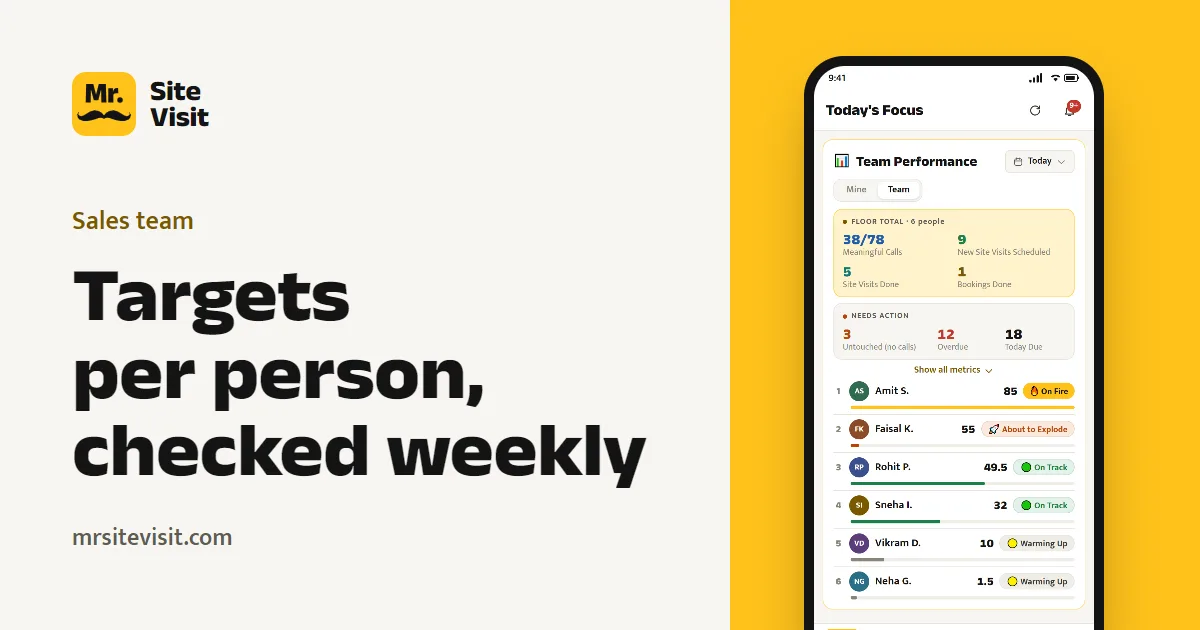
A booking target tells your salespeople where the month should end. It says nothing about what to do on Tuesday.
You probably write one number per person on the 1st. Often it’s the same number for everyone. You count it on the 30th, and by then nobody can help the person who’s short. Do you know by the 10th who’s going to miss?
There’s a better way. Give each person a booking target from their own record, not an equal share. Turn it into weekly site visits and meaningful calls they can see and control. Then check those each week, while you still have time to help.
The simple rule Split the firm’s target by each person’s own record, then turn every booking target into weekly visits and calls. Check those every Monday, not the bookings on the 30th.
A target needs two numbers, not one
Every salesperson needs one booking target for the month, and two weekly numbers that lead to it. The booking target is what your firm needs. The weekly numbers are what your salesperson controls.
Weekly activity target
- Site visits done this week
- Meaningful calls this week
- Seen every week
- Fully in the person’s hands
Monthly booking target
- Bookings that hold
- Uneven: one buyer changes the number
- Seen at month end
- Depends on the project too
A meaningful call reaches the buyer and lasts 2 minutes or more. In my view, shorter ones are mostly “call me later”. Our post on tracking your sales team explains why dialled calls don’t count.
Why both? Bookings come late and in bunches. Someone can work hard for three weeks and book nothing. Then they book two on the last Saturday. The weekly numbers show you early whether the work is happening.
General workplace research backs you here, though not from sales floors. Locke and Latham’s 2002 summary of 35 years of goal-setting research found that specific, hard goals beat “do your best”. They also found people need summary feedback that shows their progress. A weekly sheet is one way to give it.
Start from each person’s own record
A fair target starts with what each person actually did over the last three months. You need three numbers per person. Take them from your records, not from memory.
- Bookings a month: bookings that held, divided by three.
- Visits per booking: site visits done, divided by bookings.
- Calls per visit: meaningful calls, divided by site visits done.
Here’s an illustrative 5-person CP firm (channel partner firm). It sells developers’ projects for a brokerage (a share of each sale, paid by the developer). The numbers are an example, not a real firm’s:
| Person | Bookings a month | Visits per booking | Meaningful calls per visit |
|---|---|---|---|
| A | 3 | 6.7 | 9 |
| B | 2 | 9 | 11 |
| C | 1 | 15 | 14 |
| D | 1 | 10 | 12 |
| E (joined 6 weeks ago) | no record yet | ||
| Team | 7 |
Those 7 bookings a month are what your team does today. That’s your starting point, whatever you’d like the number to be.
The example numbers are invented. The method is what matters: your own records, three months of them. I haven’t found a public India figure for visits per booking, so don’t borrow one.
Is someone’s record too thin to trust? With 3 bookings or fewer in three months, one lucky buyer changes every rate. Use six months for them, or the team’s visits per booking. And check who got the better leads before you reward a record.
Share the gap by who has room, not equally
Compare your target with the team’s record. The difference is the gap. Give it to the people who can take it.
Where does the firm’s number come from? Start from the last six months’ bookings. Then adjust for the leads you can supply, any launch or festive month, and the units your projects have left. Our 2027 sales plan works the whole year by month.
Say this firm wants 9 bookings in December. The record says 7, so the gap is 2. Two more bookings need more visits. More visits need more leads. Who on your team has time to call them?
- D: does the fewest visits, about 10 a month. Say D also has the fewest active leads. Check that first; if D is full, give this booking to B. D gets the extra fresh leads and one extra booking. That doubles D’s visits, and D’s record is thin, so review it in week three.
- A: books from the fewest visits. A gets one extra booking, but check A’s calling time first.
- B and C: stay at their record. C needs 15 visits per booking. Join two of C’s visits before asking for more.
Our post on how many leads one salesperson can handle shows how to measure that calling time.
What if your gap is bigger than the team’s room? Then you need more leads or more people, not harder work. The booking target post works a target back to the leads it needs.
Targets people don’t believe in are common. In Salesforce’s 2024 survey, 67% of sales reps said they didn’t expect to meet their quota that year. That’s across industries, not only real estate.
Locke and Latham found a limit too. Performance stops rising once a goal passes what people can do, or once their commitment to it lapses. In my view, a target your people think is impossible gets you less.
A few cases change the split:
| If… | Then… |
|---|---|
| Your target is below the team’s record | Keep each person at their record, and move spare leads to the newest people |
| Someone joins or leaves mid-month | Rework only that person’s share, and tell the team why |
| You have a new joiner | Leave them out of the firm’s number. E isn’t counted in the 9; E is spare room |
| Your firm has team leaders | Each TL runs this split for their own area team, and the owner adds them up |
| One person sells ₹3 crore flats and another ₹60 lakh ones | Set the target in brokerage instead of bookings, worked the same way |
Turn each booking target into weekly visits and calls
Each booking target becomes weekly site visits and meaningful calls, from that person’s own rates. Here’s A, worked in three steps:
- Visits in the month 4 bookings × 6.7 visits per booking is about 27 visits.
- Visits a week 27 ÷ 4 weeks is 6.75, rounded up to 7.
- Calls a week 7 visits × 9 meaningful calls per visit is 63.
That’s about 10 meaningful calls a day over six days. If that’s more than A can make, change the target or the leads.
Here’s the whole team, worked the same way:
| Person | December target | Visits a week | Meaningful calls a week |
|---|---|---|---|
| A | 4 bookings | 7 | 63 |
| B | 2 bookings | 5 | 55 |
| C | 1 booking | 4 | 56 |
| D | 2 bookings | 5 | 60 |
| E (new) | learning target | 3, with a senior | 40 |
| Team | 9 bookings | 24 | 274 |
Visits a week are rounded up, so nobody’s plan falls short. If your team already shares results, put each person’s two weekly numbers on the sales office board. If not, show each person their own row.
The sheet holds 20 people and 5 weeks a month. It shows how much of your target is still unshared. So the targets you set add up to the target you need.
New joiners get learning targets for two months
Give a new salesperson a learning target, not a booking target, for their first two months. In my view, their bookings in the first weeks depend more on a good lead or a senior’s help than on them.
Locke and Latham found that on complex tasks, specific learning goals beat performance goals. The paper didn’t study sales floors. Still, selling a flat is complex, and a new joiner is learning it, so I’d apply the same idea. The cost sheet and the solo visit below are the real learning goals.
So E’s December target is about the work:
- Do 3 site visits a week alongside a senior
- Make 40 meaningful calls a week
- Learn the cost sheet and inventory of two projects
- Run one visit alone by the end of the month, with notes
From the third month, E gets a booking target from E’s own record, like everyone else.
Check it every Monday
Each week, compare each person’s visits and calls with their weekly plan. The pattern tells you what kind of help they need.
80% of plan is a sensible line to start with. It leaves room for a normal slow week. Change it after a month of your own numbers. Below it, find their row here:
| If last week… | Then… |
|---|---|
| Calls and visits are both below 80% of plan | It’s activity. Check whether they had enough fresh leads and calling time, and move leads if they didn’t |
| Calls are on plan, but visits are below | Calls aren’t turning into visits. Listen to two of their calls with them this week |
| Visits are on plan for three weeks, but no bookings | Visits aren’t turning into bookings. Join one of their visits, and check the project before the person |
| Visits are on plan, but calls are below | Probably fine: their calls are booking visits. Listen to one call anyway |
| Everything is ahead of plan | Say so in the meeting. Don’t raise their target mid-month |
| A new joiner is behind on the learning target | Pair them with a different senior for the next week |
Will the sheet keep getting filled in? Only if one person owns it. The TL types each person’s three numbers before the Monday review. If it stops by week three, drop calls and keep visits only. Reading it is about a minute a person, before the Saturday visit plan. The person who’s behind hears it in week one, not on the 30th.
Count bookings for the target the way you count them for incentives. Only the ones that hold count. Treat the first misses as coaching, not pay cuts. Three weeks below 80% is the time for a longer talk about leads, skills or the project. Our post on incentive splits covers who gets credit when two people worked a buyer.
Which team are you?
The method is the same for every team. What changes is who sets your targets and who runs the weekly check:
| Your team | Who sets it | What to watch |
|---|---|---|
| A 3 to 6 person CP firm, owner still selling | The owner, for everyone including themselves | Visits a week only; calls when there’s time |
| A 7 to 20 person CP firm with team leaders | The owner sets the firm’s target; each TL (team leader) splits it | The TL runs the Monday check for their area team |
| A developer’s in-house sales team | The sales head, per project | Visits by project; a slow project can’t be fixed by targets |
| A mandate company (a firm a developer hires to sell a whole project) | The sales head, for sourcing managers and closers | Partner visits registered, as well as your own team’s |
“Equal targets are fairer”
They feel fairer, because nobody can say they got a harder number. But an equal target asks too much of your newest person. It asks too little of your best. Your best closer hits the number on the 20th and goes quiet. Your newest person looks at the same number and stops trying.
What should be equal is the method. Everyone’s target comes from their own record, worked out the same way. Everyone gets the same weekly check. Show your team the sheet. When they see how their number was set, the fight about fairness usually goes away.
My honest view: if you only change one thing, add the weekly visits. You’ll know who needs help well before the 30th.
Who shouldn’t bother with all of this? A 3-person team where the owner sees every visit. There, a weekly visits number on the board is enough.
What I’d check this week
You can do this from your own records before your December targets go up:
- Record: pull each person’s bookings, visits and meaningful calls for the last three months.
- Gap: add up their bookings a month and compare that with the target you had in mind.
- Room: check who has the time for more leads before you hand out the gap.
- New joiners: write each one a learning target instead of a booking number.
- Weekly check: put it on your Monday agenda, about a minute a person.
Where software helps
The sheet works, but someone has to fill in your team’s visits and calls every week. In my view, numbers typed from memory tend to be rounder than the truth.
In Mr. Site Visit, each person’s scorecard counts meaningful calls, plus visits scheduled, visits done and bookings. Calls are matched from the Android call log and marked Verified. Visits are recorded by the salesperson; on Growth, with time and GPS stamped. You see it for today, this week or this month:
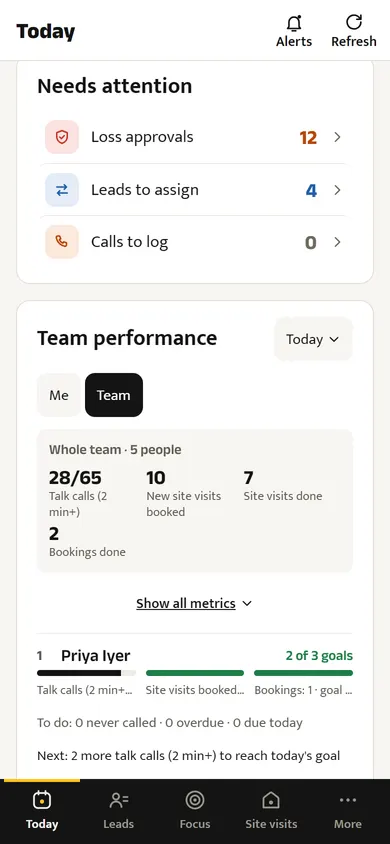
One honest limit: the app’s daily goals are the same default for everyone today. You can’t yet set a different target for each person in it. So keep your targets in the sheet. Read the actual numbers from the app.
Starter is ₹423 and Growth, which adds time and GPS at visit start and end, is ₹548, per user a month, billed yearly, from three users. See the plans and prices, or how it works for channel partner firms and developers.
This week, pull three months of records, set December’s targets from them, and try the first Monday check with your team.
Questions teams ask
How do you set sales targets for real estate salespeople?
Start from each person’s own last three months: bookings a month, and site visits per booking. Add up those records and compare them with the firm’s target. Share the gap with the people who have time and a fair visit-to-booking rate. Then turn each booking target into weekly site visits and meaningful calls.
Should every salesperson have the same target?
No. An equal target overloads the slower or newer people and asks too little of the best. What should be equal is the method: everyone’s target comes from their own record, the same way, and everyone gets the same weekly check.
What target should a new real estate salesperson get?
For the first two months, a learning target instead of a booking target: site visits done alongside a senior, and meaningful calls a week. In my view, bookings in the first weeks depend more on the lead or a senior’s help than on them.
How often should sales targets be reviewed?
Check visits and calls every Monday against each person’s weekly plan, and bookings at the end of the month. Set next month’s targets from the latest three months. Don’t raise a target in the middle of the month because someone is doing well.
Sources
- Locke and Latham, Building a practically useful theory of goal setting and task motivation: a 35-year odyssey, American Psychologist 57(9), September 2002: specific, difficult goals consistently led to higher performance than urging people to do their best; performance levelled off when the limits of ability were reached or commitment lapsed; people need summary feedback that reveals progress; on complex tasks, specific learning goals worked better than performance goals
- Salesforce, State of Sales statistics (25 July 2024): survey of 5,500 sales professionals in 27 countries; 67% of sales reps don't expect to meet their quota this year