Fake site visits: what a visit record can prove, and what it can't
By Jayesh G, Founder · 12 min read. Published 2 November 2026.
In short
- No single record proves a site visit. A salesperson's message proves nothing, and a GPS stamp shows where the phone was, not that the buyer came.
- Count a visit when two signals agree and one comes from outside the salesperson's phone: the developer's register, or the buyer.
- Each week, call back one in five visited buyers with a care call, and look for month-end jumps and very short visits.
On this page
- A visit record is only as good as who made it
- What each kind of proof shows, and how it’s faked
- A GPS stamp shows the phone, not the buyer
- Use two signals, one from outside the phone
- Call back one in five visited buyers
- If a buyer says they never came
- Warning signs in your own numbers
- Which team are you?
- “Checking says I don’t trust my team”
- What I’d check this week
- What our app records, and what it doesn’t
- Questions teams ask
“Visit done, sir. Client liked the 2BHK.” Did the buyer really come? How would you know?
On a busy Saturday, with visits at two projects, that WhatsApp line is often all the owner has. Most of the time it’s true. When it isn’t, you find out weeks later, when the buyer says they never came.
No single record proves a visit happened. Each kind of proof, or signal (any record of the visit: a message, a stamp, a desk entry, a callback), shows something different. Some show much less than they seem. The fix is to count a visit only when two signals agree, and one of them comes from outside the salesperson’s phone.
The simple rule A visit counts when two signals agree and at least one comes from outside the salesperson’s phone: the buyer, or the developer’s desk.
A visit record is only as good as who made it
A record made only by the salesperson can be made without the buyer. A record made by someone else, at the site or on the buyer’s phone, is much harder to fake.
Messages, photos and GPS stamps all come from the salesperson’s own phone. The developer’s register doesn’t. Nor does the buyer’s own word.
What each kind of proof shows, and how it’s faked
The table shows what each record proves, and what it can’t:
| Proof | It shows | It doesn’t show | Faked by |
|---|---|---|---|
| The salesperson’s message | Someone says it happened | Anything else | Typing it |
| A photo at the site | Someone was at some place | When, or that the buyer came | An old photo |
| A GPS stamp at start and end | Where the phone was, and when | That the buyer came | Starting it elsewhere, or a fake location |
| GPS checked against the site | The phone was near the project | That the buyer came | A fake location |
| The developer’s register or CP desk entry | Someone at the site saw the buyer | Whether the desk was careful | A friendly desk |
| A code sent to the buyer’s phone | The buyer’s phone was part of it | That the buyer stood at the site | The buyer reading it out on a call |
| A callback to the buyer by someone else | The buyer’s own account | Whether the number is really the buyer’s | A lead number that isn’t the buyer’s |
The table splits in two. The top four come from the salesperson’s phone. The bottom three come from someone else. Your strongest checks are in the bottom half.
A CP desk (the developer’s counter where channel partners register their buyers) is worth using even when no brokerage (your share of the sale, paid by the developer) is at stake. Its entry is made by someone who doesn’t work for you.
A GPS stamp shows the phone, not the buyer
A GPS stamp is the phone’s location and the time, saved when a visit starts or ends. It’s useful, but it proves less than most owners think.
- GPS stamp
- The location of the salesperson’s phone, with the time, saved when the visit starts or ends. It shows where the phone was, not who was with it.
First, it isn’t exact. GPS.gov says phones are typically accurate to within 4.9 metres under open sky, and worse near buildings and trees. A sales office between towers can show some way off. Don’t call that a lie.
Second, the phone says how sure it is, and it isn’t always right. Android draws its accuracy circle so the real spot is inside it 68% of the time. That’s roughly two times in three.
Third, a location can be faked. Android lets an app supply a test location in place of the real one. Android marks it as a mock, or test, location. It says such a location may not be related to where the phone really is. A CRM can look for that mark; ours doesn’t (see below). I haven’t checked iPhones.
So treat GPS as one signal. It’s good for spotting a pattern, like the same spot for two different projects. It isn’t enough on its own.
Use two signals, one from outside the phone
For every visit, ask for two signals that agree, with at least one from the buyer or the developer’s desk. Often the second signal is already there, at the desk. How many of last month’s visits could you match to a desk entry today?
Where the second signal comes from depends on where the visit happens:
| If the visit is… | Then the second signal is… |
|---|---|
| At a developer’s site with a CP desk | The desk’s entry for your buyer, with the date |
| At a site office with a visitor register | The register line for your buyer, checked by you or the desk, not a photo from the salesperson |
| At a resale flat or a site with no desk | The callback to the buyer, within a few days |
| Counted for an incentive | Always the desk entry or the callback, never the message alone |
Will the developer’s desk share its entries? Ask for your own buyers only. If it won’t, the callback is your second signal.
Call back one in five visited buyers
Each week, call back one in five visited buyers, within a few days of the visit. Someone other than the salesperson makes the call. One in five is my judgement, not a researched figure. More means more calls. Fewer means each person is barely checked. Over a month, it’s 4 or 5 callbacks a person, enough to see a pattern.
Ask how they found the site and what’s missing. People talk about the tower or the cost sheet, and you also hear what wasn’t followed up:
- Pick so nobody can predict it Roll a die for the starting visit each week, then take every fifth. Not only the ones you already doubt.
- Call within a few days The owner, a TL (team leader) from another area team, or the office.
- Ask about the visit, not whether it happened “How did you find the site? Which tower did you see?”
- Ask what’s missing “Was anything left unanswered? Can we send the cost sheet again?”
- Write it down Visited, didn’t visit, or not reached, with one line of what they said.
For an example 10-person firm with 40 visits a week, that’s 8 calls. At a few minutes each, my estimate is under an hour a week.
Take the buyer’s number from the original portal or ad lead. Don’t take it from the salesperson’s notes. Call only numbers buyers gave your firm. A briefed buyer can still answer. No check is perfect.
A buyer who saw the site can usually name the tower or the sample flat. For buyers who don’t pick up, send a short message:
The sheet holds 20 salespeople and 1,000 callbacks. It flags anyone with a visit the buyer said didn’t happen, so you talk to them that week.
If a buyer says they never came
One buyer’s “no” is a reason to ask, not proof. Buyers forget, and mix up projects and dates. So take three calm steps before you decide anything:
- Buyer: call once more and ask about the day, not the accusation.
- Desk: check the developer’s desk or register for that date.
- Salesperson: ask them, privately, what happened that day.
Act only when two signals disagree with the claimed visit. Then deal with it the way your incentive rules say, and say the rule to the whole team.
Warning signs in your own numbers
Your own visit records show where to call first. The first two work from any sheet; the last three need a tool that stamps visits. None proves anything alone, but each is a reason to look:
| If you see… | Then… |
|---|---|
| Visits jump in the last week, say from 40 a week to 70 | Call back that week’s visits first |
| Many visits, but never a revisit or a booking | Join one of their visits next Saturday |
| A visit that started and ended under 10 minutes apart | Ask what happened; in my view, a walk-through and the cost sheet take longer |
| One person starts many visits without GPS | Ask why; one person far above the rest is the sign, not the switch |
| The same GPS spot for two different projects | Call back both buyers |
Why would anyone fake a visit? One likely reason: visits are counted for a target or an incentive, and the month is ending. We have no figure for how common it is, and I doubt anyone does.
So fix the reason, not only the record. Count a visit for a target or an incentive only when it has a second signal. Or pay the incentive on revisits and bookings, not first visits; our 2027 incentive plan shows what each rule costs. Our post on setting sales targets per person counts visits too, with the same rule.
Be open about the checks. Tell the team callbacks happen every week. When you call a buyer, say you’re calling from the firm to see how the visit went.
Which team are you?
Every team can use the two-signal rule. What changes is where the second signal comes from:
| Your team | Your best second signal | Who calls back |
|---|---|---|
| A 3 to 6 person CP firm (channel partner firm), owner still selling | The developer’s CP desk entry | The owner, weekly or monthly |
| A 7 to 20 person CP firm with team leaders | The CP desk entry, plus callbacks | A TL from a different area team |
| A developer’s in-house sales team | Your own site office register | The CRM or customer care desk |
| A mandate company (a firm a developer hires to sell a whole project) | Your site desk’s entry for each partner’s buyer | Your desk, before the partner’s visit is counted |
“Checking says I don’t trust my team”
It can, if you only check the people you suspect. Then the check is an accusation, and your best people feel it too.
So tell the team before you start. Check everyone the same way, at random. A rule for one person feels like an accusation; a rule for everyone is just how the firm works. Make the callback a care call that helps the buyer and, often, the sale. Honest salespeople gain: their real numbers stop being compared with inflated ones.
I’d guess most visits are real, but I can’t prove it. That’s the point of checking: so you can trust all of them. Start it calmly, and keep it going even in months when nothing turns up.
Who shouldn’t bother with a weekly check? A 3 or 4 person firm where you go on nearly every visit yourself. A monthly callback is enough.
What I’d check this week
You can start this without any software:
- List: take last month’s visits, by person, from your sheet or group.
- Month end: compare the last week’s visits with the first three weeks.
- Desk: ask the developer’s CP desk for its entries for your buyers last month, and match them.
- Callbacks: call back one in five of this week’s visited buyers, with the care call above.
- Tell the team: say at Monday’s meeting that callbacks are now part of every week.
What our app records, and what it doesn’t
We built Mr. Site Visit, a CRM (the software your team logs leads, calls and site visits in) for real-estate teams of three or more. Here’s what a visit record in it shows.
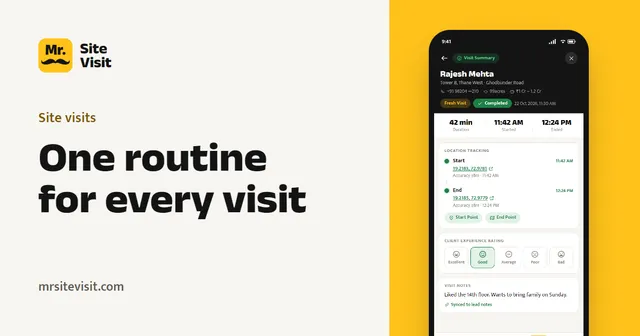
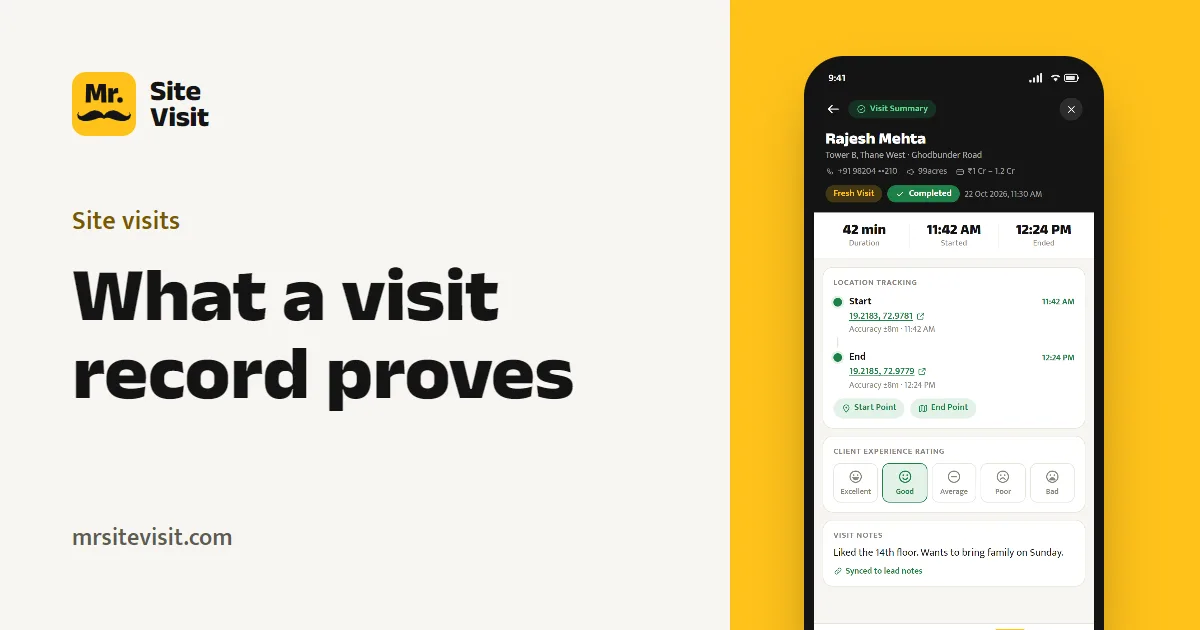
On the Growth plan and above, Start Visit and End Visit, on the phone app or in the browser, save the time and the GPS location, with its accuracy in metres. Each point opens on a map. A visit can’t be ended without notes and a rating.
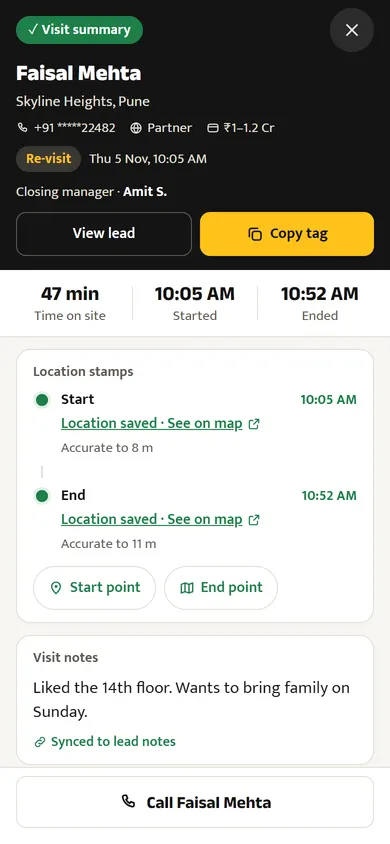
What it doesn’t do: we don’t compare the stamp with the project’s location. We don’t take a photo, send the buyer a code or look for a faked location. A salesperson can also start a visit without GPS, and the record shows that.
So in our app, the GPS stamp is your first signal, and the CP desk or the callback is your second. A check against the project’s location, or a code to the buyer’s phone, needs a different kind of tool. If you need one, ask every vendor for it. See a sample visit record, or how site visit records work.
Growth is ₹548 a user a month, billed yearly, from three users. See the plans and prices, or how it works for channel partner firms.
This week, pick one in five of your visited buyers and call them, as a care call. Then talk to the team on Monday.
Questions teams ask
How do I know a site visit really happened?
Look for two signals that agree, with at least one from outside the salesperson’s phone. The developer’s visit register or CP desk entry, a code sent to the buyer’s phone, or a callback to the buyer all count. A WhatsApp message or a photo alone doesn’t. Then call back one in five visited buyers each week.
Does GPS prove a site visit?
No. A GPS stamp shows where the salesperson’s phone was, and when. It doesn’t show that the buyer came. Phone GPS is also less accurate near tall buildings, and an app can give an Android phone a test location instead of its real one.
How do I check visits without upsetting my team?
Tell the team before you start, check everyone the same way, and make the callback a care call: how did you find the site, what else do you need? It reads as care, not suspicion. Honest salespeople gain too: inflated numbers stop being compared with theirs.
Why do salespeople report fake site visits?
One likely reason: visits are counted for targets or incentives, and the month is ending. A visit that’s easy to claim and hard to check invites it. Counting a visit only when two signals agree removes most of the reason.
Sources
- GPS.gov (U.S. government), GPS accuracy: GPS-enabled smartphones are typically accurate to within a 4.9 m (16 ft.) radius under open sky; their accuracy worsens near buildings, bridges and trees (page last modified 3 March 2022; checked 2 November 2026)
- Android Developers, android.location.Location reference: getAccuracy() is the estimated horizontal accuracy radius at the 68th percentile confidence level; isMock() returns true if the location is marked as a mock location, which may not be related to the actual location of the device (checked 2 November 2026)