Site visit management checklist: before, during and after
By Jayesh G, Founder · 13 min read. Published 26 October 2026.
In short
- Run every site visit in three parts: prepare before the buyer arrives, ask before you show, and write it down before they leave.
- No visit ends without three things recorded: what the buyer liked, what stops them, and the next date.
- Below: a checklist for each part, rules for the Saturday rush, and a free visit register you can download.
On this page
- A visit is won before the buyer arrives
- Saturday breaks the plan unless you staff it
- During the visit, four moments matter
- Keep the developer’s trust answers ready
- The visit form: ten fields are enough
- After the visit, the same evening matters most
- How the sales head runs visits each week
- “My team won’t fill a form at the site”
- Which team are you?
- When a register stops being enough
- Questions teams ask
The cost sheet on your site-office desk is a month old. A family has just asked for the price. Two more families walk in behind them. Your salesperson is still with the first. And a channel partner is on the phone, saying one of those families is “his” buyer.
By evening the visits are over. Ask the team what each family said. You may get three different memories, and no next date.
You’ll get the routine first; software comes in once, at the end. Here’s the routine good site offices run. It comes in three parts, with a checklist to print and a register to download. Before: confirm and prepare. During: ask before you show, and find the doubt. After: write it down before the buyer leaves, and message the same evening.
The simple rule No visit ends without three things written down: what the buyer liked, what stops them, and the next date.
A visit is won before the buyer arrives
My view: most of a good visit is decided before the buyer reaches the gate.
A buyer travels an hour on a Saturday to see you. They should meet someone who already knows their budget and their doubt. Before every visit:
- Confirm the day before and that morning, and ask the buyer to reply
- Send the location pin and the name of the person meeting them
- Read the call notes: budget, size, who decides, the main doubt
- Agree who can quote a discount or offer on the day, and what to say when asked
- Print the current cost sheet and check which units are still available
- Register any buyer a channel partner brings with the developer, before the visit (on a developer’s team: check the CP’s registration at your desk)
- Ask who’s coming, so the people who decide come too
That last one saves you a second visit. If the person who decides isn’t there, you’ll do the whole visit again.
A confirmation your team can send the day before:
WhatsApp’s business messaging policy says businesses may message people who gave their number and opted in, and must respect requests to stop. Send it by hand, one buyer at a time.
Is a channel partner (CP, an outside broker who brings buyers for a commission) involved? Then registration is a common place for arguments to start. Before the visit:
- Search your lead list for the buyer’s number
- If the buyer is already there, settle whose they are now, under your agreement with the developer
- Ask the developer how long a registration stays valid, and note that date in the brought-by column
Our guide to settling CP tagging disputes has the rules.
Saturday breaks the plan unless you staff it
Weekend visits pile up. So decide in advance what happens when two buyers arrive at once.
The rule: book no more visits at once than you have free people, and keep one slot spare. An illustrative Saturday: two of you are free from 11 to 1, and each visit takes an hour. That’s four slots, so book three and keep one for late arrivals.
Time a few of your own visits first; yours may run longer. Don’t overbook to cover no-shows; two families arriving at once can lose you both. Fix why booked buyers don’t turn up instead. Then agree a few rules for when the plan breaks:
| If… | Then… |
|---|---|
| Two families arrive together | A second person welcomes the next family, offers water and starts with the layout, until their own salesperson is free |
| The buyer’s salesperson is out | Hand the buyer to a named colleague, with the call notes |
| A CP arrives with a buyer who isn’t registered | Register the buyer with the developer first, then start the visit |
| A walk-in arrives with no enquiry | Take their name and number on the form, and give them a named owner |
| A buyer cancels on the day | Offer two new slots on the call, and confirm one in writing |
| The CP wants to join the walk | Welcome them; your named salesperson leads, and the form records both names |
A walk-in is a lead too. If nobody writes their name down, they belong to nobody. And nobody calls them on Monday.
During the visit, four moments matter
Don’t walk them round in silence. Talk first, then show.
- Meet at the gate Greet them by name, note the time they arrived, and introduce who’s showing them around.
- Ask before you show What matters most to them? Who else decides? What have they seen elsewhere?
- Walk with their doubt in mind Show the unit type that fits the budget, and answer the main doubt at the site.
- Ask what would stop them Before they leave, ask: “What would stop you from booking?” Then fix the next date together.
Asking what would stop them feels awkward at first. But it gives you the one thing to answer in your follow-up. And a buyer who names a doubt is still thinking about buying.
Keep the developer’s trust answers ready
Buyers of new projects weigh the developer’s record heavily. My view: most buyers will ask whether the project will be delivered on time.
ANAROCK, a property research firm, surveyed buyers in the first half of 2026. Developer reputation came first for new projects. And 48% of homebuyers named reviews or reputation and timely delivery as their top developer considerations, as The Federal reported on 17 September 2026.
So keep the trust answers ready at the site office:
- Keep the project’s RERA registration number at the desk (RERA is the state regulator that registers projects)
- Know the promised possession date, and what it depends on
- Know the construction stage, and what the cost sheet includes
- Show the developer’s past delivered projects, with their dates
If your salesperson has to say “I’ll find out”, the buyer goes home with a new doubt.
The visit form: ten fields are enough
A visit form is useful only if it’s short enough to fill before the buyer leaves.
The ten fields that matter, and why each one earns its place:
| Field | Why it matters |
|---|---|
| Date, time in and time out | When the visit happened and how long it lasted, as the salesperson reports it |
| Buyer name and number | Links the visit to the lead, so nobody starts from zero |
| Who came, and who decides | Tells you if you need a second visit with the family |
| Brought by: direct, or which CP | Puts “who brought this buyer?” on record before anyone asks |
| Project and unit types shown | So the next call talks about the right flat |
| What they liked | Gives the follow-up something warm to open with |
| What stops them | The one doubt your next message must answer |
| Budget and loan status | Tells you how ready they really are |
| Rating: hot, warm or cold | Lets the sales head see which buyers are ready, at a glance (definitions below) |
| Next step and its date | Gives the next call a date you can check on Monday |
It has the ten fields as 16 columns, plus two example rows.
Some fields are split: name and number, the times, and the next step and its date. It also adds who hosted, and whether the CP registration was acknowledged. Delete the examples before you start.
Let each salesperson add their own rows. Only one or two people should change old rows. If each person signs in with their own account, Google Sheets’ version history shows who changed a row later. Keep the sheet in a firm account, not on someone’s personal phone, and remove access the day someone leaves.
Collect only what you need, and tell buyers why you’re noting it. The Digital Personal Data Protection Act, 2023 mainly rests on consent, and lets people withdraw it. Its Rules, notified in November 2025, ask for a plain notice that says how to withdraw consent. That applies from 13 May 2027, as SCC Online reported. Check with your lawyer which duties apply to your firm, and when.
After the visit, the same evening matters most
The hours after a visit decide whether the buyer remembers you, or the project they saw next.
Fill in the form at the site office, before the salesperson moves to the next buyer. Then, the same evening, send one message that answers the doubt they named:
Agree what the ratings mean, so everyone rates the same way. Our suggestion, to adjust for your projects:
| If the buyer… | Then rate them… |
|---|---|
| Named a date to decide, or asked for the booking form | Hot |
| Liked it, with one doubt still open | Warm |
| Said the price or location doesn’t fit | Cold, and offer another project |
After that, call on the date you agreed. If the rating is hot, decide that evening who sends the cost sheet and the booking form. If the buyer comes back with family, that’s a new row in the register, linked to the first. Our follow-up system has the full plan for the days after a visit.
How the sales head runs visits each week
Someone must look at visits every day, so you hear about a bad or missing one that week, not when the deal is gone. When did you last hear about a bad visit from the buyer, not your team? The weekly buyer call is also your check that the visit really happened. Don’t count visits hosted. Count visits with a recorded doubt and a next date. That’s the number that tells you which visits have a next step.
This is the sales head’s routine. It takes a few minutes a day:
- Each evening, check that every visit done today has a form with a next date
- Each evening, list today’s no-shows and give each one a call-back owner
- Each Monday, compare visits fixed with visits done, by salesperson
- Each week, call one visited buyer and ask the three questions below
- Each month, read the “what stops them” column and share the top doubts
That weekly call is your buyer feedback form. Ask three things, and add the answers to the “what stops them” column:
- Answers Did you get your questions answered at the site?
- The host Was the person who met you prepared for you?
- The doubt What’s the one thing still stopping you from deciding?
The monthly read also tells the developer what to fix. If half your buyers name the same doubt, it’s the project’s problem, not the salesperson’s. Our post on why leads don’t become site visits shows how to count that.
“My team won’t fill a form at the site”
The fair objection: “On a Saturday, they don’t have time to write.”
They’re right that a long form won’t survive a Saturday. My honest view: a short form filled every time beats a perfect form filled sometimes. So keep it to the ten fields. Make it part of saying goodbye.
The salesperson fills it in while the buyer is still at the desk. Then they read the next date back to the buyer. It’s a short job, and it checks that the buyer agreed.
Then the sales head checks the forms that evening, every evening, for the first month. If you check, they’ll fill it. If you don’t, they’ll stop.
Which team are you?
The routine is the same. Who runs each part changes:
| If you are… | Then… |
|---|---|
| 3 to 6 people, and the owner hosts visits | Use the register as a shared sheet in a firm account, or a printed sheet at the desk; the owner checks it each evening |
| 7 to 20 people with a sales head | Name a weekend host for walk-ins and double bookings; the sales head checks forms daily |
| A developer’s site office with a CP desk | Register CP buyers at the desk before the walk, and keep the register at the office |
| A mandate company (hired by a developer to sell a project) working with outside CPs | Record who brought each buyer on every form, and share it with the developer weekly |
A mandate company is a firm a developer hires to sell a whole project. For them, the “brought by” field matters most.
Who shouldn’t bother yet? If you host a couple of visits a week and remember every buyer, a notebook works. Start the register when visits start to overlap.
When a register stops being enough
A shared sheet works until the forms get filled in on Monday, from memory. Or until a CP disputes a row someone edited later.
We built Mr. Site Visit, a CRM (the software your team logs leads, calls and visits in) for real-estate teams of 3 or more.
On Growth and Developer, Start Visit and End Visit on the salesperson’s Android phone record the time and, when GPS is on, the location with its accuracy. There’s no iPhone app. A visit can’t be closed without notes and a rating.
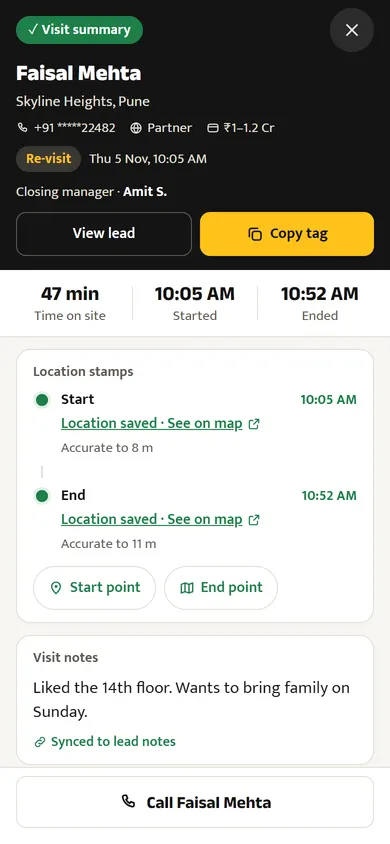
Be clear about what that proves. The GPS stamp shows where the phone was. It isn’t checked against the project’s location, and no photo is taken. A salesperson can also start a visit without GPS, and the record shows that. See a sample visit record, or how site visit records work. To check that visits really happened, see what a visit record can prove.
On the Developer plan, each CP buyer is tagged with the partner’s code and a tagging window (the days during which the partner’s claim on a buyer holds). Disputes go to a queue. Partners don’t log in; your team records them.
Prices start at ₹423 a user a month on Starter, billed yearly, from 3 users, with no GST on top. GPS on visits starts on Growth, at ₹548, and Developer is ₹1,298 a user a month, billed yearly. See the plans and prices, or how it works for developers, CP firms and mandate companies.
Print the checklists, put the register on the site office desk, and run this Saturday with it. On Monday, look at the forms together and see what your buyers told you.
Questions teams ask
What is site visit management in real estate?
It’s the routine your team follows for every visit to a project. Before: confirm the visit and prepare the buyer’s details. During: ask what matters, show the right unit and find their main doubt. After: record the visit, message the same evening and call on the agreed date.
What should a real estate site visit checklist include?
Before the visit: a confirmation the day before and that morning, the buyer’s call notes, the current cost sheet and availability, and registration of any buyer a channel partner brought. During: who decides, what they liked, what stops them. After: the visit form, an evening message and a next date.
What details should a site visit form capture?
Ten fields are enough. Date and times, the buyer’s name and number, who came and who decides, and who brought them. Then what you showed, what they liked and their main doubt. Add budget and loan status, a hot, warm or cold rating, and the next step with a date. Collect only what you need.
What should a salesperson do after a site visit?
Fill in the visit form before the buyer leaves, then send one message the same evening that answers their main doubt. Call on the date you agreed during the visit. If they’ve gone quiet, keep to a follow-up plan rather than calling every day.
How do you avoid channel partner disputes at site visits?
Register every buyer a channel partner brings with the developer before the visit, and keep the developer’s acknowledgement. If a partner arrives with a buyer who isn’t registered, register them first, then start the visit. Write who brought the buyer on the visit form.
Sources
- The Federal, report on the ANAROCK Consumer Sentiment Survey H1 2026 (17 September 2026)
- WhatsApp Business Messaging Policy (last updated 23 September 2026)
- Digital Personal Data Protection Act, 2023 (Act No. 22 of 2023, assented 11 August 2023), India Code
- SCC Online, MeitY notifies the Digital Personal Data Protection Rules, 2025 (14 November 2025): most duties apply from 13 May 2027