We get leads but no site visits: 7 real reasons
By Jayesh G, Founder · 14 min read. Published 26 October 2026.
In short
- When leads don't turn into site visits, the cause is usually one step in your own process, not every lead.
- Count seven things from last month: speed, reach, fit, the ask, no-shows, follow-ups and the project itself.
- Find the biggest drop, fix only that step for a month, then count again.
On this page
- A visit needs seven things to go right
- Find your biggest drop with last month’s numbers
- Reason 1: the first call came too late
- Reason 2: you called, but never reached them
- Reason 3: the lead was never a fit
- Reason 4: nobody asked for the visit
- Reason 5: the visit was fixed, then nobody came
- Reason 6: the buyer said “later” and nobody called back
- Reason 7: the project itself is the problem
- Fix the biggest drop first
- “Our leads are just bad”
- Which team are you?
- What I’d check this week
- When a sheet stops being enough
- Questions teams ask
Your portal dashboard says the leads came in. Your ad agency’s report says the same. Your site-visit register has a handful of names. All three are right, and the gap between them is where your visits go.
Somebody says the leads are bad. Somebody else says the team is slow. Both could be right, and you can’t tell which from the meeting.
You don’t need more leads or new software to find out which. You need the exact step where your leads stop, and you can find it with numbers you already have. Seven things must happen to a lead before it becomes a visit. Count each one from last month. The biggest drop is your reason.
The simple rule Don’t fix everything. Find the step where most leads drop, fix only that for a month, then count again.
A visit needs seven things to go right
A lead becomes a site visit only when seven steps all happen. If one step is weak, every step after it gets fewer leads.
The seven, in the order a lead meets them:
- Called fast Someone calls the lead soon after it arrives.
- Reached The buyer picks up and you have a real conversation.
- A fit Their budget, area and timing match a project you sell.
- Asked The salesperson offers a day and a time for the visit.
- Reminded The buyer hears from you the day before and that morning.
- Followed up A buyer who says “later” gets a next date, and a call on it.
- Worth the trip The project, its price and its builder make the journey feel worth it.
One number tells you how the whole chain is doing. Track it every month. Set your target from your own best source, or your best salesperson, over the last three months:
- Lead-to-visit rate
- Site visits that actually happened in a month, divided by the new leads you received that month. Count visits done, not visits fixed.
Find your biggest drop with last month’s numbers
Count how many leads survive each step. The step where the count falls most is where you start.
Take an illustrative month for a 10-person CP firm (a channel partner firm, which sells developers’ projects for a commission). The figures are an example, not research:
How the bars match the seven reasons below:
- Called: how many of the 170 were called within the hour (Reason 1)
- Reached: Reason 2
- A fit: Reason 3
- Visit fixed: Reason 4, and Reason 6 hides here too
- Visit done: Reason 5
- One project far lower: Reason 7
So in this example, 65 leads were called but never reached. That’s the biggest loss. Buying 50 more leads would lose most of them at the same step. The fix is more call attempts, at different times of day.
Put a price on it. Say each lead costs ₹400 (an illustrative figure; use yours). Then 200 leads cost ₹80,000, and each of the 18 visits cost about ₹4,400. If the team reached 130 leads instead of 105, and the later steps held, you’d get about 22 visits for the same spend:
Same leads, same money, about four more families at the site. To track this every week, see which cost to watch: per lead, per visit or per booking.
You don’t need software to get these numbers. Each one is already written down somewhere:
| Step | Count this | Where you’ll find it |
|---|---|---|
| Called fast | Leads called within an hour | Lead sheet (arrival time) and the phone’s call log |
| Reached | Leads with at least one connected call | The phone’s call log |
| A fit | Reached leads that match a project | The salesperson’s call notes |
| Asked | Leads with a visit date fixed | The visit register or the WhatsApp group |
| Reminded | Fixed visits that happened (the rest are no-shows) | The visit register |
| Followed up | Open leads with a next date | Your follow-up sheet |
| Worth the trip | Visits and lost reasons by project | Visit register and lost-lead notes |
Use the call log, not what people remember. “I called him” and a connected call on the phone are two different things.
Reason 1: the first call came too late
Leads cool fast. A buyer called the next morning may already have spoken to other agents.
The research I can cite is old and from the US, but it points to the same first check. Two findings come from research published in Harvard Business Review in March 2011. The original is paywalled, so the figures here are as SmartCompany reported them. A test of 2,241 US companies showed how slowly most replied. The same Harvard research also measured what speed was worth:
“Qualify” there means a real conversation with the person who decides. It doesn’t prove the same result for Indian property buyers. It does say speed is worth checking first.
Check: what share of last month’s leads got their first call within an hour? Look at it by salesperson and by day, and check weekends on their own. For many teams, they’re the slowest. Our guide to calling every portal lead within an hour sets up the owner, deadline and backup person.
Reason 2: you called, but never reached them
Count a call only if the buyer picked up. Many leads are tried once or twice, then quietly dropped.
Buyers are at work, driving, or ignoring unknown numbers. So one call at 11 am tells you nothing. My starting rule, not a researched number: try about six times over a week, at different times of day. If they agreed to WhatsApp messages, send one with your name and the project after the first missed call, so your next call isn’t a stranger’s. Our post on how many times to call a lead has the full plan.
Check: of the leads you called, how many had at least one connected call? Split the rest in two: wrong or switched-off numbers, and real numbers that didn’t pick up. The first is a source problem. The second is yours. Then count the tries on each unreached lead. How many got only one?
Reason 3: the lead was never a fit
Some leads can’t become visits. The budget is wrong, the area is wrong, or the buyer is only checking prices.
Price worry is real right now. ANAROCK, a property research firm, surveyed buyers across 14 Indian cities in the first half of 2026, as The Federal reported:
The same survey found 18% may postpone indefinitely or cancel. So some of your enquiries won’t be ready to visit this weekend, whatever your team does. That’s normal. Count them, so they don’t hide a bigger leak somewhere else.
To count fit the same way across the team, ask every reached buyer three things, and note the answers:
- Ask the budget, including the loan
- Ask which areas they’d consider
- Ask when they want to buy, and who decides
Check: of the leads you reached, how many didn’t match any project you sell? Split it by source. Is one source far worse than the rest? Then it may be the source, but read Reason 1 for that source before you cut it. A portal whose leads were called late will always look bad.
Reason 4: nobody asked for the visit
A common ending to a good call is “I’ll send you the details on WhatsApp”, with no visit date.
Details don’t book visits. A day and a time do. If I could change one habit on a sales floor, it would be this one. Teach the team to offer two slots before the call ends: “Saturday at 11, or Sunday at 4?” A buyer who’s interested will pick one. A buyer who won’t pick either has told you something too.
Then confirm it in writing, straight after the call:
Check: of the leads that were a fit, how many got a fixed visit date? If it’s much lower for one salesperson, listen to a few of their calls with them.
Reason 5: the visit was fixed, then nobody came
A fixed visit isn’t a visit until the buyer arrives. The gap is often a missing reminder.
On a busy Saturday, a family that confirmed on Thursday can simply go quiet. Send a short message the day before and the morning of the visit. Ask the buyer to reply. That makes the visit real again. If there’s no reply two hours before, call. Send the location pin and the name of the person meeting them.
Only message buyers who gave you their number and agreed to hear from you. Send it by hand, one buyer at a time, and stop if they ask you to. Our site visit checklist has the day-before message and the rest of the visit routine.
Check: your no-show rate. That’s visits fixed minus visits done, divided by visits fixed. Count it for last month. If it’s high, see why booked buyers don’t turn up.
Reason 6: the buyer said “later” and nobody called back
A buyer who isn’t ready this week needs a next date, or they never come back.
“Call me after Diwali” is a real lead. But if nobody writes down a date, nobody calls after Diwali. Our follow-up system gives every open lead one owner and a next-action date, and a ten-minute morning check.
Check: how many open leads have no next date at all? And how many dates have passed without a call?
Reason 7: the project itself is the problem
Sometimes the team does everything right, and buyers still won’t make the trip.
ANAROCK’s same survey found developer reputation was the top consideration for new projects, followed by location, price and construction quality. Your team can’t change any of those. If buyers keep saying “too far” or “too costly” for one project, that’s a pricing or targeting talk with the developer, not a training problem.
Check the same team in the same month. Does one project turn far fewer fit leads into visits than the others? Read the lost-lead reasons for it. Then offer those buyers another project that suits them, before you close them as lost. If visits happen but don’t book, see site visits but no bookings.
Fix the biggest drop first
Once you know your weakest step, the first fix is usually simple. Start here:
| If your biggest drop is… | Then fix this first… |
|---|---|
| Called fast | One owner per lead and a one-hour call deadline, with a backup person |
| Reached | More attempts at different times, plus a WhatsApp message with your name |
| A fit | Check that source’s speed first; then change the ad’s targeting or the portal package |
| Asked | Two visit slots offered on every good call, confirmed in writing |
| Reminded | A message the day before and that morning, and a call if there’s no reply |
| Followed up | A next-action date on every open lead, checked each morning |
| Worth the trip | A talk with the developer, and another project offered to those buyers |
Fix one step for four weeks. Then count all seven again. A fix often moves the drop to the next step, and that’s fine. It means more leads are getting further.
“Our leads are just bad”
The fair objection: “We’ve tried everything. The leads are junk.”
Sometimes they are. Your numbers tell you when, and four numbers by source settle it. If your biggest drop is at “A fit”, and it comes mostly from one source, that’s the leads. If the drop is at speed, reach, the ask or no-shows, it’s the process. New leads will leak from the same place.
My honest view: it’s tempting to blame the leads first, because that’s the one thing nobody in the room controls. Count before you agree, with your team or with me.
Which team are you?
The method is the same everywhere. Who counts, and how often, changes:
| If you are… | Then… |
|---|---|
| 3 to 6 people, and the owner still sells | Count the seven yourself once a month, from the sheet and the call logs |
| 7 to 20 people with a sales head | The sales head counts them by person every Monday; the owner sees the monthly totals |
| A developer’s team with a site office | Count by project and by source, and add CP-brought buyers as their own source |
| A mandate company working with outside CPs | Count your own leads and each CP’s registered buyers separately, so each side sees its own drop |
A mandate company is a firm a developer hires to sell a whole project. It needs both sides of the count, because its CPs bring many of the visits.
Who shouldn’t bother yet? A team getting only a few leads a week can see every lead by name. Just ask, lead by lead, where it got stuck.
What I’d check this week
You can do all of this in an hour with last month’s sheet and the phones:
- Pull every lead from last month into one list
- Count the seven steps, using the call log for calls
- Mark the step with the biggest drop
- Pick one fix from the table, and tell the team why
- Put a date four weeks out to count again
When a sheet stops being enough
Counting by hand works until you have several people, several sources and several projects. Then the counting itself becomes the job.
We built Mr. Site Visit, a CRM (the software your team logs leads, calls and visits in) for real-estate teams of 3 or more. It doesn’t make buyers pick up. It shows meaningful calls, visits scheduled and visits done for each person, plus untouched and overdue leads. Fit, reminders and lost reasons you still read from the notes.
Each new lead goes to one owner the moment it arrives, with a phone notification. If there’s no call or stage change (a move to the next stage) within the time you set (2 hours by default), it moves to the next person.
Calls are matched from each Android phone’s own call log and tagged Verified, so a typed “called” doesn’t count. A call typed in by hand is kept, marked Unverified and left out of the numbers. iPhones aren’t covered.
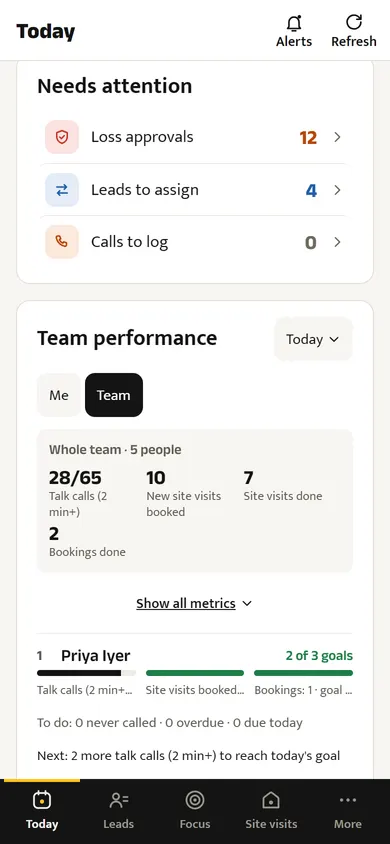
A meaningful call is a connected call of 2 minutes or more.
On Growth and Developer, each visit records the time and GPS location at its start and end. It’s a record. It isn’t checked against the site, and a salesperson can start a visit without GPS. WhatsApp reminders open with the text filled in, and the salesperson sends them by hand.
Prices start at ₹423 a user a month on Starter, billed yearly, from 3 users, with no GST on top. A 10-person team is ₹4,230 a month on Starter, or ₹5,480 on Growth, where visits record time and GPS. GPS on visits starts on Growth, at ₹548. See the plans and prices, or how it works for CP firms, developers and mandate companies.
This week, before anyone argues about the leads again, count the seven numbers with your team. Then pick the one step you’ll fix together this month.
Questions teams ask
How do you increase site visits in real estate?
Find the step where your leads stop, then fix that step. Count last month’s leads, how many were called within an hour, reached, found to be a fit, offered a visit slot, reminded and followed up. The biggest drop is your reason. More leads won’t help while that step stays broken.
What is a good lead to site visit ratio in real estate?
There’s no reliable public benchmark for Indian teams, and it changes a lot by source, project and price. Set your target from your own best: the best source or best salesperson over the last three months. Then lift the weakest step toward it, and watch the rate month by month.
Why do real estate leads not convert into site visits?
Usually it’s one of seven reasons. The first call came too late, or the buyer was never reached. The lead wasn’t a fit, or nobody asked for a visit. The buyer wasn’t reminded, or nobody called back after a 'later'. Or the project itself didn’t appeal. Your own numbers show which one.
How do you reduce site visit no-shows?
Send a short message the day before and the morning of the visit, asking the buyer to reply, with the location pin and the name of the person meeting them. Call two hours before if they haven’t replied. Message only buyers who gave you their number and agreed to hear from you.
Should I stop buying leads from a portal that gives no site visits?
Not before you check how fast and how often your team called that portal’s leads. Compare the portal with your other sources on time to first call, leads reached and leads that were a fit. If its leads were called as well as the rest and still weren’t a fit, then it’s the source.
Sources
- Oldroyd, McElheran and Elkington, The Short Life of Online Sales Leads, Harvard Business Review, March 2011 (original; paywalled)
- SmartCompany, Are you letting online leads go cold? (1 July 2011), the figures as reported from the Harvard research
- The Federal, report on the ANAROCK Consumer Sentiment Survey H1 2026 (17 September 2026)