How to track your sales team: who called, who visited
By Jayesh G, Founder · 9 min read. Published 24 October 2026.
In short
- Track five numbers per person every working day: leads called within the hour, meaningful calls, visits fixed, visits done and overdue follow-ups.
- Take calls from each phone's call log, not from what people type, and check three 'not picking' leads each morning.
- Tell the team what you track and why before you start, and check everyone the same way, the owner included.
On this page
- Five numbers show who’s working the leads
- A meaningful call is a connected call of 2 minutes or more
- Keep the five on one sheet, filled from the phone
- Ten minutes every morning is enough
- How to check “called, not picking”
- Ask what got in the way before you judge a low number
- Won’t tracking my team kill trust?
- Which team are you?
- When the sheet stops working, and what we built
- Questions teams ask
When a salesperson tells you a portal lead didn’t pick up, how would you check? Usually you can’t, so you nod. Then one of those buyers books a flat through another broker, and says nobody ever called. Who do you believe?
You don’t want to be the boss who checks every phone. You also can’t keep paying for leads nobody works. Start with a sheet. This is the routine I’d run on any sales floor, and software can come later.
The short answer: track five numbers for each person, every working day. Take calls from the phone’s own call log, not from what people type. Then spend ten minutes each morning on them, the same way for everyone.
The simple rule Count what the phone shows, not what people type: five numbers per person, every morning.
Five numbers show who’s working the leads
You need five numbers per person per day, not fifty reports. Each one answers a question you’d otherwise ask on the phone:
| Number | What it counts | A low number usually means |
|---|---|---|
| Called within the hour | New leads called within 60 minutes of arriving | Leads are waiting, or going to the wrong person |
| Meaningful calls | Calls that connected and lasted 2 minutes or more | Lots of dialling, few real talks |
| Visits fixed | Site visits booked with a date and time | Calls aren’t giving buyers a reason to come |
| Visits done | Visits that actually happened | Visits booked to look busy, or not confirmed |
| Follow-ups overdue | Promised callbacks whose date has passed | Callbacks are being forgotten |
Why within the hour?
A Harvard Business Review study looked at 2,241 US companies in 2011. Firms that contacted a lead within an hour were nearly seven times as likely to qualify it. That’s compared with firms that waited even one hour longer. Our guide on calling every portal lead within an hour covers how to set that up.
Bookings matter most, of course. But they show up weeks later. These five tell you this morning whether bookings are coming. If visits fixed stays low for the whole team, our post on why leads don’t become site visits shows how to find the step that breaks.
A meaningful call is a connected call of 2 minutes or more
Total calls is the number you’ll be tempted to praise. And it’s the easiest one to inflate. Eighty dials that nobody answers look busy on a sheet. They don’t fix a single visit.
So count the calls where a real talk happened:
- Meaningful call
- A call to a lead that connected and lasted 2 minutes or more: long enough to ask about budget, location and a visit.
Two minutes is the line we use in our own product. Pick your line, then keep it the same for everyone. What matters is that nobody can reach it by dialling and hanging up quickly. On a sheet, a long call to a friend can still count. So the random check should look at who was called, not just how long.
Keep the five on one sheet, filled from the phone
You need one row per person per day, nothing more. The trick is where the numbers come from.
Every phone keeps a call history with the number, the time and how long each call lasted. Each evening, every person counts their calls to lead numbers from that history, not from memory. It takes five minutes. It’s the same five minutes for everyone. The sheet is still typed by hand. So the three-lead check below is what keeps it honest.
Here’s an illustrative morning sheet for three people. The figures are an example, not real data:
| Person | Called in 1 hour | Meaningful calls | Visits fixed | Visits done | Overdue |
|---|---|---|---|---|---|
| A | 5 of 6 | 9 | 2 | 1 | 0 |
| B | 2 of 6 | 3 | 0 | 0 | 7 |
| C | 5 of 5 | 6 | 1 | 2 | 1 |
Who would you talk to first? Person B: leads waiting, few real calls and seven callbacks overdue. That’s one quiet conversation, not a team meeting.
Ten minutes every morning is enough
The review only works if you do it daily, before your team leaves for site. Here’s a ten-minute routine:
- Minutes 1–3 Read the five numbers for each person. Look for the one that’s out of line.
- Minutes 4–6 Pick three “not picking” leads at random and find those calls in the phone’s history.
- Minutes 7–8 Compare yesterday’s visits fixed with visits done.
- Minutes 9–10 Give each overdue follow-up a name and a time today.
Do it at the same time every day, even on a Saturday with visits all day. If you skip it twice, your team will notice.
How to check “called, not picking”
Ask to see the call, and ask everyone the same way. Start with a random check of three leads a day. Nobody knows which three you’ll pick:
A few patterns deserve a second look. None proves anything alone:
- Same lead marked “not picking” day after day, with no call in the history
- Late bursts, where most of the day’s calls happen in its last half hour
- Visits fixed that never turn into visits done
- Follow-up dates that keep moving to tomorrow
Ask what got in the way before you judge a low number
Start every conversation with “what got in the way?” Often the answer is the system, not the person. Too many leads went to one person, or leads arrived during the Saturday rush:
| If you see… | Ask first… |
|---|---|
| Few leads called within the hour | Were you on site when they came in? Who should cover then? |
| Many calls, few meaningful ones | Are these leads right for the project, or do calls end before a visit is offered? |
| Visits fixed but not done | Did anyone confirm the visit the evening before? |
| Follow-ups piling up | Is one person carrying more leads than they can call? |
| “Not picking” with no calls in the history | What happened to these leads? Then agree what changes from today. |
If the same gap shows up for three weeks after you’ve fixed the system, that’s a different conversation. By then you have dates and numbers, not a feeling. To find what your best person does differently, compare your best salesperson with the rest, step by step.
Won’t tracking my team kill trust?
It’s a fair worry: “My people will feel watched, and the good ones will leave.”
My view: hidden checking breaks trust fast. Open, equal numbers give the person who works hard a way to be seen. That’s worth more to them than being left alone. So set three rules before you start:
- Tell the team in writing what you’ll track and why, before the first morning
- Track work calls to leads only, never personal calls
- Check everyone the same way, including your best seller and yourself
There’s a legal side too. India’s Digital Personal Data Protection Act, 2023 lets an employer process staff data for employment purposes. But lawyers point out that the Act leaves parts of this unclear. So keep tracking to work, say it plainly. And check your own case with a lawyer.
You can send something like this to the team group on Monday:
Which team are you?
The routine is the same at every size. Who runs it changes:
| If you are… | Then… |
|---|---|
| 3 to 6 people, and the owner still sells | The sheet and the ten-minute look are enough for now |
| 7 to 20 people with a sales manager | The manager runs the morning review; the owner reads the sheet every Monday |
| A developer’s in-house sales team | Add the numbers by project, and watch visits done against visits fixed |
| A mandate company working with channel partners (CPs) | Track your own people this way, and CP visits by partner on a separate sheet |
A mandate company sells a developer’s project on contract, often with outside channel partners (CPs, the brokers who bring buyers for a commission). Our guide to settling “who brought this buyer?” fights covers the partner side.
When the sheet stops working, and what we built
A sheet stops working when filling it takes longer than the work. You’ll see it: rows filled on Friday for the whole week, numbers nobody can check, a ten-minute review that takes forty.
That’s the job we built Mr. Site Visit for. When someone taps Call, the phone’s own dialer opens. On Android, the app then matches the call from the phone’s call log and marks it Verified. Calls typed in by hand show as Unverified and are left out of every report. The app reads only calls with leads: the number, direction, time and duration.
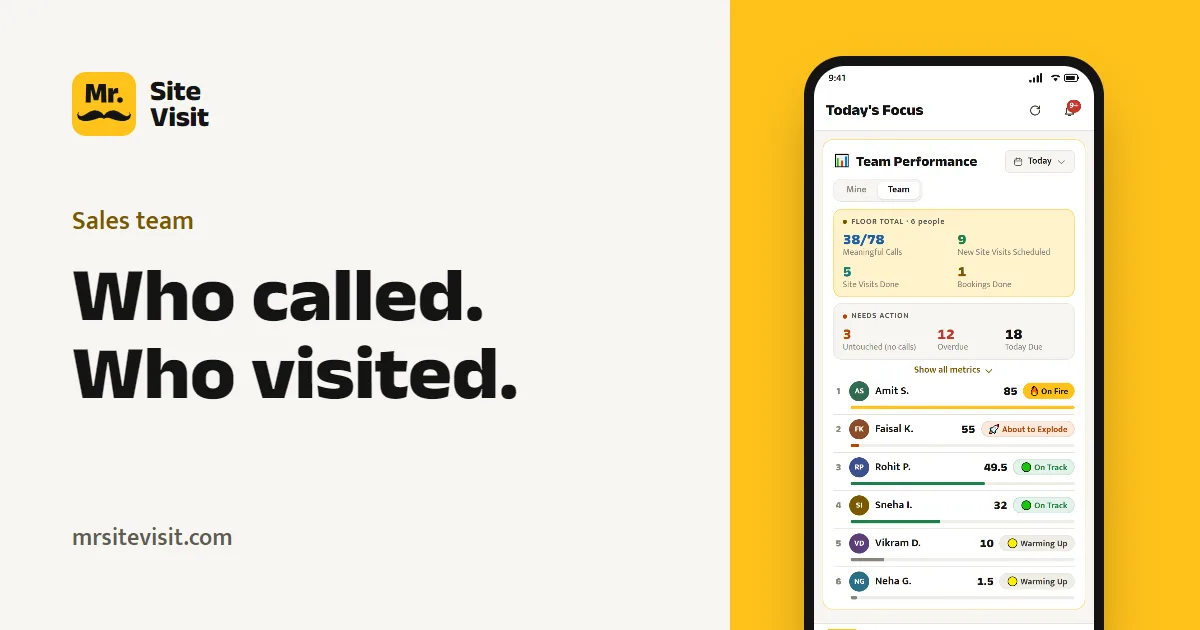
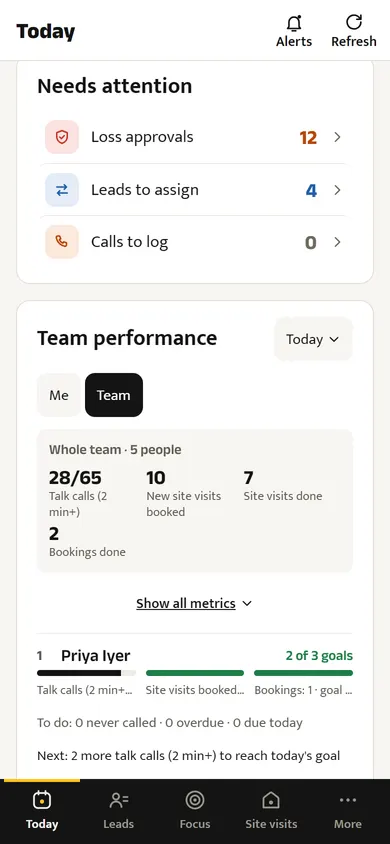
The team view shows each person’s meaningful calls, visits scheduled, visits done, bookings and overdue follow-ups:
Follow-ups due arrive as a push at 8:30 am, and overdue ones show in red. They’re reminders, though, not locks. On the Growth plan, each visit is stamped with time and GPS at its start and end. That shows where the phone was, not that the buyer came. And a visit can be started without GPS. Our post on fake site visits covers the second check.
The honest limits: calls are logged on Android only, so iPhone calls aren’t counted. If your team is mostly on iPhones, this part won’t work for you.
Starter is ₹423 a user a month, billed yearly and paid upfront. It includes logged calls and the team reports. There’s a 7-day money-back, and no free trial. Growth, at ₹548, adds the visit stamps. Both start from three users, with no GST on top. See the plans and prices, or how it works for CP firms and developers.
Whatever you use, start this week with the sheet. Send the team message on Monday, run the ten minutes each morning, and read the numbers together on Friday.
Questions teams ask
How do I track my real estate sales team’s performance?
Track five numbers per person every working day: new leads called within an hour, meaningful calls (connected, 2 minutes or more), visits fixed, visits done and follow-ups overdue. Take the calls from each phone’s call log, not from what people type. Then review them for 10 minutes every morning, the same way for everyone.
How can I check if a salesperson really called a lead?
Ask to see the call in the phone’s own call history: the number, the time and how long it lasted. Do it for two or three leads a day, picked at random, for everyone. A CRM that reads the phone’s call log does this check for you, on Android.
Can I track sales team performance in Excel?
Yes, for a small team. One row per person per day with the five numbers is enough. It breaks when the numbers are typed from memory, filled in at the end of the week, or when checking them takes longer than the work.
Is it legal to track my employees' work calls in India?
India’s Digital Personal Data Protection Act, 2023 lets an employer process staff data for employment purposes, but lawyers note it leaves parts of this unclear. Track only work calls to leads, tell your team in writing what you track and why, and check your own case with a lawyer.