What your best salesperson does that the rest don’t, in numbers
By Jayesh G, Founder · 11 min read. Published 6 November 2026.
In short
- Your best salesperson may beat the rest at only one or two steps, not all of them. In our example, it’s the early steps: calling fast and reaching the buyer. Your own numbers decide.
- Compare five steps for each person over three months: called within a day, reached, visit booked, visit done, booked. The step with the widest gap is the habit to copy.
- Watch that one step, write it as one rule, and have the team follow it for four weeks. Then count again.
On this page
- Your best salesperson may win at only one or two steps
- One table shows where the gap is
- Download the gap finder
- What the gap is worth
- Make the comparison fair first
- Copy the habit, not the person
- Should the best person just get more leads?
- Which team are you?
- “Some people are just born salespeople”
- What I’d check this week
- Where software helps
- Questions teams ask
“She just has a way with buyers.” Have you said that about your best salesperson? The numbers often tell a different story.
When you count the steps, your best person may beat the rest at only one or two of them. In the example below, it isn’t the close. It’s calling new leads faster, and reaching more of the buyers they call. I can’t point to a study that proves this for CP firms, so your own numbers decide.
So compare five steps for each person, find the step with the widest gap, and copy that one habit. Watch how your best person does it, write it as one rule, and have the team follow it for four weeks. Then count again.
The simple rule Don’t copy your best salesperson. Copy the one step where they beat the rest by the most.
Your best salesperson may win at only one or two steps
A lead becomes a booking through five steps. Your best person is rarely better at all five.
Each step has a rate: how many of your leads, buyers or visits moved on. Compare the rates, not the totals. Totals mostly show who got more leads.
- Talk call
- A connected call that lasts 2 minutes or more. It’s a better sign of reaching the buyer than “connected”. Short calls are often wrong numbers or “call me later”.
One table shows where the gap is
Take your last three months. One month is too noisy. A single big booking can make anyone look like a star.
Here’s an illustrative CP firm (a channel partner firm, selling developers’ projects for brokerage, a commission on each sale). Its best salesperson booked 4 a month. The six others averaged 2. Every figure is an example, per person per month. The first two percentages are of leads given; each one after that is of the row above it. “Times better” uses the counts, not the rounded percentages.
| Step | Best person | The rest, on average | Times better |
|---|---|---|---|
| Leads given | 120 | 120 | same |
| Called within a day | 114 (95%) | 84 (70%) | 1.36 |
| Reached (a talk call) | 66 (55%) | 48 (40%) | 1.38 |
| Visit booked, of those reached | 20 (30%) | 14 (29%) | 1.04 |
| Visit done, of those booked | 16 (80%) | 9 (64%) | 1.24 |
| Booked, of visits done | 4 (25%) | 2 (22%) | 1.13 |
Look at the last column. “Times better” is the best person’s rate divided by the rest’s, so 1.38 means 38% better and 1.00 means no gap. The best person isn’t much better at booking visits or at the close. Even the visit-done gap (1.24) is smaller than the first two. The widest gap is at the start: calling fast and reaching the buyer.
You may have expected the gap at the close, where your best person shines on a Saturday. The table says otherwise: the widest gaps sit at the first two steps, while the lead is fresh. When two gaps are this close, start with the earlier step. It feeds every step after it.
There’s outside evidence that the early steps matter. OpenAgent’s 2019 study ranked 2,054 agents across Australia by listings, over 12 months. Its top 10% tried to contact all their leads, against 92.7% for the bottom 10%. They also answered faster:
Those were agents selling homes for owners, not a CP firm’s team. I found no published Indian data comparing top and average salespeople. So treat it as a direction, not a benchmark. Your own five rates are the real answer.
Download the gap finder
The sheet holds 20 people. For each one, it shows how many times better your chosen person is at every step. It also shows their bookings if they matched that person at their widest gap. If the widest gap is the first step, treat that figure as the most it could be, not the likely number. It flags anyone with fewer than 30 leads. And if the person you compare with called under 80% of their leads, it warns you.
What the gap is worth
A gap at an early step passes to every step after it.
In the example, the rest reach 48 buyers a month each.
Say they reached 66, like your best person, and kept their own rates for every later step. Their reached count goes from 48 to 66, which is 1.38 times. So their bookings rise 1.38 times too: about 2.75 a month instead of 2. The estimate uses the reached gap, which already includes the faster first calls.
That’s three-quarters of a booking per person. Across six people, it’s 4 to 5 more bookings a month from the same leads, if their later rates hold. That’s an estimate, not a promise. But nobody had to become a better closer.
The middle of the team is also where most of your people are. A 2012 summary of Steenburgh and Ahearne’s Harvard Business Review research says core performers are the largest group on sales teams. My reading: a small lift across six people can be worth more than pushing one star harder.
The same summary says this group does well with tiered targets. Our post on sales targets per salesperson sets them step by step.
Make the comparison fair first
A gap can come from the leads, not the person. Check four things before you act.
- Compare people on the same sources. A person who gets the walk-ins and referrals will look better at everything
- Use three months, and leave out anyone under about 30 leads in that time
- Look at the counts behind each rate. Trust a gap only where both sides have at least 10 to 15 behind it
- Check the first step. A person who calls only the leads they like will look great at every later step
The last one matters most. If your best person called only 60% of their leads, their later rates look better than they are. They picked the easy buyers, and the rest got nothing.
Copy the habit, not the person
Once you know the step, find out what your best person does there. Ask them, but also watch. In my view, a good salesperson often can’t say what they do differently.
- Sit with them One morning, at the step with the widest gap. Note when they call, and what they say first.
- Listen to five calls At that step. Note what they ask before they hang up.
- Write one rule Short enough to say aloud: “Every new lead is called before lunch, and again after 6 pm.”
- Four weeks The rest follow the rule. The team leader checks it each morning.
- Count again Did that step’s rate move? If not, you copied the wrong habit. Watch again.
One rule at a time. Hand the team five habits at once, and they’ll follow none of them. You won’t know which one worked, either.
Will your people keep this up? They don’t have to fill in anything new. You or the team leader type six numbers per person once a quarter. The first quarter takes a few hours; later ones are quicker. Tell the team it’s to find one habit, not to rank them. And ask your best person to teach the habit, not to be checked on it.
What does that habit look like on the ground? At the “reached” step, it’s often timing. A 99acres lead that came in at 11 pm gets its first call at 9 am. The second one comes after 6 pm, when buyers are off work. At the “visit done” step, it’s often the confirmation call the evening before, with the site address on WhatsApp.
Should the best person just get more leads?
Up to a point. Past their calling time, their speed drops, and speed may be why they were best.
Our post on how many leads one salesperson can handle works out that limit from the hours in a day. Below it, extra leads to your best person can pay. Above it, you’ve only moved the gap from the rest to them.
And watch how the rest of your team feels. If the best person gets every good lead, the others stop trying. Then the gap gets wider, for the wrong reason.
Which team are you?
The method works at any size. What changes is who watches and how often.
| Your team | What fits |
|---|---|
| 3–6 people, the owner sells | You may be the best salesperson. Count your own five steps too, and write down your habit |
| 7–20 people with a team leader | The team leader runs the comparison every quarter and picks one habit for the next month |
| A developer’s in-house team | Compare within each project. Leads differ too much between projects |
| Area teams with a closing manager | Compare the “reached” and “visit booked” steps per person. Count the closing manager’s bookings per visit done separately |
| A mandate team with outside CPs | Compare your own callers on the five steps. Compare outside partners by visits done per lead they sent |
Who shouldn’t bother yet? A team of three where everyone books about the same. The gaps will be too small to read. Spend the effort on more leads.
“Some people are just born salespeople”
Some are better with people, that’s true. My view: the gap you can see in the numbers is often a habit. When they call, how often they try, and whether they confirm the visit.
You can copy a habit. You can’t copy charm. So start with the habit, and let the rest of the gap be what it is.
What I’d check this week
- Pull three months of leads, calls, visits and bookings for each person
- Work out the five rates, and find the step with the widest gap
- Check that the best person called nearly all their leads
- Sit with them for one morning at that step
- Write one rule, and start it on Monday
Where software helps
You can count all five steps by hand. Take each lead’s date from your lead sheet. Then, in each person’s Android call history, note the first call’s date and any call of 2 minutes or more. Start with your best person and one other; it’s slow work for a whole team.
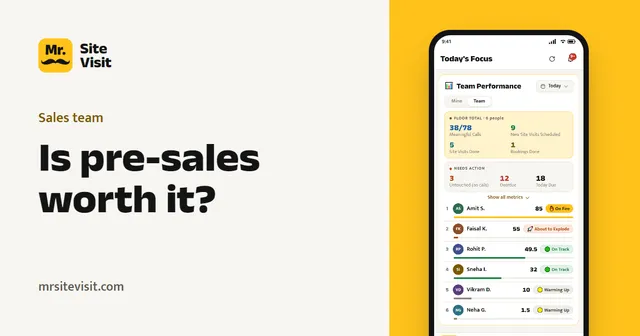
In Mr. Site Visit, calls are logged from the team’s Android phones, with their length. The Team performance view on the Today screen shows each salesperson’s numbers. You see talk calls of 2 minutes or more, site visits booked and done, and bookings.
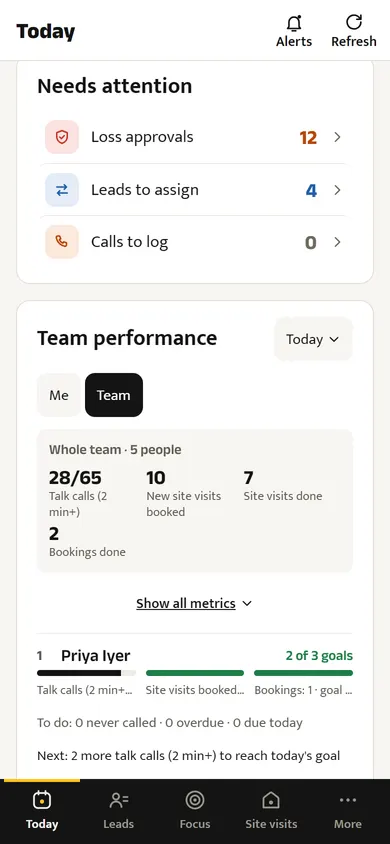
This view gives you four of the six numbers: talk calls, visits booked, visits done and bookings. Leads given and leads called within a day still come from your lead sheet and call history. The Excel then works out the five rates. And it won’t tell you what the habit is. That still takes a morning beside your best person. Plans start at ₹423 per user a month, billed yearly, from three users. See the plans and prices, or how it works for CP firms.
This week, count the five steps for your best person and for one other. You’ll likely see the gap in a single row.
Questions teams ask
What do top real estate salespeople do differently?
Often the best salesperson wins at one or two steps, not at everything, and it may not be the close. It can be the early steps: calling new leads faster and reaching more buyers. Compare five steps for each person over three months. The step with the widest gap is the habit the rest can copy.
How do I compare my salespeople fairly?
Use three months, not one. Compare people who got the same kind of leads, from the same sources. Look at rates, not totals: visits booked per buyer reached, bookings per visit done. And leave out anyone with fewer than about 30 leads in that time.
Should I give more leads to my best salesperson?
Only up to their calling time. Past that, their speed drops. In my experience, their results then slip too. It’s usually worth more to copy their best habit across the team, because the middle of a team is its largest group.
What is a talk call?
A talk call is a connected call that lasts 2 minutes or more. It’s a better sign that the salesperson reached the buyer than a call that only connected, because a short connected call is often a wrong number or a “call me later”.
Sources
- Elite Agent, New data from OpenAgent reveals the behaviours of top performing agents (18 September 2019): 2,054 agents across Australia over 12 months, ranked by listings; the top 10% attempted to contact 100% of their leads against 92.7% for the bottom 10%, and responded within 97 minutes against 191
- University of Virginia Darden School of Business, One size does not fit all when motivating a sales force (18 July 2012), summarising Steenburgh and Ahearne in Harvard Business Review: core performers are the largest group on sales teams and thrive on multi-tiered targets