Your 2027 sales incentive plan: pay per visit, per booking, or both?
By Jayesh G, Founder · 12 min read. Published 4 November 2026.
In short
- Pay mainly on bookings that hold. Then incentive rises and falls with the brokerage that pays for it.
- Pay per site visit only where the job ends at the visit, such as pre-sales or a new joiner’s first months. Keep it small, and count only visits someone else’s record confirms.
- Every rupee you pay per visit costs your visits-per-booking in rupees for each booking. Test the rules on a slow month before you announce them.
On this page
- Pay for what pays you: bookings that hold
- Three rules, the same cost in a normal month
- A slow month: visit pay doesn’t shrink
- A padded month: visit pay grows
- Every rupee per visit costs twelve per booking
- When visit pay makes sense
- Check the half-of-pay line before you cut salaries
- Test the rules on your own year
- Which team are you?
- “My people want visit money”
- Write the 2027 rules on one page before January
- What I’d check this week
- Where software helps, and where it doesn’t
- Questions teams ask
The incentive rule pinned in your office pays for site visits. The developer pays you for bookings. Have you checked what happens in the months those two don’t match?
In a good month, nobody notices. In a slow month, you pay full visit money on a thin brokerage (your firm’s commission on the sale, paid by the developer). And at month end, a visit that’s easy to claim gets claimed.
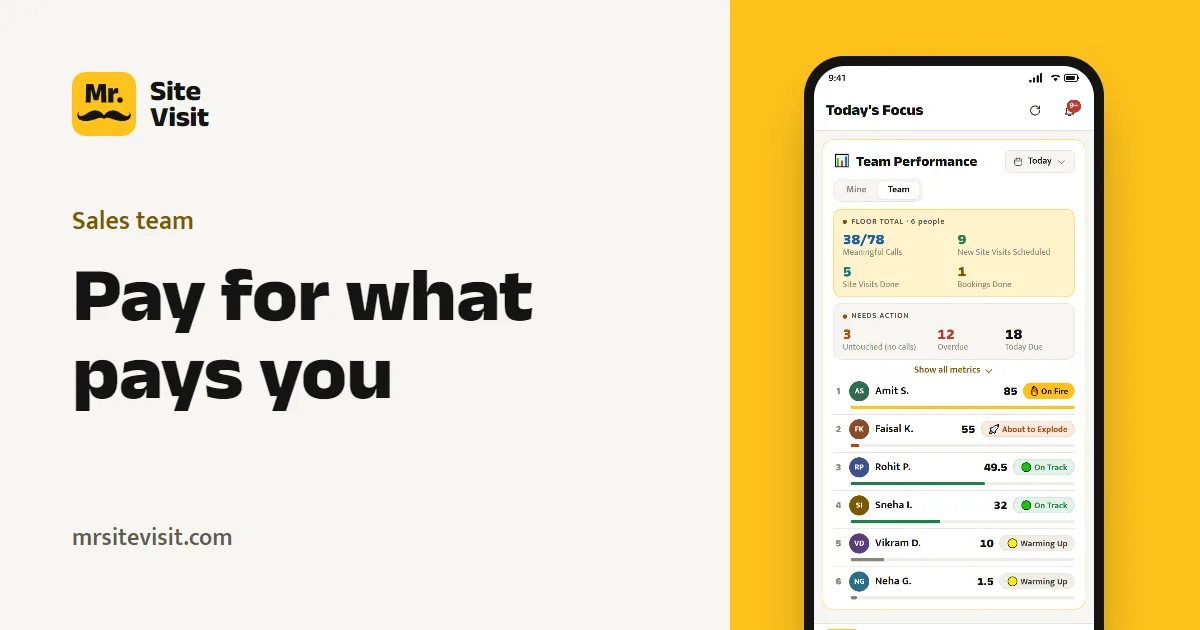
So here’s the answer for 2027. Pay mainly on bookings that hold, so incentive rises and falls with the brokerage that pays for it. Use visit pay only where someone’s job ends at the visit. Keep it small. And test any rule on a slow month before you announce it.
The simple rule Pay for what pays you: bookings that hold. Pay per visit only where the job ends at the visit, keep it small, and count only visits a second record confirms: the CP (channel partner) desk’s entry or a callback.
Pay for what pays you: bookings that hold
A booking-only rule costs you a fixed share of every brokerage. Visit pay doesn’t move with brokerage at all.
Steven Kerr named this problem in 1975: “On the folly of rewarding A, while hoping for B”. Firms pay for one thing and hope for another. Pay for site visits while hoping for bookings, and you’ll get site visits.
A visit still matters. It’s the step before most bookings. But a visit costs the firm money, and a booking brings money in. Your incentive should know the difference.
Three rules, the same cost in a normal month
To compare rules fairly, set them to cost the same in an ordinary month. Then see what each does when the month isn’t ordinary.
Here’s an illustrative firm, the same one as in our 2027 sales plan. It earns ₹2,00,000 brokerage per booking. A normal month has 60 site visits and 5 bookings. Each example rule pays the team ₹90,000 that month:
| Example rule | What it pays | Normal month: 60 visits, 5 bookings |
|---|---|---|
| A: booking only | ₹18,000 per booking | ₹90,000, 9% of brokerage |
| B: visit only | ₹1,500 per site visit | ₹90,000, 9% of brokerage |
| C: both | ₹500 per visit + ₹12,000 per booking | ₹90,000, 9% of brokerage |
So far, there’s nothing to choose between them. The difference shows up in the other months.
A slow month: visit pay doesn’t shrink
In a slow month, the visits still happen, but fewer buyers book. Say the same 60 visits bring 3 bookings, so ₹6,00,000 of brokerage.
Think of that Monday review. The team had a full Saturday rush at the site office, the visit register says 60, and three families booked. On rule B, the visit money is already owed.
Rule A falls with the brokerage, so it stays at 9%. Rule B still pays the full ₹90,000, which is now 15%. And the brokerage for those bookings may arrive months later.
When does a slow month hit you? Your own last twelve months will show it. Look at the month after a busy season, or after a price rise. You can’t plan it away, but you can choose a rule that shrinks with it.
A padded month: visit pay grows
Now the month end. Suppose 72 visits are claimed instead of 60, and there are still 3 bookings. The extra 12 visits may be real, or they may be revisits by the same family, or entries made from the office.
| Example rule | Padded month: 72 visits claimed, 3 bookings |
|---|---|
| A: booking only | ₹54,000, 9% of brokerage |
| B: visit only | ₹1,08,000, 18% of brokerage |
| C: both | ₹72,000, 12% of brokerage |
On a visit-pay rule, the visit list that reaches you on the 30th is also a pay claim. Every line on it is money, so every line needs a check before Monday’s review.
Rule A doesn’t care how many visits were claimed. Rule B pays for every one of them. That’s the pull our post on fake site visits describes: a visit that’s easy to claim and hard to check invites it.
Your team may never pad a visit. A visit-only rule pays the same either way.
Every rupee per visit costs twelve per booking
Visit pay looks small because it’s quoted per visit. Price it per booking instead.
- Visit pay per booking
- The amount you pay per site visit × your site visits per booking. At 12 visits per booking, ₹500 a visit is ₹6,000 a booking before anyone books.
Your visits per booking come from last year: site visits done ÷ bookings that held. If yours is 15, ₹500 a visit is ₹7,500 a booking. If it’s 8, it’s ₹4,000.
This is why rule C keeps the visit part small. In the example, the ₹500 visit part costs ₹6,000 of each ₹18,000 a booking. The booking part carries the rest.
When visit pay makes sense
Some people’s work ends at the visit. They should be paid for the visit, as long as it really happened.
| If… | Then… |
|---|---|
| Pre-sales (the people who call leads and book visits) never close | Pay per visit that happened, confirmed by the CP desk or a callback |
| A new joiner is in their first three months | A small visit amount until a date you set at hiring, then the booking rule |
| A launch month needs many first visits fast | A visit amount for that month only, written with its end date |
| Salespeople both run visits and close | Booking pay, with slabs: a higher amount per booking after a set number in the month |
| The visit can’t be checked by a second record | Don’t pay for it |
A second signal means a record the salesperson didn’t make alone. That’s the entry at the CP desk on site, or a callback to the buyer. Our fake site visits post explains the two-signal rule.
One more option: pay for revisits instead of first visits. A family that comes back a second time is closer to booking. Count it with the same second signal.
What about slabs and caps? Our post on splitting incentive between the salesperson and the closing manager covers both. It also covers paying when brokerage arrives and cancellations. I won’t repeat them here.
Check the half-of-pay line before you cut salaries
A plan with a low fixed salary and a big incentive has a 2027 question attached. The Code on Wages, one of India’s four labour codes, came into force on 21 November 2025 (checked 4 November 2026).
Under it, “wages” means basic pay plus two allowances, dearness and retaining. The government’s labour reforms note adds a 50% rule for computing wages, or another share if the government notifies one. It’s used for gratuity, pension and social security. Gratuity is the lump sum a long-serving employee gets on leaving.
Taxmann’s reading of the Code on Wages explains the rule. Some pay is left out of wages, and commission is on that list. If the left-out parts are more than half of total pay, the excess counts as wages. So what if most of a salesperson’s pay is commission? Part of it may then count as wages for those benefits.
Before January Ask your CA (chartered accountant) whether your incentive counts as commission. Ask how the half-of-pay test applies to your pay slips and to PF (provident fund) and gratuity. Ask how TDS (tax cut at source) applies to incentive. I’m not a tax or labour adviser.
The sheet below flags anyone whose incentive alone is more than half their total pay. That’s a first filter, not the legal test, because allowances count too. Take the list to your CA before January.
Test the rules on your own year
The examples above are one firm’s numbers. Yours will differ, so test the three rules on last year’s months and your own team.
Fill the Months tab with last year’s twelve months. Look at your three slowest. Which rule kept incentive at a share of brokerage you could carry?
How do you pick that share? Start with last year: total incentive paid ÷ brokerage received. Then check what your slowest month could pay without dipping into savings. That’s your ceiling, whatever a normal month looks like.
A developer’s own team earns no brokerage. Use the booking’s sale value or the money collected in its place, and run the same slowest-month test.
Then fill the Team tab: each person’s fixed pay, usual visits and bookings, and the rule they’re on. It shows each person’s monthly incentive and total pay.
The sheet uses one average brokerage for the whole firm. It counts incentive in the month the work happens. If you pay when brokerage arrives, the money leaves later; our 2027 sales plan shows that cash month by month.
Which team are you?
| Your team | What fits |
|---|---|
| 3–6 people, the owner closes | Booking only. Visit pay just for a new joiner’s first months |
| 7–20 people, area teams and a closing manager | Booking pay with slabs; visit pay only for pre-sales, with a callback check |
| A developer’s in-house sales team | Booking pay on bookings that hold, or on collections; visit pay only for the pre-sales desk |
| A mandate company (runs a developer’s project sales) with outside CPs | Your own people as above; outside CPs are paid by their agreements, not this plan |
Who shouldn’t bother? A firm where the owner closes every buyer and the others only make calls. Pay them a fixed amount until someone else closes.
“My people want visit money”
Fair point: rent is due every month, and bookings aren’t. A salesperson can’t wait three months for their first incentive. If another firm pays per visit, won’t your people leave?
Some might. But the problem they’re describing is time, not visits. So solve the time:
- New joiners: a small visit amount for three months, then the booking rule, both written in the offer letter.
- Everyone: pay booking incentive monthly, as brokerage arrives, so nobody waits a year. The incentive split post has the timing options.
- Your best people: slabs with no upper limit. They earn more than a visit rule would pay them.
Ask the person who wants visit money one question. Would they rather earn ₹1,500 a visit, or ₹18,000 a booking at 12 visits a booking? Those are the same in a normal month. The booking rule pays your best closers more.
Write the 2027 rules on one page before January
A rule changed in the middle of the year feels like a pay cut, even when it isn’t. So start it on 1 January, or on 1 April with the new financial year, and announce it a month before.
- Write what you pay per booking, and what counts as a booking that held
- Write who gets visit pay, how much, and the date it ends
- Write what counts as a visit: which second record confirms it
- Show the slabs. If you set no cap, test the rule on your best month too
- Say when incentive is paid: monthly, when brokerage arrives
- Say what happens to incentive when a booking cancels
- Note what your CA said about the half-of-pay line
On cancellations, one clear rule: if incentive was paid before the brokerage arrived and the booking cancels, it comes off the next month’s incentive.
Read it out at the team meeting and send it to the team’s WhatsApp group. Ask each person to reply “agreed”.
What I’d check this week
- Count last year’s visits per booking, from site visits done and bookings that held
- Find your three slowest months, and what last year’s rule paid in them
- List who would be on visit pay in 2027, and why their job ends at the visit
- Run the team through the sheet, and send anyone over half to your CA
Where software helps, and where it doesn’t
Mr. Site Visit doesn’t calculate incentives. Keep the rules and the money in the sheet. What it gives you is the count the rules depend on.
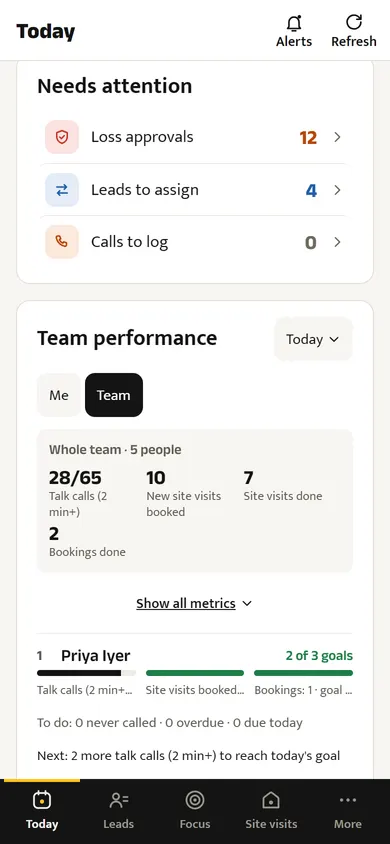
Each person’s scorecard counts meaningful calls, visits scheduled, visits done and bookings, for this month or last. Calls are matched from the Android call log. On the Growth plan, each visit is stamped with the time and GPS at its start and end. The stamp shows where the phone was, not that the buyer came, so keep your callback too.
Starter is ₹423 and Growth is ₹548, per user a month, billed yearly, from three users. See the plans and prices, or how it works for channel partner firms.
This week, pull last year’s visits and bookings, fill the sheet, and pick the rule you’d be happy to pay in your slowest month.
Questions teams ask
Should a real estate firm pay incentive per site visit or per booking?
Mainly per booking that holds, so incentive rises and falls with the brokerage that pays for it. Pay per site visit only where someone’s job ends at the visit, such as pre-sales or a new joiner’s first three months. Keep visit pay small, and count only visits a second record confirms.
How much incentive should a real estate salesperson get per booking?
There’s no market standard we could verify. Work it from your brokerage. Last year’s total incentive ÷ brokerage received gives your starting share. Then check that your slowest month could pay it. In our example, ₹18,000 on a ₹2,00,000 brokerage is 9%.
Do India’s new labour codes affect sales incentives?
They can. Under the Code on Wages, in force from 21 November 2025, commission is among the pay left out of “wages”. If the left-out parts are more than half of total pay, the excess counts as wages for gratuity, pension and social security. Ask your CA whether your incentive counts.
What incentive should a new real estate salesperson get?
Their first bookings may be months away, so a booking-only rule pays them nothing at first. Give a small visit amount for the first three months, counted only for confirmed visits, or a fixed joining amount. Then move them to the booking rule on a date you set at hiring.
Sources
- Press Information Bureau, India’s Labour Reforms: Simplification, Security, and Sustainable Growth (21 November 2025): wages include basic pay, dearness allowance and retaining allowance; 50% of total remuneration (or a notified percentage) added back to compute wages, for gratuity, pension and social security
- Taxmann, Definition of wages under the Code on Wages 2019, section 2(y) and the 50% rule (published 1 September 2026, updated 25 September 2026, checked 4 November 2026): the exclusions include “any commission payable to the employee”
- Taxmann, Govt enforces key wage, bonus and minimum wage provisions under the Wages Code (posted 22 November 2025, updated 1 September 2026): principal provisions in force from 21 November 2025, Notification No. S.O. 5322(E) dated 21.11.2025
- Steven Kerr, On the Folly of Rewarding A, While Hoping for B, Academy of Management Journal 18(4), 1975, pages 769–783