Who earns the incentive: the salesperson or the closing manager?
By Jayesh G, Founder · 8 min read. Published 28 October 2026.
In short
- Pay both. The area team keeps its usual share on every booking that came from its visit; the closing manager’s share comes on top, from the firm’s side.
- Pay monthly, once the developer pays your brokerage, or half on booking and half on receipt. Use slabs that rise with bookings, and don’t cap earnings.
- Write the split on one page before the first handover, with the hard cases: cancellations, cross-sells and buyers nobody handed over.
On this page
When a visited buyer books, who earned it? The salesperson who ran the site visit? Or the closing manager who got the price approved and brought the family back?
If your answer is “one of them”, I’d expect the other to stop helping. The salesperson holds on to buyers instead of handing them over. Or the closing manager stops chasing buyers that won’t pay them anything.
Think of a Saturday at the site office. The salesperson who ran the 11 o’clock visit is already with the next family. The first family wants a price answer before they leave. That’s when the closer should step in, and when a salesperson worried about their incentive won’t let them.
So pay both, and agree what a handover (passing a visited buyer to the closer) means. The area team keeps its usual share on every booking that came from its visit. The closing manager’s share comes on top, from the firm’s side. Pay monthly, after the brokerage (your commission on the sale) arrives. Write it all on one page before the first handover.
The simple rule Nobody earns less for handing a buyer over. The closer’s share comes on top, not out of the salesperson’s.
Pay both, or the handover stops
A split works only if a handover never costs the salesperson money. Otherwise they’ll keep the buyer, even when they don’t have the time to close.
The area team (the two or three salespeople who sell one micro-location) runs the calls and site visits. The closing manager takes serious visited buyers to booking. Our post on the team structure for channel partner firms explains the split.
Won’t paying two people eat your margin? In the example below, about ₹10,000 a booking, plus the closer’s salary. So it only pays if the closer adds bookings. The worked example below shows how many.
Pay on bookings, not on visit counts or leads handled. A visit count is easy to pad; a booking isn’t. Our 2027 sales incentive plan tests visit and booking pay on a slow month.
A split that works, worked through
Here’s one way to set it up. Every figure is an illustrative example, not a market rate; put your own in:
| Example figure | Amount |
|---|---|
| Brokerage on one booking | ₹2,00,000 |
| Area team’s share (10%), as today | ₹20,000 |
| Closing manager’s share (5%), from the firm | ₹10,000 |
| Left with the firm per booking | ₹1,70,000 |
Does it pay back? Take an example firm with four bookings a month. Give the closer an example salary of ₹40,000:
| Example month | Firm keeps |
|---|---|
| Before: 4 bookings, no closer | ₹7,20,000 |
| With a closer, still 4 bookings | ₹6,40,000 |
| With a closer, 5 bookings | ₹8,10,000 |
In this example, the closer pays back at about half an extra booking a month, or one extra booking every two months. With no extra booking, the firm is worse off. Run it for one month and compare the bookings.
Within the area team, who gets the ₹20,000? Agree it up front. One illustrative choice: 70% to whoever ran the first visit, and the rest to whoever brought the lead. If two people claim the first visit, the earliest visit in the record counts.
Who gets what, case by case
Most arguments come from the cases nobody wrote down. Decide them now:
| If… | Then… |
|---|---|
| The buyer books on the first visit, no handover | Area team share only; the closer earns nothing on it |
| The buyer was handed over and books | Area team share, plus the closer’s share on top |
| They book a different project in the same area (a cross-sell) | Area team share; the closer’s share too, only if the closer handled this buyer |
| The buyer went cold, and the closer revived them later | Both shares, if the lead history shows the original visit |
| The booking is cancelled before the brokerage arrives | No incentive, for anyone, if you pay on receipt |
| Half was paid on booking, then it cancels | One option: deduct that half from the next month’s incentive |
The last row is why timing matters as much as the split. My honest view: if you fix only one thing, fix the cancellation rule. That’s where I’d expect most of these fights to start.
Pay monthly, after the brokerage arrives
Pay incentives monthly. But pay only on brokerage the developer has actually paid you. Then a cancelled booking or a delayed payment never leaves you out of pocket.
Why not once a year? Thomas Steenburgh used field data from one Fortune 500 company, as summarised by the Darden School. He estimated weaker performers would sell less if quarterly bonuses were replaced with annual ones. It isn’t real estate, but it points the same way: don’t make people wait a year. Monthly is my own choice for a CP (channel partner) firm, because brokerage arrives unevenly.
What if your brokerage takes months to arrive? Then waiting for it feels like never being paid. A middle path: half the incentive on booking, half when the brokerage is received. It trades some safety for morale, because you carry the risk on the first half. Use it only where brokerage is slow, with the cancellation row above. Tell the team the expected dates. Then a slow developer doesn’t look like your broken promise.
Should your best person have a cap?
No. Use slabs instead: they pay a higher share after a set number of bookings. They keep the middle of your team reaching for the next one. A cap tells your best person to stop.
The same summary covers an experiment by Michael Ahearne at one firm. Core performers, the large middle group, did well on targets with several tiers. The tiers didn’t have the same effect on the weakest or the strongest. And Steenburgh argues that capping commission makes stars call it quits once they hit their target. The full research appeared in Harvard Business Review in 2012.
For a closing manager, a slab might look like this (illustrative). Pay 5% on the first four bookings in a month, and 6% on the fifth and after. On a ₹2,00,000 brokerage, the fifth booking earns ₹12,000; the first four stay at ₹10,000 each. To pick your own numbers, set the first slab at a level the closer already reaches. The same slab idea can work for the area team too. No upper limit.
Write it on one page
The split only protects you if it’s written down and everyone has signed or acknowledged it. Put these on one page:
- Write each share: the area team, the closing manager, and how the area team splits its own
- Define a handover: when a buyer counts as handed to the closer
- Set the timing: monthly, on brokerage received, or half and half
- Decide cancellations: what happens to money already paid
- Show the slabs, and say there is no cap
- Name who settles a dispute: usually you, at the Monday review
Send it to the team’s WhatsApp group and ask each person to reply “agreed”. It isn’t a legal contract, but it ends most arguments before they start. I’m not a tax adviser. Ask your CA how incentive shows on the pay slip, and whether TDS applies. Ask too what happens to unpaid incentive when someone leaves.
Which team are you?
| Your team | What fits |
|---|---|
| 3–5 people, the owner closes | No closer share yet; the owner’s margin is the closer’s pay |
| 6–10 people, one closing manager | The split above, paid monthly on brokerage received |
| 10–20 people, several area teams | One page for all teams, with the same rules everywhere |
| A mandate company | The same split between sourcing and closing managers; outside CPs are paid by their own agreements, not this split |
Who shouldn’t bother? A firm where one person finds and closes every buyer. There’s no handover, so there’s nothing to split.
What I’d check this week
Look at your last ten bookings before you write the page:
- Note who ran the first visit, and who closed, for each booking
- Check how many months each brokerage took to arrive
- Count bookings that were cancelled after an incentive was paid
- Draft the one page, and read it out at the next team meeting
Where software helps, and where it doesn’t
Mr. Site Visit doesn’t calculate incentives; you’ll still do that in a sheet. What it gives you is the evidence the split depends on.
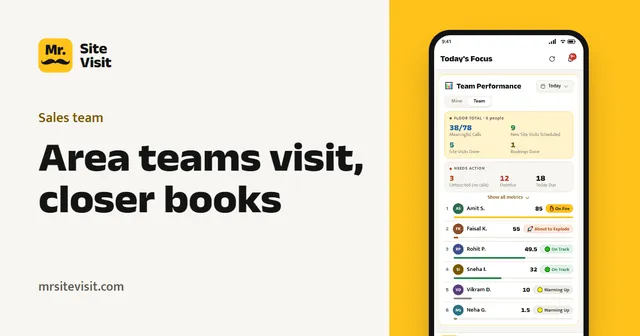
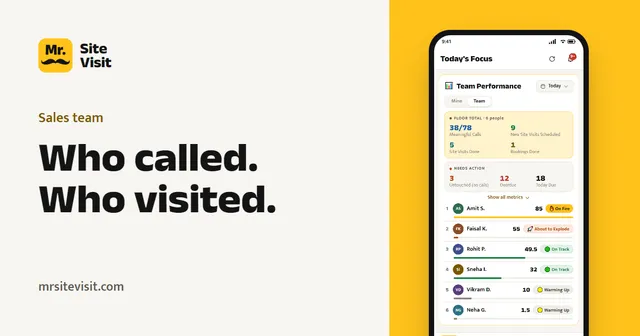
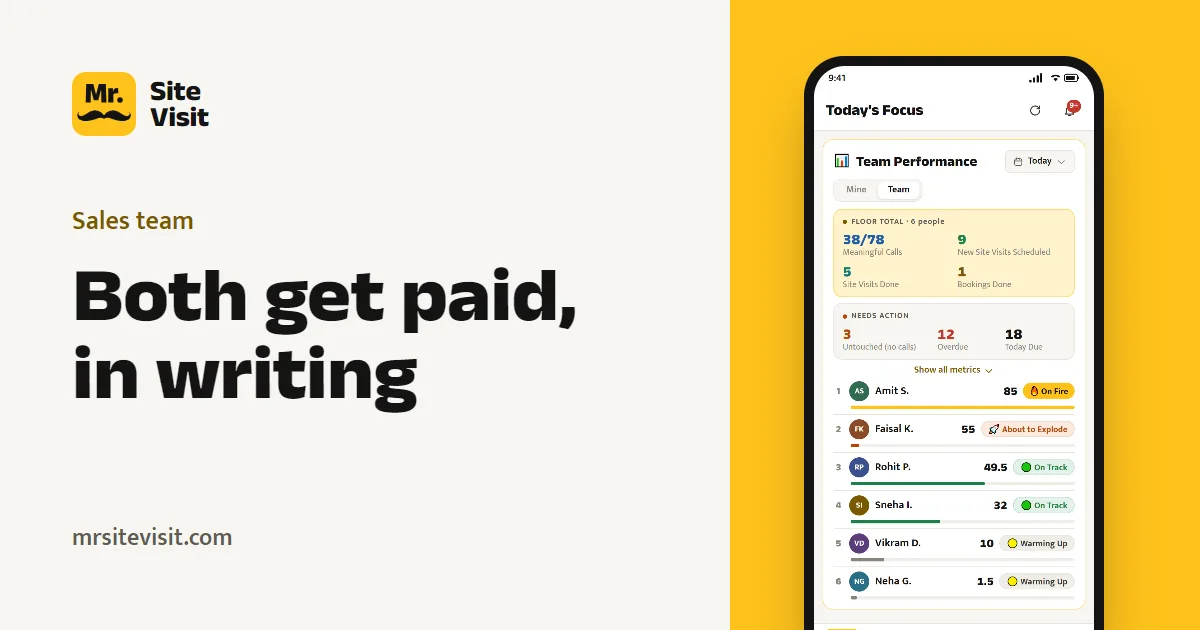
Move a lead to the closing manager, and its calls and notes go with it. So the record shows who ran the first visit. The team view shows each person’s meaningful calls, visits and bookings. On the Growth plan, each visit is stamped with time and GPS at its start and end. That shows where the phone was, not that the buyer came.
Growth is ₹548 a user a month, billed yearly, from three users, with no GST on top. There’s a 7-day money-back, and no free trial. See the plans and prices, or how it works for channel partner firms.
Whatever you use, write the page this week. Read it out with your team, and ask for one “agreed” from each person.
Questions teams ask
How should a CP firm split incentive between the salesperson and the closing manager?
Pay both. The salesperson or area team that ran the visit keeps its usual share of every booking that came from it. The closing manager gets an extra share on top, paid from the firm’s side, not taken from the salesperson. Write the split down before the first handover.
When should real estate sales incentives be paid?
Monthly, once the developer has paid your brokerage, so you never pay out money you haven’t received. If the brokerage takes months to arrive, pay half on booking and half on receipt. Tell the team the expected payment dates, so a delay doesn’t feel like a broken promise.
What happens to the incentive if a booking is cancelled?
Decide it in writing before it happens. The simplest rule: incentive is earned when the brokerage is received, so a cancelled booking pays nothing. If you pay half on booking, say whether that half is taken back from the next month’s incentive.
Should I cap my salespeople’s incentives?
No. Researcher Thomas Steenburgh argues, in a summary on the Darden School site, that capping commission makes top performers call it quits once they hit their target. His study supports paying a higher rate after the target instead. So use slabs, and let your best people keep going.