The CP firm team structure that turns visits into bookings
By Jayesh G, Founder · 13 min read. Published 26 October 2026.
In short
- For a team of 7 under the owner: 6 people in area teams of 2–3, one per micro-location, each selling at most 5 projects, and 1 closing manager.
- Area teams find buyers and run site visits. The closing manager takes every serious visited buyer to booking, working with the developer’s team on units and price.
- Each closing push takes 30–45 minutes, in my experience. That’s time a salesperson with tomorrow’s visits can’t give, so small firms do good visits and lose bookings.
On this page
- Small CP firms lose bookings after the visit, not before it
- The 7-person structure: two area teams, one closer
- An area team is 2–3 people on one micro-location, with 5 projects at most
- The closing manager’s job starts when the visit ends
- One person can’t do the visits and the closing
- The handover happens within a day of the visit
- Measure and pay each role on its own number
- Which team are you?
- The closer can become a bottleneck, and some firms shouldn’t bother
- What I’d check this week
- Where software helps, and what we built
- Questions teams ask
Small CP (channel partner) firms are good at site visits. They lose the business in the week after. You’ve probably watched it happen.
A family likes the flat on the visit. Now they want a price answer, a unit kept for them and a revisit with the parents. Your salesperson is already on the next visit. By the time anyone calls the developer, someone else has booked them.
You can’t fix that with more visits. You fix it with structure. Split your salespeople into small area teams, one per micro-location (a cluster of projects a buyer would compare on one drive). Give each area team a short list of projects. Then make one person the closing manager, who takes every serious visited buyer to booking.
The simple rule Area teams bring the visit. The closing manager brings the booking.
It’s the structure I recommend to CP firm owners, from years on the ground with sales teams. I haven’t measured it across firms, so treat it as a plan to test for a month. I won’t tell you to hire more people. I’ll show you the split, and the maths behind it.
Small CP firms lose bookings after the visit, not before it
In the firms I’ve worked with, the deal is usually lost in the days after a good visit. Your team does the visit well. The follow-through needs time nobody has.
After a visit, your serious buyer has questions only the developer’s side can answer. Is the 2 BHK on a higher floor still available? Can the price move if they book this week? Will the developer hold the unit until Sunday’s revisit with the parents?
Each of those is a round of calls. You call the developer’s sales manager, then the buyer, then the sales manager again. In my experience, one closing push like that takes 30–45 minutes. A salesperson with three visits tomorrow can’t give it to five buyers.
So who chases the visited buyer in your firm today? Usually whoever ran the visit, in a free minute, or you, late at night. The two kinds of work pull in different directions:
Before the visit: speed
- Call new leads within the hour
- Pitch the right project in the area
- Confirm the visit and the pickup
- Run the visit on site
After the visit: time
- Check live units with the developer
- Get the price and offer approved
- Plan the revisit with the family
- Negotiate and collect the booking
The general sales world learned the same lesson. One well-known method, Aaron Ross’s Predictable Revenue, splits finding buyers and closing them into separate roles, as an 11x guide summarises it (August 2026). Salesforce describes the same split: one person finds and qualifies buyers, then books the meeting for the person who closes.
The 7-person structure: two area teams, one closer
Here’s the 7-person split on one page, with you as the owner above it:
| Role | People | What they own | Measured on |
|---|---|---|---|
| Owner | 1 (outside the 7) | Developer relationships, cash, hiring | Bookings and brokerage collected |
| Closing manager | 1 | Every serious visited buyer, until booking or a clear no | Visit-to-booking |
| Area team A | 3 | Micro-location A, up to 5 projects | Calls of 2 minutes or more, visits done |
| Area team B | 3 | Micro-location B, up to 5 projects | Calls of 2 minutes or more, visits done |
Three area teams of two work too, if you sell in three areas. In my view, an area team of one breaks down on the first weekend someone’s on leave.
In Maharashtra, check the paperwork too. MahaRERA (the state’s real-estate regulator) requires staff who deal with buyers to be trained and certified, under its agent training guidelines. Our guide to competency certificates for CP staff covers who needs one.
An area team is 2–3 people on one micro-location, with 5 projects at most
An area team sells one area, not one project. So a buyer who doesn’t fit one project stays with your firm. A lead that doesn’t fit one project often fits another nearby, if someone knows the area.
Say your buyer came for a project in Wakad, and its 2 BHK is above their budget. An area team that sells five Wakad projects has the next option ready on the same drive. A salesperson who knows only one project loses your buyer to whoever knows the area.
Why 5 projects at most? Because your area team has to know each one by heart, from the price sheet to which towers still have units. Past five, the pitch gets thin and the facts get mixed up.
When a lead doesn’t fit, the area team decides fast:
| If… | Then… |
|---|---|
| The budget is below this project’s range | Pitch the area team’s lower-priced project in the same area |
| They want a bigger home or a ready unit | Pitch the area team’s project that has it |
| They want a different area | Hand the lead to the area team that sells that area, the same day |
| Nothing in your list fits | Mark it lost with the reason, so the owner sees the gap |
Three people cover your Saturday rush. One can be on site while another works the phone. Two is the minimum.
The closing manager’s job starts when the visit ends
The closing manager takes over every serious buyer after their first visit. Their job ends with a booking or a clear no.
What counts as serious? My rule of thumb: the buyer liked a unit, the budget fits, and you know who decides. The salesperson who ran the visit marks it. If the closer disagrees, the lead goes back to the area team with a note, and you settle any dispute at Monday’s review.
- Closing manager
- The person in a CP firm who turns visited buyers into bookings. They work out units and price with the developer’s team, then negotiate with the buyer.
Their day looks nothing like a salesperson’s. Here’s what fills it:
- Check live units and holds (units kept aside for a buyer) with the developer’s sales team
- Get price, offer and payment plan approved before the buyer asks twice
- Book the revisit with the decision makers, often the parents
- Negotiate, and know when to walk away
- Collect the booking amount, the form and the ID documents
- Register the buyer with the developer before every visit, so your brokerage (your commission on the sale) is safe
Pick someone your developers’ teams treat as an equal. In most firms, that’s your most experienced salesperson, or a team leader who already closes the hard deals. No one fits yet? Run the role yourself for a month, or give it to your senior salesperson on trial, before you hire. Then introduce the closer to each developer’s sales manager in person, so the calls about holds and price get answered.
What if the developer’s own team has already met your buyer on site? The closer works with them, not around them. Your registration of the buyer with the developer decides whose buyer it is; our guide to CP tagging disputes covers what to do when that’s argued.
One person can’t do the visits and the closing
The time maths shows why. Every job you add to a salesperson comes out of selling time.
In its 2022 survey of sales professionals worldwide, Salesforce found reps spend just 28% of their week actually selling. That’s global sales data, not real estate. On a CP floor the cause is the same: add the developer calls and the negotiation, and the next lead waits.
Here’s an illustrative week for the structure above. The figures are an example, not measured data:
Spread across six salespeople, those same hours look small: 1.5–3 hours each. But they never arrive as a neat block. They come as interruptions in the middle of new-lead calls and visit confirmations, so they get pushed to tomorrow.
| Who does the push | The push | What waits |
|---|---|---|
| The salesperson who ran the visit | Squeezed between calls and visits | New leads, or the visited buyer |
| The owner | At night, for the buyers they remember | Developer meetings, hiring |
| One closing manager | Planned into the day, every buyer | Nothing new: it’s their whole job |
Isn’t it cheaper to just hire another salesperson? Only if your problem is too few visits. If visits are fine and bookings lag, a seventh person running visits adds more buyers to the same leaky step.
The handover happens within a day of the visit
A handover only works if it’s fast and written down. A buyer who waits days for an answer has time to visit other projects. Our post on pre-sales teams covers the first-call side of that handover.
- Same evening The salesperson who ran the visit writes the visit notes: the budget and the unit they liked. Add what worried them, and who decides.
- Next morning The closing manager reads the notes and calls the developer’s team for units and price.
- Next morning, after the developer call The closing manager calls the buyer, with that salesperson’s name in the first line.
- Within the week The revisit, the negotiation, and a booking or a clear reason it didn’t happen.
That salesperson stays on the lead as its source. They’re the face the buyer met, and they come to the revisit if the buyer asks.
Measure and pay each role on its own number
Give each role the number it controls. Area teams control calls and visits; the closer controls what happens after.
- Area teams: meaningful calls (connected calls of 2 minutes or more), visits done, and visits handed over with notes. Our post on tracking your sales team shows how to count them from the phone.
- Closing manager: visit-to-booking, and days from first visit to booking.
- The owner: bookings, and brokerage collected.
The strongest objection comes from your own team. Won’t your salespeople keep buyers to themselves to protect their incentive? They will, if the closer takes it. So pay the area team on every booking that came from its visit, and pay the closer on top. Agree the split in writing before you start.
Here’s an example with illustrative numbers. Say you pay a salesperson 10% of the brokerage on each booking today. Keep that share for the area team, exactly as now.
Then pay the closer 5% from your own share, plus their salary. Your margin per booking drops a little. Does it pay back? Here’s the same example worked through, with every figure illustrative:
| Example figure | Amount |
|---|---|
| Brokerage on one booking | ₹2,00,000 |
| Area team’s share (10%) | ₹20,000 |
| Closer’s share (5%) | ₹10,000 |
| Left with the firm per booking | ₹1,70,000 |
| Closer’s monthly salary | ₹50,000 |
In this example, one extra booking a month more than pays for the closer. Put your own brokerage and salary in, and the month’s test shows whether the extra booking comes.
Write the split down first If the area team loses its incentive when it hands over a buyer, buyers stop being handed over.
Which team are you?
This structure is for a team of about 6–10. Smaller and bigger firms adapt it:
| Your team | What fits |
|---|---|
| 3–5 people, the owner sells | One area team. The owner is the closing manager, with an hour a day kept for visited buyers |
| 6–10 people | The structure here: 2–3 area teams and one closing manager |
| 10–20 people | One closing manager for every two area teams, plus a manager over the area teams |
| A mandate company or developer team | The same split, often called sourcing and closing managers |
The closer can become a bottleneck, and some firms shouldn’t bother
The closer can become a bottleneck. If your closer handles 24 buyers in a busy week, some will wait. Watch the days from visit to first closing call, and add a second closer before that number grows.
How will you know the closer isn’t sitting on a buyer? Every Monday, list the visited buyers with the days since their last call. Anyone past three days gets a reason, or a call that morning.
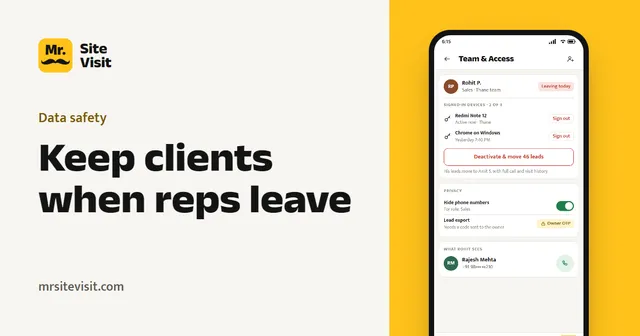
The closer can also leave, and take the hottest buyers in their head. Keep every buyer, call and note in the firm’s account, not on a personal phone. Our guide to salespeople leaving with clients covers the handover.
Who shouldn’t bother? A firm that sells one project, or a team of three where the owner already closes every deal. You’re already running this structure, just with fewer people.
What I’d check this week
You can test this without any software. Take a sheet and the last 30 days:
- Count the visited buyers, and how many booked
- For each who didn’t, note who followed up, and how many days later
- List the projects each person pitches, and circle anyone above five
- Group your leads by micro-location, and draw the area teams
- Name your closing manager, and agree the incentive split
If the second check shows visited buyers waiting days for a call, you’ve found where the bookings go.
Where software helps, and what we built
The structure only works if the handover really happens. A tool that moves the lead with its calls and notes makes that easy to check.
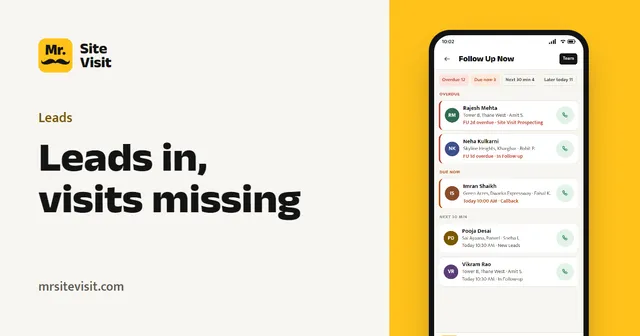
That’s the job we built Mr. Site Visit for. Leads from 99acres, Housing.com, MagicBricks, Meta and your website are routed by project, source or area, so each one lands with the right area team. If nobody calls in time, it moves to the next person; you set the time, and the default is 2 hours.
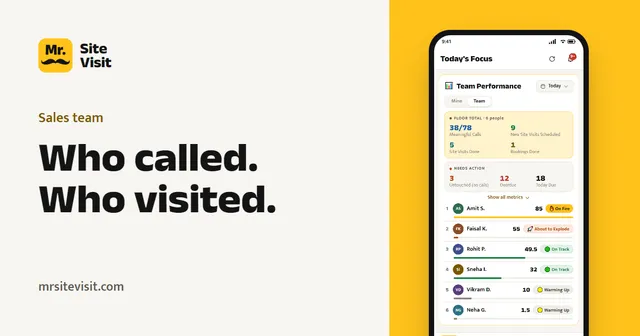
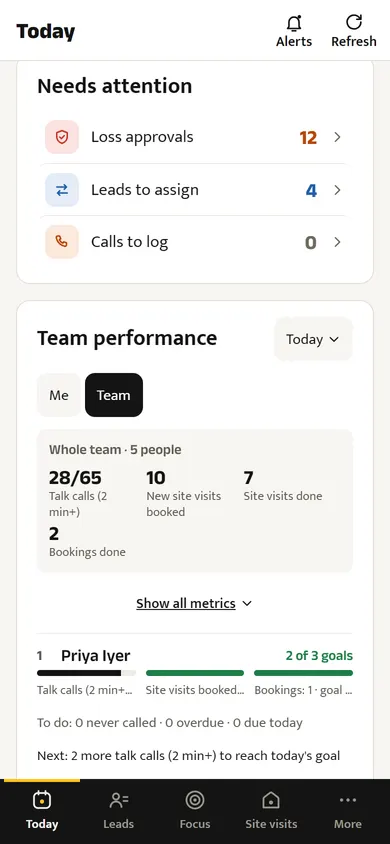
When a buyer has visited, you move the lead to the closing manager with its calls and notes attached. On Android, calls are matched from the phone’s call log and marked Verified. The team view shows each person’s numbers side by side:
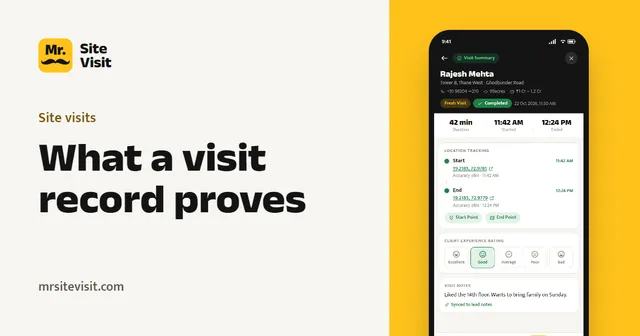
On the Growth plan, each visit is stamped with time and GPS at its start and end. That shows where the phone was, not that the buyer came.
The honest limit: calls are logged on Android only, so iPhone calls aren’t counted. Starter is ₹423 a user a month and Growth is ₹548, billed yearly, from three users, with no GST on top. There’s a 7-day money-back, and no free trial. See the plans and prices, or how it works for CP firms.
Whatever you use, start this week. Name your closing manager and run it for a month. Then compare visit-to-booking with last month, together with your team.
Questions teams ask
What is the best team structure for a real estate channel partner firm?
For about 7 people under the owner, split by area and by stage. Put 6 people in area teams of 2–3, each area team on one micro-location with at most 5 projects. Add 1 closing manager who takes every serious visited buyer to booking. Area teams bring the visit; the closing manager brings the booking.
What does a closing manager do in a CP firm?
The closing manager takes over a buyer after the site visit. They check live inventory and price with the developer’s sales team, plan the revisit with the family, negotiate, and collect the booking amount and documents. They’re measured on visit-to-booking, not on visits.
How many projects should one real estate salesperson pitch?
Keep an area team to 5 projects at most, inside one micro-location. That’s few enough to know every price sheet, offer and available unit by heart. It’s also enough to cross-sell when a buyer’s budget or layout doesn’t fit the first project.
Won’t salespeople refuse to hand buyers to a closer?
They will if the closer takes their incentive. So pay the area team on every booking that came from its visit, and pay the closer on top for the booking. Write the split down before you start, and the handover becomes the area team’s fastest way to earn.
When does a CP firm need a separate closing manager?
When visits are good but bookings lag, and the owner can’t chase every visited buyer personally anymore. With 3–5 people, the owner is the closer. In my judgement, from about 6 people, or once visited buyers wait more than a day for a call, give the job to one person.
Sources
- Salesforce, State of Sales research (5th edition), 8 December 2022: reps spend 28% of their week actually selling; 7,775 responses from 38 countries
- 11x, the Aaron Ross (Predictable Revenue) sales method: revenue work split into specialised roles (1 August 2026)
- Salesforce blog, what a sales development rep does: top-of-funnel work, then a booked meeting for the rep who closes (28 June 2024)
- TaxGuru, MahaRERA guidelines on training and certification of real estate agents and their staff (issued under Order No. 41 of 2023 dated 10 January 2023)