MahaRERA turned down an agent's brokerage claim. Put yours in writing.
By Jayesh G, Founder · 9 min read. Published 26 October 2026.
In short
- In an order reported on 30 May 2026, MahaRERA said one agent's brokerage dispute with a developer was a civil matter, outside RERA.
- So protect the brokerage before the visit: signed terms, the buyer registered with the developer, and a record of the visit.
- Ask for your fee in the agreement for sale (Clause 15A), and keep any promise you make a buyer: MahaRERA enforced one, uncontested, in August 2026.
On this page
- MahaRERA called one brokerage claim a civil matter
- The agent produced no written brokerage agreement
- Put five things in writing before the visit
- Ask for your fee in the agreement for sale
- Keep an evidence file for every booking
- Keep any promise you make a buyer
- If your brokerage is stuck right now
- “Developers won’t sign that”
- Which side are you?
- What a CRM keeps, and what it doesn’t
- Questions teams ask
In an order reported in May 2026, MahaRERA (Maharashtra’s real-estate regulator) called one agent’s unpaid brokerage (their commission on a sale) a civil matter, outside its powers. So if you were counting on a complaint there to get your money, you may need another plan.
It often starts after a good visit. The buyer books, and then the developer’s CP desk (the channel partner desk) says the buyer “came direct”, or came through someone else. Your proof? One WhatsApp chat on one salesperson’s phone.
I’m not a lawyer, and this isn’t legal advice. Here’s what MahaRERA said in one reported 2026 case, and what to put in writing so your next booking doesn’t end the same way.
In that Maharashtra case, the brokerage claim was left to the civil courts. Other states have their own RERA authorities. Either way, protect it before the visit, with signed terms, a registered buyer and a visit record. Is it simply late, not disputed? Our guide to late brokerage payments helps. It has a payout tracker.
My rule, not legal advice Signed terms, a registered buyer and a visit record, before the visit. Without them, your claim rests on memory.
MahaRERA called one brokerage claim a civil matter
MahaRERA dismissed a registered agent’s brokerage claim against a developer. The order was reported on 30 May 2026.
The agent had asked MahaRERA to make a developer pay brokerage on a sale in a Mumbai project. The authority said commission disputes “do not fall within its jurisdiction” (its power to decide). They need civil remedies, meaning a normal court or forum, as PropTech Pulse reported. The report doesn’t give the order’s date or number. That’s one order under the RERA Act (the 2016 law that regulates real estate), on its own facts.
My honest view: one order isn’t a rule, but I’d ask a lawyer before counting on a RERA complaint for brokerage.
The agent produced no written brokerage agreement
MahaRERA dismissed the complaint on jurisdiction. The report also notes what the agent hadn’t produced:
- No written brokerage agreement produced
- A claim built on early meetings and “verbal understandings”
The developer said the agent took no part in the final deal for that unit, and that the buyers reached it through a different source. With nothing on paper, the agent’s word was set against the developer’s. Does that sound like a conversation you’ve had at a CP desk? In my view, a dated email carries more weight at a CP desk than a long chat.
Put five things in writing before the visit
Protect a brokerage before the buyer reaches the site. After the booking, it’s much harder.
Your agreement with the developer is often called the empanelment or CP agreement (empanelment means the developer has formally listed you as a partner). Does yours cover these five? Ask for it per project, signed. And check with your accountant how tax applies to your brokerage invoice:
- Rate: the brokerage rate or slab (the rate by price band) for this project
- Due date: on agreement, at a payment stage, or on registration
- Ownership: how a buyer becomes yours, usually buyer registration before the visit, acknowledged by the developer
- Duration and ties: how long that lasts, and the rule if two partners claim one buyer
- Cancellation: what happens to brokerage if the booking is cancelled
Buyer registration matters most. Before every visit, send the buyer’s details to the developer’s CP desk, in their format. Keep their reply; a dated email is better than a chat. No reply? Send it again in writing, and note the date. Our guide to settling CP tagging disputes covers tie rules and how long a tag should last.
Ask for your fee in the agreement for sale
MahaRERA’s model agreement for sale (the main sale contract) has a clause for a registered agent’s fee. Ask for it to be filled in.
MahaRERA added Clause 15A to its model agreement for sale in October 2024. It came through Orders 62 and 63 of 2024, as LiveLaw reported. When a registered agent facilitates the sale, it records the agreed fee or commission, including taxes. It also says who pays: the developer, the buyer, or both.
- Clause 15A
- A clause in MahaRERA’s model agreement for sale that records a RERA-registered agent’s agreed fee, including taxes, and who pays it.
The report doesn’t say whether developers must fill it in. And it’s for a RERA-registered agent, so keep your own registration current. Are your name and fee in the signed agreement? Then the sale contract itself shows you facilitated it. Ask at the time of booking.
Keep an evidence file for every booking
One file per booking can help settle arguments, because it shows who did what, and when.
Keep these in a firm account, not on one salesperson’s phone:
| What | Why it matters |
|---|---|
| Signed brokerage terms for the project | Sets the rate and when it’s due |
| Buyer registration sent to the developer, with their reply | Shows the buyer was yours, and from when |
| Visit record: date, time, place, who attended | Your own record that you brought them, though a developer may still question it |
| Your RERA agent registration number, current | Clause 15A is for a registered agent, and a developer may ask for it |
| Messages with the buyer after the visit | Shows you worked the deal, not just the introduction |
| The agreement for sale, with Clause 15A filled in | Puts your fee in the sale itself |
| Your invoice and the developer’s payment record | Shows what’s paid and what’s pending |
Build it as you go. In my view, a file put together after a dispute starts is thinner than one kept from the first call.
Keep any promise you make a buyer
In one 2026 order the agent didn’t contest, a promise to pass on part of a commission was enforced against him. And the amount was worked out on the sale price, not on his fee; the report doesn’t explain why.
Take an order dated 5 August 2026. MahaRERA made an agent pay a buyer 1% of the sale price (the sale consideration), before taxes and charges. The buyer had bought an apartment in Kandivali East.
Before the agreement was signed, he’d emailed the buyer that he’d pass on 1% of his commission. He didn’t pay.
He also didn’t respond to the complaint, so MahaRERA decided it without his side (ex parte, per the report). It called the broken promise an unfair trade practice. That means a misleading or unfair promise to a buyer. It cited Section 10(c) of the RERA Act. PropTech Pulse reported the order on 20 August 2026.
Careful with offers In that uncontested case, a promise of 1% of commission became an order to pay 1% of the sale price.
Does your team offer buyers anything from the brokerage? Put the owner’s approval on it first, in writing. Then honour it in full.
If your brokerage is stuck right now
Start by collecting what you have, before you send angry messages.
- Gather the file Terms, buyer registration, visit record, messages, invoice. Note any gaps.
- Write to the developer One calm email with the dates and documents, asking for a payment date.
- Ask the CP desk head for a meeting Bring the file; some disputes can be settled here.
- Talk to a lawyer Ask three things: which forum fits, any time limit, and the likely cost against the amount.
Your lawyer may talk about a legal notice (a formal letter demanding payment), a civil suit (a case in a regular court), or arbitration (a private hearing, only if your CP agreement provides for it). I can’t give you a cost range. Weigh the lawyer’s estimate against the brokerage at stake.
“Developers won’t sign that”
The fair objection: “Big developers send their own CP agreement. A small firm can’t rewrite it.”
That’s often true. You may not change their template. But you can read it for the five points above. Ask in writing about any that’s missing, and keep the reply. And you can always register every buyer before the visit and keep the acknowledgement. That costs you a few minutes per buyer.
What I’d tell an owner: some developers won’t put the rate or the registration rule in writing at all. Then at least you know the risk. Decide before you spend time on that project.
Which side are you?
The same file helps both sides of the desk:
| If you are… | Then… |
|---|---|
| A CP firm of 3 to 6 people | Keep one evidence folder per booking in a shared drive; the owner checks it before each invoice |
| A CP firm of 7 to 20 with a sales head | Make buyer registration before the visit a rule for everyone, and check it in the Monday review |
| A mandate company (hired by a developer to sell a project) | Give every outside partner the same written registration rule, and answer each registration in writing |
| A developer’s CP desk | Acknowledge every registration with its date, so disputes are settled by the record, not by memory; see settling tagging disputes |
A firm of 3 or 4 can run all of this on a shared drive and one rule. You don’t need software for it.
What a CRM keeps, and what it doesn’t
A CRM (the software your team logs leads, calls and visits in) helps when records are scattered. The visit time sits in one phone. The developer’s reply sits in another’s WhatsApp.
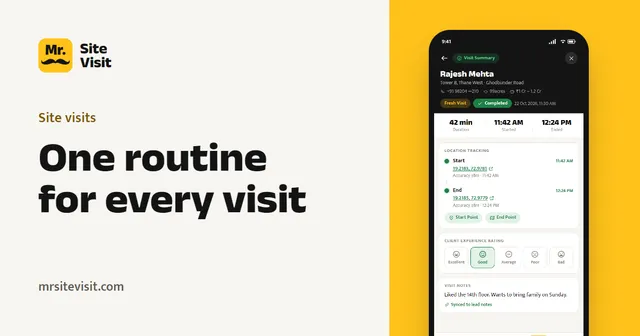
We built Mr. Site Visit, a CRM for real-estate teams of 3 or more. On Growth and Developer, each visit records its time, GPS location and accuracy. That’s at the start and the end, on the salesperson’s Android phone. It’s a record, not proof: the location isn’t checked against the site. Every lead and its history stay in the firm’s account when someone leaves.
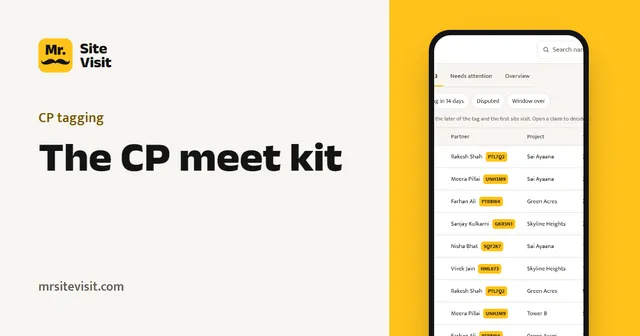
Partner tagging is on the Developer plan only. Each partner-brought buyer is tagged with the partner’s code and a tagging window. Claims go to a dispute queue. We don’t track brokerage invoices or payouts. Partners don’t get a portal either. Keep those in your accounts folder.
Growth is ₹548 a user a month and Developer ₹1,298, billed yearly, from 3 users, with no GST on top. See how site visit records work, or the plans and prices.
This week, check your three biggest CP agreements against the five points above. Then start “registered before the visit” as a rule for your whole team from Saturday.
Questions teams ask
Can a real estate agent file a MahaRERA complaint for unpaid brokerage?
In one order reported on 30 May 2026, MahaRERA didn’t take up an agent’s brokerage claim against a developer. It said commission disputes fall outside the RERA Act and need civil remedies, and noted that no written brokerage agreement was produced. Whether your case is different is a question for a lawyer.
What should a channel partner’s brokerage agreement with a developer say?
Five things. The brokerage rate or slab for the project. When it’s due: on agreement, at a payment stage, or on registration. How a buyer becomes yours, usually buyer registration before the visit, acknowledged by the developer. How long that lasts, and the tie rule. And what happens if the booking is cancelled.
What is Clause 15A in MahaRERA’s agreement for sale?
MahaRERA added Clause 15A to its model agreement for sale in October 2024. It’s for when a RERA-registered agent facilitates a sale. It records the agent’s agreed fee or commission, including taxes, and who pays: the developer, the buyer or both. That puts your fee inside the sale contract itself.
Can I promise a buyer a cashback from my brokerage?
Only if you’ll honour it in full. In an order dated 5 August 2026, MahaRERA made an agent pay a buyer 1% of the sale consideration, excluding taxes and charges. He’d promised by email to pass on 1% of his commission. MahaRERA called the broken promise an unfair trade practice under Section 10(c).
How do I prove a buyer came through my firm?
Register the buyer with the developer before the visit and keep the acknowledgement, ideally a dated email. Keep a record of the visit with its date and time, and your messages with the buyer. One file per booking, kept in a firm account, can help settle arguments.
Sources
- PropTech Pulse, Can agents file brokerage complaints before MahaRERA? Order explained (30 May 2026)
- LiveLaw, MahaRERA order on the real estate agent fee clause in agreements for sale, Orders 62 and 63 of 2024 (2 November 2024)
- PropTech Pulse, MahaRERA orders broker to share 1 percent brokerage with homebuyer (20 August 2026; order dated 5 August 2026)