Your buyer went direct to the builder. Why it happens, and what to do
By Jayesh G, Founder · 10 min read. Published 12 November 2026.
In short
- In my experience, many buyers who go around their broker aren’t crooks. They’re afraid of paying more, or of being tied to one broker.
- In most new projects, your brokerage comes from the developer under your CP agreement, not as an extra bill to the buyer. Many buyers don’t know that. Tell them at the first call.
- Ask where else they’ve enquired, register them before the visit, and keep the acknowledgement. When it happens anyway, your record and your written agreement decide the money.
On this page
- Many buyers go direct out of fear
- In a new project, the developer pays you
- Five ways a buyer slips past you
- The register decides who brought the buyer
- Say it at the first call
- When it happens anyway
- Which firm are you?
- “If I say the developer pays me, they’ll ask for a discount”
- What I’d check this week
- Where software helps
- Questions teams ask
It’s a line many owners have heard at the developer’s desk: “No, sir. I came directly. Nobody brought me.” Have you heard it too?
You had shown him the floor plan. You booked his site visit and answered his calls for weeks. Then, at the booking desk, nobody had brought him.
From what I’ve seen on sales floors, many buyers who go around their broker aren’t crooks. They’re afraid of paying more, or of being tied to one broker. That changes the fix. Rules on tagging protect you when a dispute starts. Tell the buyer what you cost them at the first call. That stops many disputes from starting.
The simple rule Tell the buyer at the first call what you cost them. A buyer who thinks you add to the price will find a way around you.
Many buyers go direct out of fear
In my experience, a buyer usually goes around a broker to protect their money, not to cheat the broker. Look at it from their side of the table.
They’re spending the biggest sum of their life. Many have heard stories of brokers adding to a price. A relative may say walking in alone gets a better deal. So when they reach the booking desk, “I came direct” sounds like the safe answer.
Here are the reasons buyers give, and what each one needs from you:
| What the buyer believes | What it needs from you |
|---|---|
| “The broker’s fee is inside my price” | Tell them who pays you, before the visit |
| “Direct buyers get a discount” | Ask the developer in writing whether the price is the same through you |
| “If I register with one broker, I’m stuck” | Tell them the registration period the developer gave you in writing, and that it only decides credit, not where they buy |
| “My cousin knows someone at the developer” | Ask at the first call who else is helping them |
| “I enquired on a portal first, so I’m already theirs” | Ask where else they’ve enquired, and note it |
You can answer most of this fear before the visit.
In a new project, the developer pays you
In most new projects, your brokerage comes from the developer, under your CP agreement with it. You don’t send the buyer a bill.
Some buyers don’t know this. They assume a broker in the middle means a higher price. The developer may build its sales costs into its prices. So “it’s in my price” isn’t entirely wrong. What the buyer needs to know is simpler: is the price the same with you or without you?
- Price parity
- The developer charging a buyer the same price whether they come through a channel partner or walk in directly.
Don’t promise parity on a developer’s behalf. Ask its CP desk to put it in writing for each project. (The CP desk is the developer’s team that registers and pays channel partners.) If a developer won’t confirm it in writing, you can’t promise it to a buyer.
Five ways a buyer slips past you
In my experience, “direct” buyers usually take one of five routes. Each leaves a sign you can spot early.
| Route | The sign | What to do |
|---|---|---|
| Says “I came direct” at booking | The buyer goes quiet after the visit | Register before the visit, and get it acknowledged |
| Comes back through another referrer | A relative or friend “knows someone” | Ask at the first call who else is helping |
| Enquired on a portal first | They already know the project well | Ask where they enquired; tell the CP desk when you register |
| Visits again alone | “We just want to see it once more” | Offer to come; log every visit you do |
| Books a different unit type | They switch from 3 BHK to 4 BHK | Register the buyer for the project, not one unit |
The portal route causes many arguments. Is the buyer’s number already in the developer’s system from a portal enquiry? Then ask the CP desk in writing, before the visit. If it won’t accept your registration, decide before Saturday whether that buyer is worth your team’s time.
The last route matters more than it looks. GeoSquare reported a case in May 2026, about a 4 BHK in Santacruz West. The developer argued that introducing a buyer for a different flat type didn’t earn brokerage on the one they booked.
The register decides who brought the buyer
When a buyer’s story and yours don’t match, the developer’s record usually decides. So the record has to show you first. An acknowledgement is the developer’s written or WhatsApp confirmation that you registered the buyer.
That same case shows how; GeoSquare covered it in two reports on 29 May 2026. The agent said he’d shared a floor plan with the buyers in September 2025. The developer said their first site visit was on 17 September 2025, with another referrer, recorded in its member referral register.
MahaRERA (Maharashtra’s real-estate regulator) rejected the agent’s complaint in an order dated 24 May 2026. It found no written brokerage agreement, and called the dispute a civil matter. The agent was left free to go to a civil court.
Some developers write this into their own rules. One, Casagrand, says on its CP page that when the buyer’s primary source (the first one on its record) is found with another source or channel partner, the secondary source gets no credit. Its page also says its decision is final. When we checked it on 12 November 2026, it didn’t define “primary”. So ask each developer what it means. My reading: the question is always whose entry came first, and whether they can show it.
Our post on settling “who brought this buyer?” fights has the four rules for that record.
Say it at the first call
Most of this is fixed in one conversation, before anyone visits the site. Ask three questions, then say one thing.
- Ask where else they’ve enquired. “Have you looked at this project on any website or with anyone else?” Note it before you register them.
- Ask who else is helping. “Is anyone else helping you, a relative or another broker?”
- Ask who decides. “Who else will be part of the decision?” If the family visits again without you, you want to know first.
- Then say it. You cost them nothing extra, once the developer has confirmed it.
Here’s a message you can send after that call. Use it only once the developer has confirmed price parity in writing. Send it on WhatsApp, so you keep a dated copy.
When it happens anyway
Some buyers will still go around you. What then? Act within days, calmly, and on record.
- Find your registration, with its date and the developer’s acknowledgement
- Ask the CP desk, in writing, for its record of the buyer’s first visit
- Send your claim in writing, with both records attached
- Read your agreement: in that May 2026 order, the claim turned on whether one existed
- If two firms registered the same buyer, ask the CP desk which entry is dated first
- Stay polite with the buyer; they may still refer a friend
If the CP desk won’t move, take it to the developer’s sales head, in writing. A civil claim costs time and money, so weigh it against the brokerage at stake and the relationship. Decide that with a lawyer; this post isn’t legal advice.
And if one developer keeps doing this, my honest view: move your team’s Saturdays to projects that pay what they promise. Our post on unpaid brokerage and MahaRERA explains why a written agreement matters before the first visit. For what to put in the registration itself, see our channel partner registration format.
Which firm are you?
The fix is the same everywhere. Where it breaks depends on your size.
- 3–6 people, owner selling. You probably register buyers yourself. Make the first-call script a habit before you hire.
- 7–20 people. Juniors book visits without registering first. Make it a rule: no site visit until the buyer is registered.
- Firms selling one developer’s launch. Agree the tagging window and the parity question with the CP desk before your team makes a single call.
“If I say the developer pays me, they’ll ask for a discount”
Some will. It’s a fair worry, so decide your answer before the buyer asks.
Check first whether your CP agreement allows passing any brokerage to a buyer. Some developers don’t allow it. Ask the CP desk before you offer anything, and get the answer in writing. After that, it’s your call. My honest answer: I wouldn’t share brokerage by default. Explain the service first: the shortlist, the visits, the negotiation help. Share only if it saves a booking you’d otherwise lose. Either way, a buyer who knows the truth is far less likely to go around you.
What I’d check this week
None of this needs software. A lead sheet and your last three disputes are enough.
- Look at your last three “came direct” cases: which of the five routes was it?
- Check how many site visits last month had a registration acknowledged before the visit; if it wasn’t every one, make it your rule from Monday
- Ask each developer’s CP desk, in writing, whether the price is the same through you
- Add the three first-call questions to your team’s call script
Where software helps
No app can stop a buyer from saying “I came direct”. It can make your record clear, dated and quick to share.
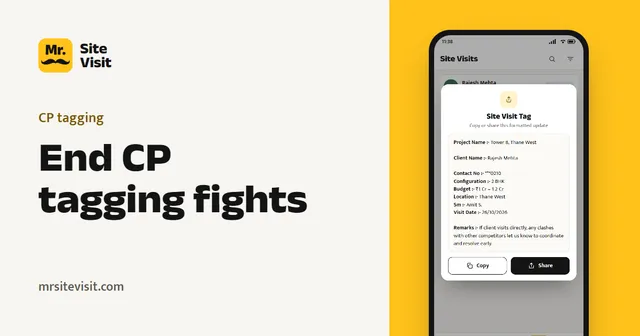
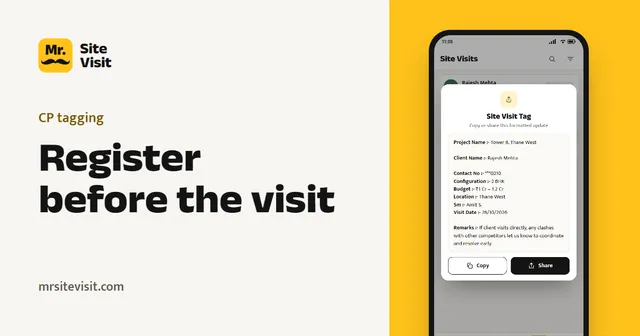
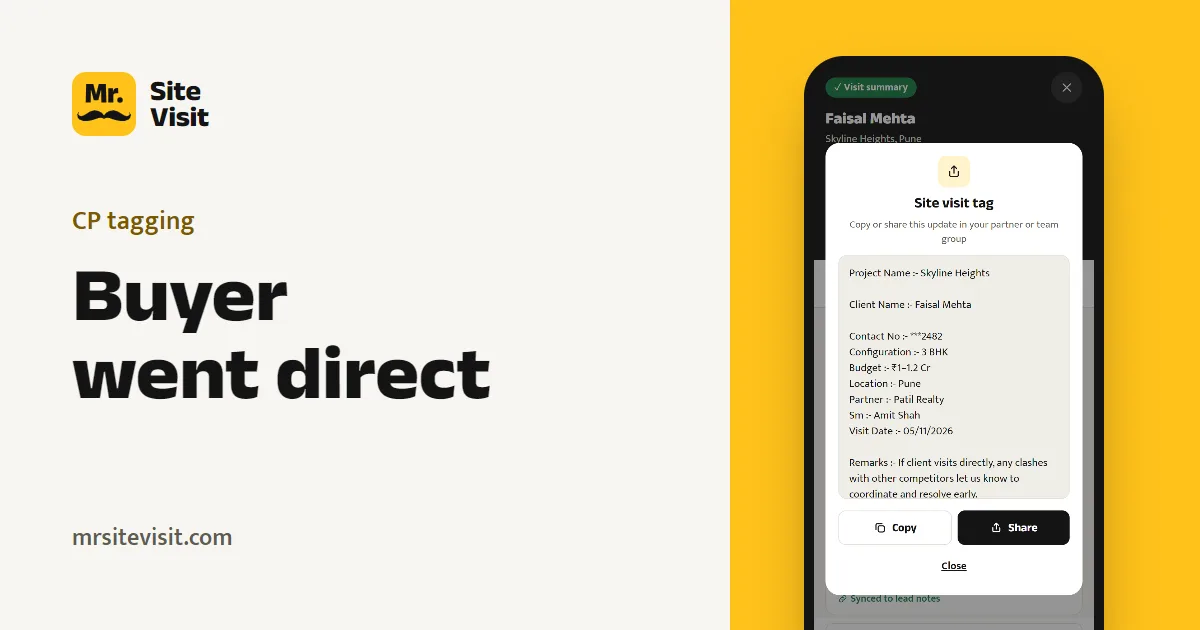
In Mr. Site Visit, scheduling a visit creates a Site Visit Tag. It’s a formatted message with the buyer’s number masked, ready to send to the developer’s group.
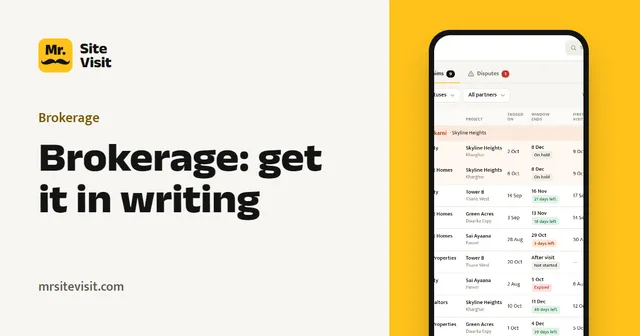
The visit itself is stamped with GPS and time at its start and end. That’s a record of where your salesperson was, not proof the buyer was there. And a repeat number is flagged when a lead comes in, so your team sees a buyer they already have.
It doesn’t track the developer’s registration or when a tag expires. Keep the developer’s acknowledgement with the lead.
See how it works for channel partner firms, or check the plans and prices.
This week, add the three questions to your first call, and ask each developer about price parity in writing. Start with the project your team sells most.
Questions teams ask
Why do buyers go direct to the builder after a broker’s site visit?
Usually out of fear, not greed. Many believe a broker adds to the price, or they’ve heard of a discount for coming direct. Some enquired on a portal first, so the developer already has them. Others came through a relative or another referrer. Tell buyers what you cost them at the first call, and register them before the visit.
Who pays the channel partner’s brokerage in a new project?
The developer, under its channel partner agreement with your firm. You don’t bill the buyer separately. The developer may build its sales costs into its prices, so what matters to a buyer is whether the price is the same through you as direct. Ask the developer to put that in writing.
What can I do if a buyer I brought books directly with the developer?
Check your registration record and its date, ask the CP desk for its record of the first visit, and raise it in writing within days. A brokerage claim rests on your written agreement. In a May 2026 order, MahaRERA treated an agent’s claim with no written agreement as a civil matter.
Should I tell a buyer that the developer pays my brokerage?
Yes, once the CP desk has confirmed the price is the same through you and direct, and your agreement doesn’t restrict what you say. A buyer who thinks you add to the price will look for a way around you. A buyer who knows you cost them nothing extra has less reason to. Some will then ask you to share your brokerage; decide your answer before they ask, and check what your CP agreement allows.
Sources
- GeoSquare, MahaRERA rejects real estate agent's complaint against Mumbai developer (29 May 2026): order dated 24 May 2026; first site visit recorded with another referrer in the developer's Member Referral Register; no written brokerage agreement, so a civil matter
- GeoSquare, MahaRERA rejects real estate agent's claim for brokerage fee against developer (29 May 2026): 'Mere introduction of a client for a different flat type does not entitle a broker to claim brokerage for another independent transaction' (the developer's argument)
- Casagrand, Channel partner registration and lead process (checked 12 November 2026): if the primary source is found with another source or channel partner, credit is not given to the secondary source