Channel partners or your own sales team: which booking costs less?
By Jayesh G, Founder · 10 min read. Published 6 November 2026.
In short
- A channel partner booking costs you the brokerage plus your CP desk. An in-house booking costs the team, the ads and the site office, spread over the bookings it makes.
- Cost per booking by channel = everything that channel costs in a month ÷ the bookings it made. Work it out from your last six months.
- The in-house team is cheaper only above its break-even pace. Many developers use both channels, so the numbers set the mix, not a choice of one.
On this page
- The two channels cost different things
- Work out both from your last six months
- Your own team is cheaper only above a pace
- Download the channel cost calculator
- What the cost per booking leaves out
- Count each booking to the right channel
- Set the mix with your own numbers
- Which team are you?
- “CPs are cheaper; we only pay when they sell”
- What I’d check this week
- Where software helps
- Questions teams ask
Channel partners contribute to nearly 60% of home sales across the Mumbai region. That’s CREDAI-MCHI, the region’s developers’ body, saying it this year. Outside the Mumbai region the share can differ. Does your own sales mix look like that?
So your question isn’t whether to work with CPs (channel partner firms, paid brokerage on the bookings they bring). Brokerage is their commission. The question is how much to lean on them, and how much on your own team. In my experience, many sales heads answer it by feel. The CFO answers it by the brokerage bill.
Work out the cost of one booking from each channel, from your own last six months. A CP booking costs the brokerage plus your CP desk. An in-house booking costs the team, the ads and the site office, spread over the bookings it makes. Your own team is cheaper only above its break-even pace.
The simple rule Cost per booking by channel = everything that channel costs in a month ÷ the bookings it made. Compare the two before you move a rupee.
The two channels cost different things
A CP booking mostly costs brokerage, paid when the booking happens. An in-house booking mostly costs a monthly bill, whatever you sell.
| What you pay | Through channel partners | Through your own team |
|---|---|---|
| On each booking | Brokerage, as a share of the agreement value | The salesperson’s incentive |
| Every month | The CP desk, CP managers, CP meets and events | Salaries, ads and portals, cabs, phones |
| Shared costs | The site office and sample flat, partly | The site office and sample flat, partly |
| If sales slow down | You pay less brokerage | You still pay the team and the ads |
That last row is why the answer changes with your pace. Brokerage falls when sales fall. Salaries and ad spend don’t.
Work out both from your last six months
Take six months, so one big month doesn’t decide it. Add up each channel’s costs, and divide by its bookings.
Here’s an illustrative project. The average agreement value is ₹1.2 crore, and the CP brokerage is 3%. Every figure is an example. Put your own in their place:
| One month, in the example | Channel partners | In-house team |
|---|---|---|
| Bookings | 10 | 6 |
| Paid per booking | ₹3,60,000 brokerage | ₹50,000 incentive |
| Monthly costs | ₹3,00,000 CP desk and events | ₹21,00,000 salaries, ads, site office share, cabs |
| Total | ₹39,00,000 | ₹24,00,000 |
| Cost per booking | ₹3,90,000 | ₹4,00,000 |
In this example, the two are almost the same. Yours may not be. A CFO who sees only the brokerage bill can assume CPs cost more, so put both numbers side by side.
Two cautions on the example. First, the site office cost is split, and the split changes the answer.
A fair start: share the site office, the sample flat and any closing managers who handle both channels’ buyers by each channel’s bookings. In the example, the whole site office share sits on the in-house side, which makes in-house look dearer. Write your split down, and keep it the same every month.
Second, count cancellations. A booking that cancels in month two isn’t a booking.
One more check, with your accountant. Brokerage is often paid in stages and carries GST, so count the full cost of each booking, not only what you paid that month. If your closing managers earn an incentive on CP bookings too, add it to the CP side.
Your own team is cheaper only above a pace
Spread the in-house team’s monthly cost over more bookings, and each one gets cheaper. Over fewer, and each one costs more.
- In-house break-even
- The in-house team’s fixed monthly cost ÷ (the CP cost per booking − the in-house incentive per booking). In the example, ₹21,00,000 ÷ ₹3,40,000 is just over 6 bookings a month.
Here’s what the example team’s booking costs at different paces, against ₹3,90,000 through CPs:
At 4 a month, every in-house booking costs ₹1,85,000 more than a CP booking. At 9, it’s about ₹1,07,000 cheaper. Same team, same ads. Only the pace changed, and it moved each booking’s cost by about ₹2.9 lakh.
So before you cut the CP share to save brokerage, ask one question. Can your own team really book more each month with the leads you have? If not, you’ve only moved the cost.
Download the channel cost calculator
The sheet averages the six months for you, so one launch month doesn’t tilt the answer. It also shows your in-house cost at 2 to 12 bookings a month. The CP cost sits beside it.
What the cost per booking leaves out
Some of what each channel gives you isn’t in the rupees. Weigh these next to the numbers, not instead of them.
Channel partners give you
- Buyers your ads would never reach: their own contacts and local trust
- A cost that falls when sales slow
- Reach across many areas without hiring
Your own team gives you
- Buyers who came to you directly, on your own record
- Control of the pitch, the price and the follow-up
- A team that knows every tower and every unit
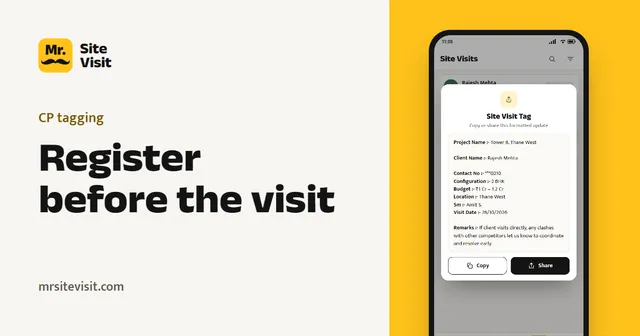
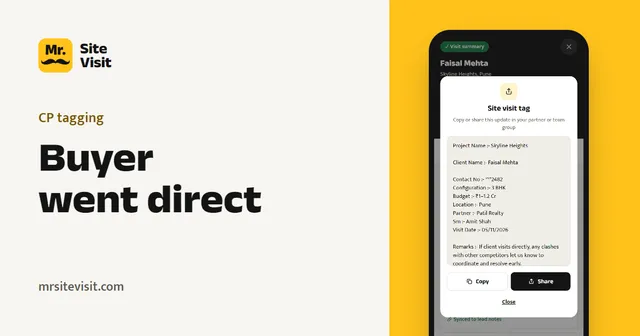
CPs also bring work you have to run. One buyer, claimed by two firms, is the classic fight at the site office. So is a buyer claimed by a CP and your own team. Our channel partner registration format shows the fields that settle most of them.
There’s a rule to price in too. In Maharashtra, MahaRERA (the state’s real-estate regulator) re-emphasised in May 2024 that promoters must work only with trained and certified agents. From 1 January 2024, they must also disclose those agents’ names and addresses. Non-compliance can bring action against the project. Check the current rule with your legal team. So checking each CP’s registration is part of your CP desk’s cost. Other states’ rules differ.
Count each booking to the right channel
Your numbers are only as good as the line that says who brought each buyer. This is where many cost sheets go wrong before the sums start.
A buyer sees your ad, calls your team, then walks in with a CP a week later. Whose booking is it? Decide it by rule, before the month, not by argument after it:
| If… | Then… |
|---|---|
| A CP registered the buyer first, inside the tagging window | It’s a CP booking, and the brokerage is part of its cost |
| Your team had the buyer on record first, with a call or a visit | It’s an in-house booking. Tell the CP with the date |
| A walk-in with no registration and no earlier record | It’s direct. Check the CP register before you write it down |
| The tagging window expired before the booking | Follow your written rule, and apply it to everyone the same way |
Your ads also reach buyers who later walk in with a CP. Keep the ad cost on the in-house side, but note how many CP bookings first came through your ads. That’s part of what the ads buy.
The tagging window is the number of days a CP’s registration of a buyer stays valid. Write it in your CP agreement. If it isn’t written, every close case becomes a meeting.
Set the mix with your own numbers
Once you have both costs and your pace, the mix mostly decides itself. These are my starting points, not market rules. My own view: if the two costs are within 10%, don’t cut either channel yet.
| If your numbers show… | Then… |
|---|---|
| In-house cost per booking well above the CP cost | Cut ad spend for your own team, and don’t hire until its pace rises |
| In-house cost per booking well below the CP cost | Feed your own team more direct leads. Keep the CPs who bring the most bookings |
| The two within about 10% of each other | Keep the mix. Work on the in-house pace first; it’s the number you control |
| A new launch with little demand yet | Lean on CPs for reach, and keep the in-house team small until the pace shows |
Our post on cost per booking shows the full cost chain for the in-house side: lead, conversation, visit, booking.
Which team are you?
The method is the same. How much each channel matters isn’t.
| Your business | What fits |
|---|---|
| One project, a small site team | Count both monthly. Your in-house pace is the number that moves the answer |
| Several projects, one sales head | Work it out per project. A cheap channel on one tower can be the costly one on another |
| A developer with a mandate firm | Ask the mandate firm for its cost per booking by channel too, in the same format |
| A mandate firm running a developer’s sales | Use it to show the developer where your own team beats outside CPs, and where it doesn’t |
Who shouldn’t bother yet? A developer with under about three bookings a month in total. One booking either way swings the answer too much. Count for six months first.
“CPs are cheaper; we only pay when they sell”
It feels true, because brokerage only arrives with a booking. But in the example, it’s the biggest single cost on a booking. Check yours. And your CP desk costs money every month, whether CPs sell or not.
So count it. Are CPs really cheaper at your pace? Then the numbers will show it, and you can show your CFO. If they aren’t, you’ll know where to put next quarter’s ad budget.
What I’d check this week
- List last six months’ bookings, each with its channel: CP, in-house or direct
- Add up each channel’s costs for the same months, with your site office split written down
- Work out the cost per booking for each, and your in-house break-even
- Check that your CP agreement states the tagging window
- Take the two numbers to your next sales review
Where software helps
If a sheet is enough for you today, stay with the sheet. What breaks first is the channel of each booking. The CP register sits in one file, and your team’s calls in another.
On Mr. Site Visit’s Developer plan, each outside partner gets a partner code. Each claim has a tagging window: 60 days by default, and yours to change. Claims for the same buyer land in one list with their dates, so the site office sees every claim for that buyer.
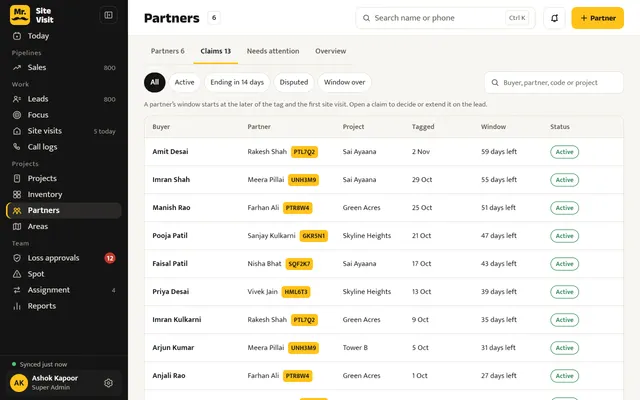
Every lead keeps its source, and reports count leads by source and by project. The Developer plan is ₹1,298 per user a month, billed yearly, from three users. See the plans and prices, or how it works for developers.
This week, put last month’s bookings in two columns, CP and in-house, and their costs beside them. Take the two numbers to your next sales review, and ask your CFO which one they had in mind.
Questions teams ask
Is it cheaper for a developer to sell through channel partners or an in-house team?
It depends on your pace. A channel partner booking costs the brokerage plus your CP desk, and that cost barely moves. An in-house booking costs the team, ads and site office, spread over its bookings. Above its break-even pace, your own team is cheaper. Below it, channel partners are.
How do I calculate cost per booking by channel?
Add up everything one channel cost in a month, then divide by the bookings it made that month. For channel partners, that’s the brokerage plus the CP desk and events. For your own team, it’s salaries, incentives, ads, portals and the site office. Use six months, not one.
What is the break-even for an in-house sales team?
Break-even bookings a month = the in-house team’s fixed monthly cost ÷ (the CP cost per booking − the in-house incentive per booking). Below that pace, each in-house booking costs more than a channel partner booking.
Should a developer stop working with channel partners?
Rarely. In the Mumbai region, CREDAI-MCHI says channel partners contribute to nearly 60% of residential transactions. Cutting them off can cut your reach more than your costs. Use the numbers to set the mix and the CP desk rules, not to choose one channel.
Sources
- PropNewsTime, Channel partners drive nearly 60% of MMR home sales, says CREDAI-MCHI at first exclusive property expo (last updated 7 May 2026): CREDAI-MCHI said “channel partners currently contribute to nearly 60% of residential transactions across MMR”
- Free Press Journal, MahaRERA re-emphasis only on trained and certified agents to operate in real estate sector (2 May 2024): promoters of housing projects in Maharashtra must disclose the names and addresses of the agents they deal with and engage only trained and certified agents; non-compliance may lead to action against the project, including rejection or revocation of registration, or a penalty