Paying your team from your savings? Fix the CP firm cash gap
By Jayesh G, Founder · 11 min read. Published 9 November 2026.
In short
- A CP firm pays salaries every month, but brokerage lands months after the booking. Without a planned buffer, the owner's savings become the buffer.
- Size it: one month's costs × the months you wait for brokerage. Every new hire adds to it before they book anything.
- Keep the firm's money separate, pay yourself a fixed salary, set limits on how much you'll fund, and invoice so the MSME payment rules can work for you.
On this page
- The gap is built into the business
- Work out your buffer in five minutes
- Every new hire costs cash before they book
- Keep your money and the firm’s apart
- Decide your limits before the next bad month
- Three ways to make the gap smaller
- The MSME rules can work for a registered firm
- Already short this month? Do it in this order
- Which firm are you?
- “Once the big booking comes, it’ll all be fine”
- What I’d check this week
- Where software helps, and where it doesn’t
- Questions teams ask
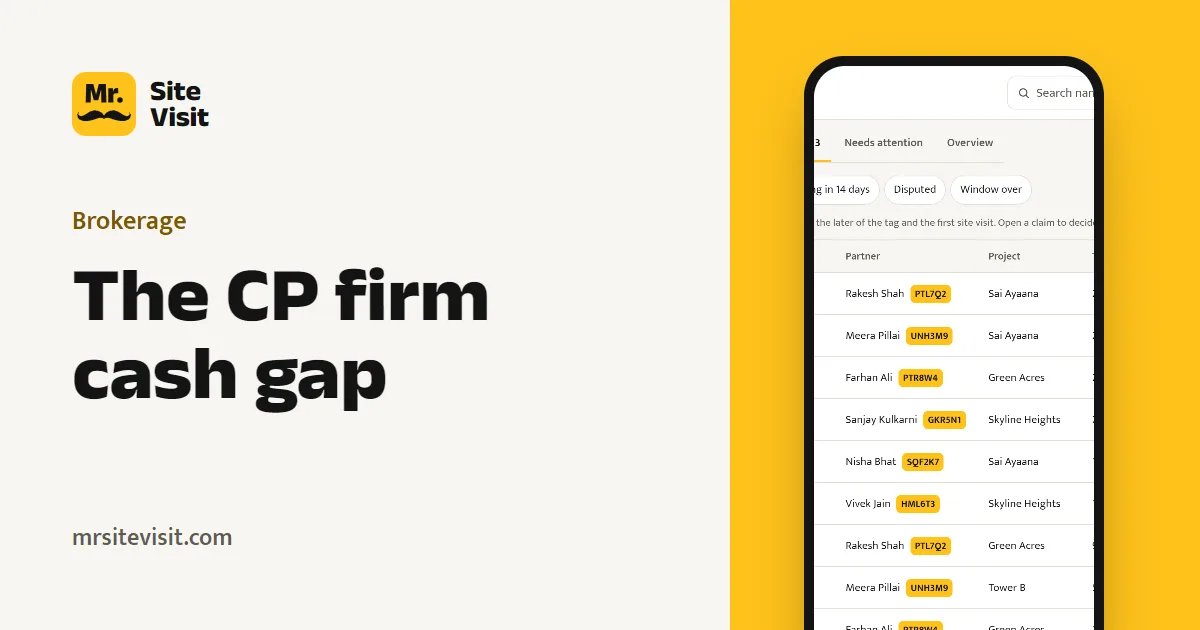
Paying salaries from your own savings is how a CP firm runs, until you plan the gap.
A CP firm (a channel partner firm that sells developers’ projects) pays its people on the 1st. The money for that work comes months later. It arrives when the developer releases the brokerage (your commission on the sale). In between, someone pays. Without a plan, it’s the owner, from the account the family thinks is for the house.
Treat the gap as a cost of the business. Work out how big it is. Keep a buffer in the firm’s own account. Pay yourself a fixed salary. And decide in advance how many months you’ll fund before you change something.
The simple rule Your buffer is one month’s costs × the months you wait for brokerage. Below that, your savings are the buffer.
The gap is built into the business
In many firms, brokerage arrives months after the booking. When depends on each developer’s terms; many pay on milestones. Salaries, rent and ads go out every month regardless.
Here’s a typical path, with illustrative timings. Every developer’s terms differ:
- Booking day. The buyer books. The firm has already paid a month or two of salaries to get here.
- The milestone, about a month later. Often the agreement registration, or a set share of the buyer’s payment.
- The invoice. Raised when the milestone is reached, if the papers are ready. A missing KYC copy (identity papers) or a wrong GST number sends it back.
- The payment, months after booking. The CP desk checks the booking. Accounts approve it. Ask each developer whether it pays only on fixed dates.
Each booking is a small loan to the developer. One booking is easy. Twenty bookings a quarter is a permanent gap that grows with the firm.
Do you know how many months your firm usually waits, from booking to money in the bank? If not, our post on late brokerage payments has a free tracker sheet. It works the wait out from your bookings.
Work out your buffer in five minutes
It takes two numbers. One is what the firm costs in a month. The other is your usual wait for brokerage, in months. Do your developers differ a lot? Start with the longest recent wait among the ones you sell most for.
- Cash buffer
- Money in the firm’s own account to pay costs while brokerage is on its way: one month’s costs × the months you usually wait.
Here’s an illustrative 7-person firm. The costs, waits and salaries in this post are examples to show the sum, not a real firm; put in your own:
| Monthly cost | Example |
|---|---|
| Salaries, 7 people | ₹3,00,000 |
| Office rent | ₹60,000 |
| Ads and portal plans | ₹40,000 |
| Incentives paid out, monthly average | ₹40,000 |
| Cabs, phones and the rest | ₹20,000 |
| Total a month | ₹4,60,000 |
Say this firm usually waits four months for brokerage. Its buffer is ₹4,60,000 × 4, or ₹18,40,000. That’s the safe size while the firm is growing, or when a developer slows down.
If brokerage from earlier bookings already lands every month, your real need is the dip in a bad month. Test the buffer against your slowest three months.
Brokerage lands after TDS (tax deducted at source). So count what reaches the bank. GST on your invoice may also fall due before the developer pays you. Your CA (chartered accountant) can tell you both, and whether to add GST to the buffer.
The buffer comes back as brokerage lands. But it never goes away, because new bookings start new waits. Do bookings sometimes cancel after brokerage is paid? Then keep a little extra for brokerage a developer may take back.
Every new hire costs cash before they book
Growth makes the gap bigger, and it happens before the new person sells anything. Their first weeks go on learning the projects and sitting in on Saturday site visits. Count two waits: until their first booking, then until its brokerage lands.
Hiring two people next month means finding over ₹4 lakh before their first brokerage arrives. That can make the firm feel poorer in the very months it’s growing. Have you felt that?
Our post on profit per booking covers the other side: whether each booking makes money once it lands.
Keep your money and the firm’s apart
Separate the two with a current account for the firm, even if it’s a proprietorship. A gap mixed into the family account is a gap nobody can see.
- Run every firm cost from one firm bank account, and only firm costs
- Pay yourself a fixed salary each month, and count it as a cost
- When you put savings in, write down the amount and date, and take it back first when brokerage lands
- Ask your CA how to record that money for your firm type
- Keep a three-line sheet each month: cash in, cash out, brokerage still due
The fixed salary matters more than it looks. Some owners take “whatever is left”. They can’t tell whether the firm makes money or just moves it around. And the family budget swings with every developer’s payment run.
What do you pay yourself today? If the honest answer is “it depends”, start there.
Decide your limits before the next bad month
Set limits now, while things are calm. In a bad month, it’s tempting to fund one more month, and then another.
These are my suggested limits. Change the numbers to suit the firm, but write them down:
| If… | Then… |
|---|---|
| Brokerage invoiced but not paid is more than 3 months of salaries | Take no new projects from the developer who pays slowest until it’s back below |
| The buffer falls below one month’s costs | No new hires this month |
| You’ve put in savings two months in a row | Cut one cost or chase one payment before a third month |
| One developer owes over half your unpaid brokerage | Spread next quarter’s focus across more projects |
The first row is the hardest. It feels like turning away business. But a project that pays in eight months uses your buffer twice as long. Four months is half the strain.
Three ways to make the gap smaller
The buffer covers the gap. These three shrink it. Each has a cost; I’d try the first one first.
| Lever | What it costs you |
|---|---|
| Pay booking incentive when the brokerage arrives, not on booking day | Salespeople wait longer, so say it clearly and promise it survives if they leave |
| Agree an earlier milestone or a part payment in writing, before you take a project | Some developers will say no; ask anyway, before your team sells a single unit |
| Bank finance against invoices already raised, for a known gap only (ask your bank what it offers a firm your size) | Interest, and a loan to repay; never use it to cover a loss |
The first lever is the biggest for most firms. Our post on splitting incentive covers paying it when brokerage arrives. For the second, get the rate and milestone in writing before the first visit. For an overdraft, talk to your bank and your CA. Set the limit before you need it.
The MSME rules can work for a registered firm
If the firm is registered as a micro or small enterprise (Udyam registration, the government’s free MSME register), two rules may help. They protect registered micro and small suppliers only. The size limits depend on investment and turnover. Your CA can check the current limits on the Udyam portal. Is yours registered?
The first is the MSMED Act (the Micro, Small and Medium Enterprises Development Act, 2006). “Acceptance” is the day the developer accepts your service. If it doesn’t object in writing within 15 days, the service counts as accepted (deemed acceptance). The time limits, as a CA explains them on Taxguru, checked 9 November 2026:
| If… | Then the developer must pay… |
|---|---|
| You agreed a payment date in writing | By that date, and never more than 45 days from acceptance |
| There’s no written payment date | Within 15 days of acceptance |
| It pays after the due date | Interest at three times the RBI bank rate, added up month by month (Ministry of MSME) |
If the developer objects to your invoice in writing within 15 days, the clock works differently. We haven’t checked every case, so ask your CA.
The second is newer. It applies to payments for the financial year 2023-24 onwards (assessment year 2024-25). Under Section 43B(h) of the Income Tax Act, a business that pays a micro or small enterprise late can claim that cost only in the year it pays.
So a developer that knows you’re a micro or small enterprise may have a tax reason to pay on time. That reason is strongest before 31 March. Whether it matters to them is for their CA.
Check with your CA first Whether these rules apply depends on your registration, your agreement and when the developer “accepts” your service. Ask your CA before you quote them to a developer.
In practice, put the Udyam number on every invoice. Raise invoices the day a milestone is reached, not at month-end. And send the ones that are due before the developer closes its books in March.
Our post on late brokerage payments has the chase ladder and what happens if it goes to a dispute.
Already short this month? Do it in this order
If the gap is already here, don’t start with a loan. Work through these in order:
- Stop new hires. Every hire adds months of cash before any comes back.
- Chase the oldest invoice. The one past its due date, with the developer who owes the most.
- Write down any savings you put in. Amount and date, so it comes back first.
- Ask the slowest payer for a part payment. On bookings already past their milestone.
- Talk to your bank last. For a known gap, with invoices in hand.
Which firm are you?
The gap hits every CP firm. Where it hurts most depends on your size.
- 3–5 people, owner selling. The buffer is smaller, but it all comes from the owner. Start with the separate account and a fixed salary.
- 6–15 people, growing. Hiring is where the cash goes. Work out each new hire’s cash cost before you make an offer.
- Firms selling mostly one developer’s projects. The gap is that developer’s payment habit. Spread the risk before growing.
“Once the big booking comes, it’ll all be fine”
Maybe. But the big booking lands on the developer’s timetable, not the firm’s.
And when it lands, it often goes straight into the hole: last month’s salaries and the savings you put in. Then the next wait starts. One big cheque doesn’t fix a gap that’s built into how CP firms are paid. A buffer and a few written limits do.
What I’d check this week
All of these take a pen and your bank statement. No software needed.
- Add up one month’s real costs, including your own salary
- Work out your usual wait, from booking to brokerage in the bank
- Multiply the two: that’s your buffer. Compare it with the firm’s account today
- Add up the savings you’ve put in this year, and write down each date
- Ask your CA whether your firm qualifies as a micro enterprise
- Ask from which date the rules would cover your invoices
Where software helps, and where it doesn’t
Mr. Site Visit isn’t accounting software, and it won’t manage cash. That’s for the CA and the bank.
What it can do is keep the booking side honest. You can add your own pipeline stages, such as “Brokerage invoiced” and “Paid”, and filter leads by stage. That shows which bookings are still waiting. It doesn’t hold amounts or due dates; those stay in your sheet or with your CA.
Reports by project and source show how many visits and bookings each project gives you, if your team logs them. They don’t show who pays slowly; that comes from your tracker sheet. Check both before you take on a slow payer. See how it works for channel partner firms, or check the plans and prices.
Start this week: work out your buffer, and pay yourself a fixed salary from next month.
Questions teams ask
How much cash does a channel partner firm need in reserve?
At least one month’s running costs for every month you usually wait for brokerage. If your firm costs ₹4.6 lakh a month and brokerage lands about four months after a booking, plan for around ₹18.4 lakh while you’re growing. Below that, the gap gets filled from the owner’s savings or by paying people late.
Should a CP firm owner pay themselves a salary?
Yes, a fixed amount, even a small one, counted as a cost. If you only take what’s left, you can’t see whether the firm makes money, and your family’s budget swings with every brokerage cheque.
Can the MSME rules help a CP firm get brokerage on time?
They can, if your firm is registered as a micro or small enterprise. The MSMED Act sets a payment limit of 45 days at most from acceptance, and Section 43B(h) of the Income Tax Act lets a buyer claim a late-paid cost only in the year it pays. Ask your CA whether your firm qualifies.
Is it wrong to put my own savings into the firm?
No. Most owners do at some point. The problem is doing it without a record or a limit. Write down each amount and date, take it back first when brokerage lands, and decide in advance how many months you’ll fund before you change something.
Sources
- Ministry of MSME, Development Commissioner (MSME), Legal framework: delayed payments under the MSMED Act, 2006 (checked 9 November 2026): compound interest at three times the RBI bank rate if goods or services aren't paid for within 45 days of acceptance
- Taxguru, Alok Goyal (CA), Section 43B(h): MSME income tax implications from AY 2024-25 (16 January 2024): MSMED Act Sections 15 and 2(b) (pay by the agreed date, at most 45 days from acceptance; 15 days without a written agreement); a buyer's deduction for purchases or services from micro and small enterprises is allowed in the year of payment if paid late