A real estate sales plan for 2027: your year, month by month
By Jayesh G, Founder · 11 min read. Published 4 November 2026.
In short
- Don't divide next year's booking target by twelve. Spread it by last year's monthly bookings, so busy months get more.
- Turn each month's bookings into site visits with your own visits per booking. Where visits needed beat what your people can do, hire two months earlier.
- Plan cash on the month brokerage arrives, not the month you book. Then compare plan and actual every month, and re-spread what's left.
On this page
- Last year’s shape, not twelve equal months
- Pick a target the leads and people can carry
- Turn each month into site visits
- Hire two months before the short months
- Plan cash on the month brokerage arrives
- Compare plan and actual every month
- Which team are you?
- “The market decides. A plan won’t change it”
- What I’d check this week
- Where software helps
- Questions teams ask
What will your firm book next March? Most owners can say what they want for the year. Can you say what that means for March alone?
The usual plan is one number for the year, divided by twelve. Then March comes. Your best senior is training a new joiner on a Saturday. And the cash for March’s work is still waiting on December’s few bookings.
You can build a better plan in an evening from last year’s records. Spread next year by last year’s shape, hire before the short months, and plan cash on the day brokerage (your share of each sale, paid by the developer) arrives.
The simple rule Spread the year by last year’s monthly bookings, hire two months before the months that run short, and plan cash on the month brokerage arrives.
Last year’s shape, not twelve equal months
Your 2027 plan should follow the shape of your 2026 bookings. If March and October were busy, plan more there. This plan uses the calendar year; if you plan April to March, the method is the same.
Take an illustrative CP firm (channel partner firm). It has five salespeople. The numbers are an example, not a real firm’s:
| Month | 2026 bookings | 2027 plan |
|---|---|---|
| January | 3 | 3.8 |
| February | 4 | 5 |
| March | 6 | 7.5 |
| April | 4 | 5 |
| May | 4 | 5 |
| June | 3 | 3.8 |
| July | 3 | 3.8 |
| August | 4 | 5 |
| September | 4 | 5 |
| October | 6 | 7.5 |
| November | 4 | 5 |
| December | 3 | 3.8 |
| Year | 48 | 60 |
Each 2027 month gets the same share of the year as in 2026. The table shows 3.75 as 3.8; the visits and cash below use the exact figure. Round only when you split the month between people.
Why not even months? Five a month would call January a miss and March a big win. Neither would be true. Look at your own history. Use two years if you have them, and follow whatever shape they show.
Last year’s shape can mislead, though. A one-off launch month, or a project you’ve stopped selling, distorts it. Replace such a month with the average of the months around it. Then copy the shape.
Next, count the weekends you can really run visits in each month. A month that loses a festival week might hold 12 visits a person, not 16. In the sheet, change that month’s people count from 5 to 3.75 (5 × 12 ÷ 16).
Under a year of records? Use the months you have, and the booking target calculator for the rest.
Pick a target the leads and people can carry
Set the target from the leads and people you’ll have, plus what you’re adding.
The market won’t do the growing for you. In the July to September quarter, ANAROCK counted homes sold up 3% on a year earlier across the top seven cities. New launches rose 18%, and unsold homes 12%.
My read: more projects are chasing a few more buyers, so each buyer sees more options. Those are top-seven-city figures, so check your own city’s. Then base your growth on what you’ll add: a salesperson, a project, a source.
This firm adds one salesperson, running visits from March. That’s 16 visits a month for ten months, or about 13 bookings at 12 visits each. Last year’s 48 plus 13 is about 61, so it plans 60. Check the leads too: the booking target calculator shows whether your sources can supply the extra visits.
Can the team carry it? 60 bookings × 12 visits is 720 visits a year, or 60 a month. Five people can run 80 a month, so the year fits. But two months run short.
Turn each month into site visits
Each month’s bookings become site visits through your own visits per booking. This firm needed 12 site visits for each booking last year.
So March’s 7.5 bookings need 90 visits. A quiet January needs 45. Now compare those with what the team can do. Each salesperson here does about 16 visits a month. So five people can run 80:
March and October are 10 visits short. Every other month needs 60 or fewer, so it fits.
Visits come from leads. The booking target calculator works each month back to the new leads it needs. Run it for your two biggest months.
A bigger firm uses the same plan once per area team, with each TL (team leader) filling in their own team’s months. Then add the teams up. If one team has spare visits in March and another is short, move leads between them before you hire.
Hire two months before the short months
Hire about two months before the first month that runs short. In our example, a new salesperson spends two months learning. They can’t carry visits alone yet. Finding the person takes time too, so start the search now, in November.
- Find the first short month Here, March: 90 visits needed, 80 possible.
- Count back two months The new person should join by the start of January.
- Plan their learning January and February: Saturday visits alongside a senior, a learning target, no bookings expected.
- Count them from March Six people can run 96 visits, enough for March and for October.
One hire in January covers both peaks, and leaves room to grow. Hire in March instead, and your best senior spends the busiest Saturdays training someone. Our post on sales targets per salesperson covers the new joiner’s learning target.
In Maharashtra, a new person who deals with buyers also needs the competency certificate from MahaRERA (the state’s real-estate regulator). Build that into the two months.
Plan cash on the month brokerage arrives
Your cash follows the month the developer pays brokerage, not the month you book. Use your own record of how long developers take. This firm waits about three months.
Many developers also deduct TDS (tax deducted at source) before paying. The rate is 2% TDS once a developer pays you over ₹20,000 in a financial year. It applies if the developer meets the turnover test. Without your PAN, it’s 20%. So a ₹2 lakh brokerage, before GST, arrives as ₹1.96 lakh. Your CA (chartered accountant) can confirm each developer’s case.
Here’s the first third of 2027 for the example firm. Its costs are ₹5.85 lakh a month, and the new hire adds an example ₹30,000:
| Month | Bookings planned | Cash arriving, from bookings three months earlier | Left after costs and the hire |
|---|---|---|---|
| January | 3.8 | ₹11.8 lakh, from October’s 6 | ₹5.6 lakh |
| February | 5 | ₹7.8 lakh, from November’s 4 | ₹1.7 lakh |
| March | 7.5 | ₹5.9 lakh, from December’s 3 | −₹27,000 |
| April | 5 | ₹7.4 lakh, from January’s 3.8 | ₹1.2 lakh |
March is the only month where the cash arriving doesn’t cover its costs: −₹27,000 that month. The cause is December’s three bookings paying in March, the busiest month. Costs are held flat here; if incentives rise with bookings, March and October need more.
Over the three months, the firm is still about ₹7 lakh ahead. So can it afford the hire? My rule: before you commit, hold back March’s gap plus one month’s costs.
| The check | Example firm |
|---|---|
| Hold back: March’s gap + one month’s costs and the hire | ₹27,000 + ₹6.15 lakh = about ₹6.4 lakh |
| January and February leave, after costs | ₹5.6 lakh + ₹1.7 lakh = ₹7.3 lakh |
| Covered? | Yes, so hire in January |
| If it weren’t | Delay other spending, or ask the developer about faster payment, rather than hire late |
Cancellations aren’t in this example. If 1 in 10 cancels, take a tenth off the cash. Does a developer pay late? The brokerage tracking post below has the chase ladder.
The sheet takes one average brokerage and one payment delay. If a project pays much later, or in two parts, plan it in a copy of the Plan tab; our brokerage tracking post covers split payments. Put the new hire’s salary in the Plan tab’s extra costs column, from the month they start. The example fills ₹30,000 in every month, so change it to match your hire.
Compare plan and actual every month
Compare plan and actual at the end of every month. Spread any gap over the months that are left. Don’t pile it onto next month.
| If, at month end… | Then… |
|---|---|
| You’re behind by a booking or two | Spread the gap over the remaining months, in the same shape |
| You’re behind for three months running | Check leads and visits per booking before you raise anyone’s target |
| You’re ahead | Keep the plan. Don’t raise the year in the middle of it |
| A developer pays later than planned | Move that cash in the plan, and check what it does to the next peak |
| A new project starts selling | Add its bookings and visits as new rows, not inside the old months |
To check the month ahead, see our post on forecasting next month’s bookings.
Which team are you?
The method is the same for every firm. What changes is what you plan by:
| Your team | Plan by | Watch most |
|---|---|---|
| A 3 to 6 person CP firm, owner still selling | Month, for the whole firm | Cash in the busy months |
| A 7 to 20 person CP firm with team leaders | Month and area team | When to hire before the peaks |
| A mandate company (a firm a developer hires to sell a whole project) | Month and project | Partner visits as well as your own |
| A developer’s sales team | Month, project and inventory left | Launches, and the units you can sell |
“The market decides. A plan won’t change it”
Partly true. A plan won’t create buyers. But it decides whether you’re ready when they come.
Without one, the hire comes late. The visits run short in the busy month. And the cash runs thin in the same weeks, while the Monday review asks why March missed.
My honest view: if you only do one thing, find your first short month and hire two months ahead of it. The rest of the sheet depends on it.
Who shouldn’t bother with the full plan? A 3-person firm where the owner does most visits. Write down last year’s bookings by month, and watch cash in the busy ones.
What I’d check this week
You can do this from last year’s records before December:
- Shape: count 2026’s bookings by month, from booking forms, not memory.
- Visits: work out your visits per booking for the year.
- Capacity: count how many visits one salesperson really ran in a busy month.
- Delay: check how long each developer took to pay brokerage last year.
- Peak: find your first short month in 2027, and count back two months.
Where software helps
The plan needs last year’s bookings and visits by month. In a WhatsApp group and a sheet, they’re hard to find a year later.
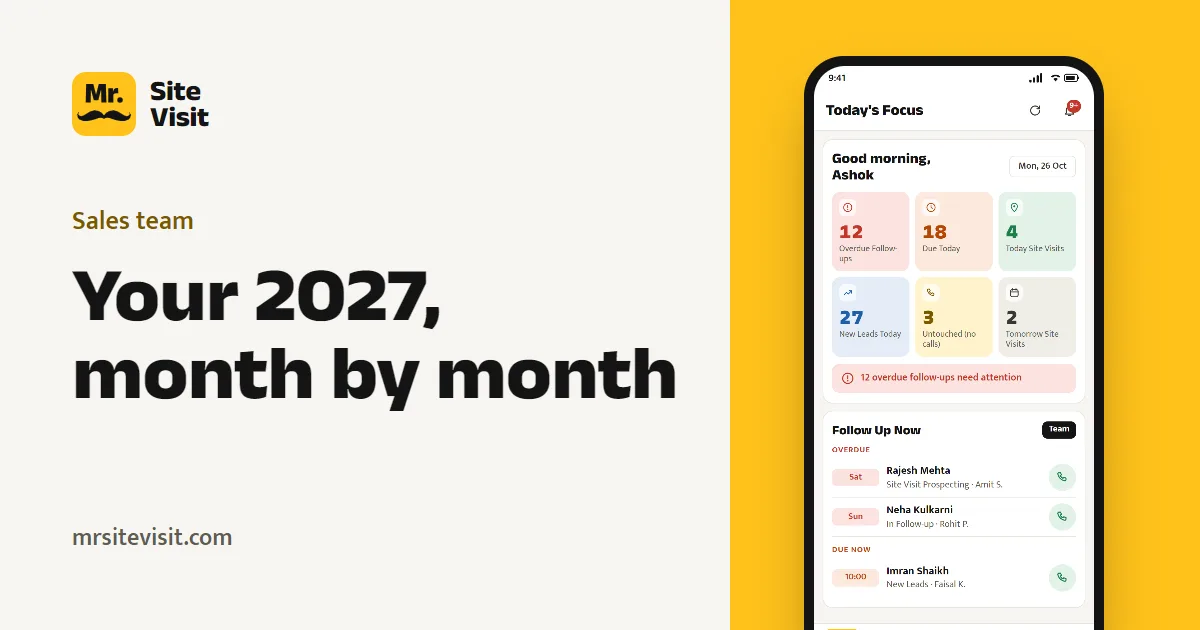
In Mr. Site Visit, site visits and bookings are recorded on each lead, with the person and the project. The dashboard shows them for this month, last month or a quarter. From now on, the shape builds up for next year’s plan. For 2027, use your booking forms and visit sheets. The plan itself stays in the sheet: you can’t set each person’s target in the app.
Starter is ₹423 a user a month, billed yearly, from three users. See the plans and prices, or how it works for channel partner firms.
This week, start the sheet before your December target meeting. Type in 2026’s twelve months, and find the month that runs short first.
Questions teams ask
How do I make a yearly sales plan for a real estate firm?
Take last year’s bookings by month and spread the new target in the same shape. Multiply each month’s bookings by your visits per booking to get the site visits you need. Compare that with what your salespeople can do, hire two months before any short month, and plan cash on the month brokerage arrives.
Should I divide the yearly booking target by twelve?
No. Bookings aren’t even across the year. If March and October were your busy months, plan more bookings, visits and leads there. An even split makes the quiet months look like failures and leaves the busy months short of people.
When should a CP firm hire for next year?
Two months before the first month your visits needed beat what your team can do. In our example, a new salesperson needs about two months of learning before running visits alone. So a hire made in the short month itself is too late.
Why does a CP firm run short of cash in its busiest months?
Because brokerage arrives months after the booking. The busiest month’s work is paid from the bookings of a quieter month before it. Plan the cash on the month the developer pays, after 2% TDS, not on the booking date.
Sources
- Business Today, Housing sales in top seven cities rise 3% on year in Q3 (29 September 2026), quoting ANAROCK: about 1,00,220 units sold in Q3 2026, up 3% year on year and 10% on the quarter; new launches about 1,14,320 units, up 18%; available inventory up 12% to about 6,30,590 units
- ClearTax, TDS on commission and brokerage (section 194H): 2% rate and ₹20,000 yearly threshold from 1 April 2025 (checked 3 November 2026)