How to forecast next month's bookings from the buyers you already have
By Jayesh G, Founder · 7 min read. Published 31 October 2026.
In short
- Next month's bookings mostly come from buyers you already have: those negotiating, those who revisited and those who visited recently.
- Count today's buyers at each stage, multiply by your own booking rate for that stage from the last three months, and add them up.
- Read a range, not one number. A small team's month can swing by a booking or two either way.
On this page
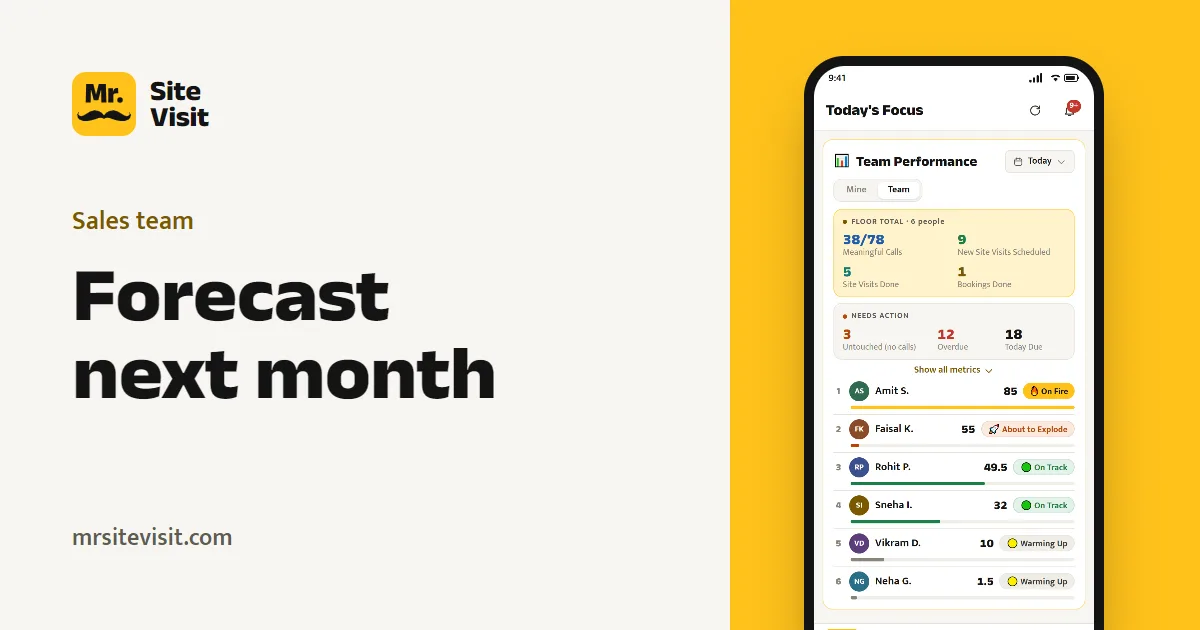
Much of next month’s bookings is decided already. They’re sitting in your team’s phones today, as buyers who visited, came back, or asked for a cost sheet.
Many sales heads forecast by asking the team how many bookings next month, and getting a hopeful guess back. It’s hope, not a count. And it’s why the month-end surprise keeps happening, in both directions.
So forecast from the buyers you already have. Count them by stage. Multiply each stage by your own booking rate from the last three months. Add them up, and read the answer as a range. Once the sheet is set up, the weekly count is short. And it gives you a number you can check against what really happened.
The simple rule Forecast = buyers at each stage today × your own booking rate for that stage. Read it as a range.
Count buyers by stage, once each
Put every live buyer in one of four stages, at the furthest point they’ve reached. Count each buyer once.
Decide first what a booking is: token paid, or agreement signed? Use the same one in your history and in today’s count.
| Stage | Who’s in it |
|---|---|
| Negotiating | Cost sheet shared, discussing price or payment |
| Revisit done | Came back a second time in the last 30 days, often with family |
| Visit done | First visit in the last 30 days |
| Visit fixed | A visit booked for the next two weeks |
Leave new leads who haven’t visited out of the count at first. Check your own history: if some book within a month, add them as a fifth stage.
Use your own booking rates, not someone else’s
Every team’s rates are different: the project, the price, the team. So use yours, from the last three months.
- Booking rate for a stage
- Of the buyers at that stage on the 1st of a month (their furthest stage only), the share who booked that same month.
Here’s an illustrative team’s history, three months added together. The figures are examples, not anyone’s real numbers:
| Example team, last 3 months | Buyers on the 1st | Booked that month | Rate |
|---|---|---|---|
| Negotiating | 18 | 7 | 39% |
| Revisit done | 30 | 6 | 20% |
| Visit done | 90 | 6 | 7% |
| Visit fixed | 60 | 3 | 5% |
With fewer than about 10 buyers at a stage, add more months, or the rate jumps around too much.
Multiply, add, and read a range
Now multiply today’s count at each stage by its rate. With the example rates:
| Today | Buyers | × Rate | Expected bookings |
|---|---|---|---|
| Negotiating | 5 | 39% | 1.9 |
| Revisit done | 8 | 20% | 1.6 |
| Visit done | 25 | 7% | 1.7 |
| Visit fixed | 20 | 5% | 1.0 |
| Total | About 6 |
So the forecast is about six bookings. But don’t promise six. A small team’s month swings: one family delays, one loan comes through early. The sheet shows a cautious and a hopeful number, at 70% and 130% of the forecast: here, about 4 and 8. That range is a rough rule of mine, not a statistic, so check it against your own last six months.
The real worry behind a forecast is money. You commit salaries and ad spend, and the bookings don’t come. So plan costs on the cautious number. Treat the hopeful one as a bonus.
Use the forecast to act, not just to report
A forecast is only useful if it changes what you do this week. Here’s how I’d read it:
| If the forecast shows… | Then this week… |
|---|---|
| Most bookings depend on the negotiating stage | Get those buyers a decision meeting with the closing manager and the developer's offer |
| Few buyers at revisit | Push second visits with family for last month's first visits |
| Few visits fixed for the next two weeks | This month is fine; next month is at risk. Fix the calling and visit booking now. |
| Forecast well below your break-even | Don't add costs this month, and look at which projects pay for their visits |
That last row ties to money. Multiply the forecast by your average brokerage per booking to see what next month brings in. Our post on profit per booking shows how many bookings a month cover your costs. And how many leads you need for a target works backwards from the number you want.
Review it every week
A forecast made on the first of the month is stale by the tenth. NAR’s guidance for brokers says the same: base it on data, not gut feeling or wishful thinking, and check agent follow-ups monthly, weekly or even daily.
So update the counts every Monday, and read the result as bookings expected in the rest of this month. Your rates came from counts on the 1st, so early-month Mondays fit best; late in the month, expect the number to run low. Twenty minutes a week keeps the number honest.
And watch the market around you. Anarock expected October to December 2026 to look like last year’s festive quarter, as Outlook Money reported. Your own rates matter more, but a slower market shows up in them first.
Which team are you?
The method is the same. Who runs it changes with your size:
| If you are… | Then… |
|---|---|
| 3 to 6 people, the owner still sells | The owner counts on Monday, with the sheet, in twenty minutes |
| 7 to 20 people with team leaders | Each team leader forecasts their team; add them up for the firm |
| A mandate company working with outside partners | Count the buyers your own team handles, and ask each partner for their count by stage |
| A developer's sales team | Forecast per project, since each project has its own rates |
Who shouldn’t bother? A team with one or two bookings a month. At that size, just know each buyer by name.
Not sure it’s worth the effort? Start small. One project or one team, twenty minutes on Monday, for four weeks. Was the range close? If it wasn’t useful, stop.
“My salespeople know their buyers better than any sheet”
They often do. A good closing manager can feel when a family is close, after the second Saturday visit with the parents.
So use both. Count first, then ask: “Who in negotiating will book this month?” Where the salesperson’s answer and the count disagree, that’s the conversation worth having. My honest view: use the count to check the hope, and the salesperson to check the count.
Where Mr. Site Visit fits
We built Mr. Site Visit for real estate sales teams of three or more. It doesn’t make the forecast for you; the sheet does that.
What it gives you is two of the counts, from the record. Visits scheduled and done, and bookings, show per person and per project. So “visits done in the last 30 days” is a number on the screen, not a guess. Follow-ups come as reminders, with overdue ones in red, so you can see which follow-up is late. The call itself is still your team’s.
Starter is ₹423 and Growth ₹548 a user a month, billed yearly, from three users, with no GST on top. See the plans and prices.
This Monday, count your live buyers by stage with your team. Then check one thing: how many are in negotiating today?
Questions teams ask
How do I forecast real estate bookings for next month?
Count the buyers you have today at each stage: negotiating, revisit done, first visit done in the last 30 days, and visit fixed. Multiply each count by your own booking rate for that stage from the last three months, and add them up. Read the result as a range, not an exact number.
How do I work out my booking rate for each stage?
Look back three months. On the 1st of each month, count the buyers at each stage, at their furthest stage only, and how many of them booked that month. Add the three months, then divide bookings by buyers. With fewer than about 10 buyers at a stage, add more months.
Why is my sales forecast always wrong?
Usually because it’s built on what salespeople hope, not on what buyers did. Use your own past booking rates, count each buyer once at their furthest stage, and remember that one booking more or less moves a small team’s month a lot.
Can I forecast bookings without a CRM (the software your team logs leads and visits in)?
Yes. A sheet with the four stages and your last three months of history is enough. A CRM makes the counts easier because the stages and visits are already recorded.
Sources
- David Lawrence, Building accurate sales forecasts for your business, NAR (National Association of Realtors) Broker-to-Broker Network, 4 December 2023: base forecasts on data, not gut feeling; track how and when leads enter, sales-cycle length and conversion; review monthly, weekly or daily
- Outlook Money, Housing market regains momentum ahead of Diwali (27 October 2026): Anarock expects October–December to resemble last year’s festive quarter