Your real estate marketing budget for 2027, worked from your bookings
By Jayesh G, Founder · 10 min read. Published 4 November 2026.
In short
- Start from the site visits your 2027 plan needs from paid sources, not from last year's bill.
- Budget each source at its own cost per site visit, with the agency fee and any GST you can't claim back. Keep a small share for tests.
- Cap it by what a booking's brokerage can carry, and spend it a month ahead of the months that need the visits.
On this page
- Start from the visits your plan needs
- Price each source by its cost per site visit
- Add what the invoice adds
- Keep a tenth for tests
- Cap it at what brokerage can carry
- Spend it a month ahead of the busy months
- Which team are you?
- “Spend more to get more”? Sometimes, in steps
- What I’d check this week
- Visits by source: counted, or rebuilt by hand
- Questions teams ask
In my view, too many ad budgets are last year’s bill plus a bit. Is yours? Then the portal rep calls in November, and the old bill is the only number on the table.
Last year’s bill paid for sources that brought visits and sources that didn’t. It also paid for the months you spent too late. Adding a percentage keeps all of it.
So build next year’s budget from your plan instead. Start from the site visits your plan needs, and price each source by what a visit from it costs. Then cap the total by what your brokerage (your share of each sale, paid by the developer) can carry.
The simple rule Budget = paid site visits needed × each source’s cost per site visit, plus a small test share. Keep cost per paid booking well under the brokerage you keep.
Start from the visits your plan needs
Your budget starts with one number: the site visits your 2027 plan needs from paid sources. Referrals and walk-ins bring the rest without ad money.
This post uses the example firm from our 2027 sales plan. It plans 60 bookings at 12 site visits per booking. That’s 720 visits. This example assumes half its bookings came from paid sources last year, so it needs 360 paid visits.
Use your own visits per booking and your own paid share. If you don’t know your paid share, count last year’s bookings by the lead’s first source.
Price each source by its cost per site visit
Each source gets budget at its own cost per site visit. A ₹300 lead that never visits cost you ₹300 and gave you nothing.
Cost per site visit is what you spent on a source ÷ the site visits its leads made. Here’s the example firm’s 2026, and its plan for 2027:
| Source | 2026 spend | 2026 visits | Cost per visit | 2027 visits | 2027 budget |
|---|---|---|---|---|---|
| Meta ads | ₹3,60,000 | 120 | ₹3,000 | 160 | ₹4,80,000 |
| Google ads | ₹2,70,000 | 60 | ₹4,500 | 70 | ₹3,15,000 |
| Portal A package | ₹2,40,000 | 48 | ₹5,000 | 40 | ₹2,00,000 |
| Portal B package | ₹1,50,000 | 60 | ₹2,500 | 90 | ₹2,25,000 |
| All paid | ₹10,20,000 | 288 | 360 | ₹12,20,000 |
The extra 72 visits go to the cheapest sources that can grow. We’ve assumed Meta can take more spend and Portal B a bigger package; Portal A gets a little less. The 2026 spend includes the agency fee, before GST.
This example also holds each source’s cost per visit flat, for simplicity. If Meta’s rises 15% across the year, add about ₹72,000.
Will a cheap source stay cheap at twice the spend? In my view, often it won’t. So grow it in steps, and check its cost per visit every month. Our post on cost per booking shows how to count visits by source.
Add what the invoice adds
Your cost per visit must include the agency’s fee and any GST you can’t claim back. Otherwise every source looks cheaper than it is.
Google India adds 18% GST to its bills. The total is 18% either way: 9% + 9% if your billing address is in the same state as Google’s billing office, one 18% otherwise. Check your portal and agency invoices for GST too; if they show it, it goes in.
Is your firm GST-registered? Ask your CA (chartered accountant) whether you can claim that GST back against the GST you collect. If you can’t, it’s a real cost: add 18%. For the example firm, ₹13.42 lakh would become about ₹15.8 lakh, or ₹52,800 per paid booking. That’s 28% of the ₹1.9 lakh it keeps, over the cap below, so it would cut its costliest source.
- Add the agency’s fee to each source it manages
- Add 18% GST if your firm can’t claim it back
- Divide a yearly portal package by the visits it brought in the year
- Count only visits that really happened, not visits booked on the calendar
A portal package’s cash still goes out the day you sign. Put that day in your cash plan.
Keep a tenth for tests
Set aside about a tenth of the budget for tests: a new source, a new ad, a new project’s campaign. That’s my rule of thumb, not a measured figure.
Without it, next year’s budget is this year’s sources again, and you never find a better one. For the example firm, a tenth of ₹12.2 lakh is ₹1.22 lakh. That brings the year to about ₹13.4 lakh.
Run each test fairly, with a fixed amount and a fixed time. Our post on Meta vs Google Ads sets out a fair four-week test.
Cap it at what brokerage can carry
Your cost per paid booking must stay well under the brokerage you keep from that booking. Check it before you sign anything.
Here’s the check for the example firm, test share included:
| Step | Example firm |
|---|---|
| Paid visits ÷ 12 per booking | 360 ÷ 12 = 30 paid bookings |
| Budget ÷ paid bookings | ₹13.42 lakh ÷ 30 = about ₹44,700 |
| Brokerage kept per booking, after cancellations | about ₹1.9 lakh |
I’d keep marketing under a quarter of the brokerage you keep, per paid booking. Above that, salaries and rent start to squeeze.
The cap is a ceiling, not a target. Over it? Cut the costliest source first, then look at visits per booking. Far under it? Grow the cheapest source in steps. On these numbers the plan clears the cap, but only just.
Across the whole year, the example firm’s ₹13.4 lakh is about 12% of the ₹1.14 crore of brokerage it expects to keep. That’s a result of the method, not a target.
I found no reliable published figure for what an Indian CP firm spends as a share of brokerage, so don’t borrow a US rule of thumb.
Treat the cap as rough. Take off incentives and cabs too, about ₹15,000 a booking in our ROAS on brokerage example, and the share is just over a quarter.
Spend it a month ahead of the busy months
Spend each month’s money about a month before the visits are needed, so March’s visits are bought in February. One month is this example’s assumption: check the usual days from lead to visit, by source, in last year’s records. Only the monthly money moves like this. Portal packages are paid the day you sign.
For the example firm, the packages (₹4.25 lakh) go out up front. Meta, Google and the test share, ₹9.17 lakh, are spread. Each month’s share is next month’s visits ÷ 720. March and October need 90, so February and September get the most:
| Month the money is spent | Visits it feeds | Share of the year | Budget |
|---|---|---|---|
| January | February’s 60 | 8.3% | ₹76,417 |
| February | March’s 90 | 12.5% | ₹1,14,625 |
| March | April’s 60 | 8.3% | ₹76,417 |
| September | October’s 90 | 12.5% | ₹1,14,625 |
| The other eight months, about ₹66,900 each | 420 visits | 58.3% | ₹5,34,917 |
| Monthly money, the year | 720 visits | 100% (shares rounded) | ₹9,17,000 |
On Google Ads, you set a daily budget, not a monthly one. Google’s help page says to divide a monthly budget by 30.4. Change the daily figure when the month changes.
The sheet holds ten sources, and marks which are paid up front. It runs as a steady cycle: December’s money feeds next January, assumed to need as many visits as this one.
Which team are you?
Every team budgets the same way. What changes is the brokerage, or margin, you hold the cost against:
| Your team | Hold the cost against | Watch most |
|---|---|---|
| A 3 to 6 person CP firm (channel partner firm) | Brokerage kept per booking | One package that eats the year |
| A 7 to 20 person CP firm | Brokerage kept, by source and project | Sources that grow, and stay cheap |
| A mandate company (a firm a developer hires to sell a whole project) | Your fee after partner payouts | Partner visits, which cost you no ads |
| A developer’s sales team | Margin per flat | Launch months, which need the money earlier |
Developers and mandate teams get many visits from partners. Count the partner payout per visit as that source’s cost, and start the budget from the launch calendar, not last year’s months.
“Spend more to get more”? Sometimes, in steps
Sometimes it’s true. More money on a source that still brings cheap visits usually brings more visits. But the next rupee on a source isn’t as cheap as the average one. When the agency asks for more, ask for three things:
- Name the source the extra money goes to
- Give the site visits it expects, and their cost per visit, not leads
- Show the cap check after the increase
Then add in steps, and watch each source’s cost per visit every month. In June, redo cost per visit by source and move the test share to what’s working.
My honest view: if your team doesn’t call every lead within the hour, fix that before you spend more. Our post on bad leads or bad selling shows how to tell which it is. And count each visit for the lead’s first source. It’s a simple rule, not the whole truth, so keep it all year; our post on lead source tracking explains why.
Who shouldn’t bother with a full budget? A firm on one portal package and referrals. Check that package’s cost per visit before renewal, and stop there. New firm, no history? Run one or two sources for eight weeks, then price them.
What I’d check this week
You can do this from last year’s records before any renewal call:
- Visits: count 2026’s site visits by the lead’s first source.
- Spend: add each source’s spend, with the agency fee and any GST you can’t claim.
- Cost per visit: divide the two, for each source.
- Cap: work out the brokerage you keep per booking, after cancellations.
- Calendar: find your busy months, and plan the money one month earlier.
Visits by source: counted, or rebuilt by hand
The whole budget hangs on site visits by source. If the source is missing on many of your leads, every cost per visit is a guess.
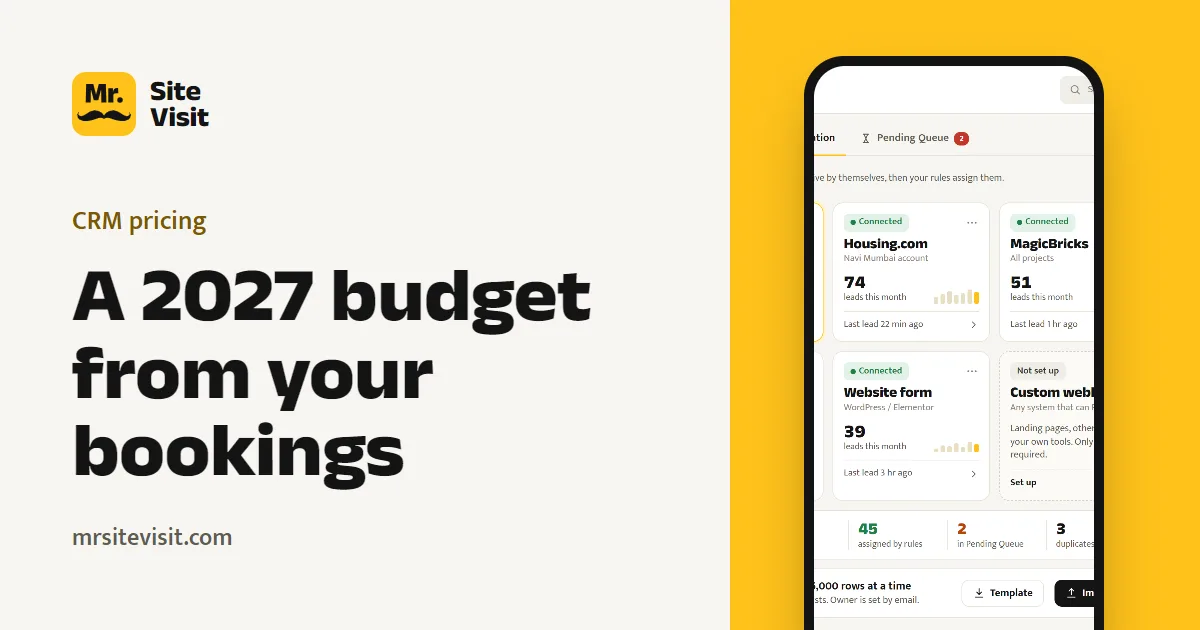
In Mr. Site Visit, leads from 99acres, Housing.com, MagicBricks, Meta and your website arrive with their source, and keep it. Visits are recorded on the same lead. If your team records each visit there, visits by source are a count, not a reconstruction. You still work out the budget in the sheet.
Will it lower your portal bill? No. It saves the hand-counting from WhatsApp and Excel before every renewal.
Starter is ₹423 a user a month, billed yearly, from three users. See the plans and prices, or how it works for channel partner firms.
This week, sit with your closing manager and check last year’s site visits by source. Price each one before the portal sales rep calls.
Questions teams ask
How much should a real estate firm spend on marketing?
Work it from your plan. Take the site visits you need from paid sources. Price each source’s share at its own cost per site visit, with the agency fee and any GST you can’t claim back. Keep a little for tests. Then check that cost per paid booking stays well under the brokerage you keep.
Should next year’s marketing budget be last year’s plus a percentage?
No. Last year’s bill includes sources that didn’t bring visits. Start from the visits your new target needs, and price each source by what a site visit from it really cost you.
Do I add GST to my ad budget?
Only if you can’t set it off. Google India adds 18% GST to its invoices. If your firm is GST-registered, ask your CA whether you can set that GST off against the GST you collect. If you can’t, it’s a cost, and it goes in the budget.
When should I spend more on ads in the year?
About a month before the months your plan needs the most site visits. A lead usually takes days or weeks to become a visit; your own lead and visit dates show how long. So money spent in the busy month itself mostly brings next month’s visits. Portal packages are the exception: they’re paid when you sign.
Sources
- Google Payments Center, GST on purchases in India (checked 3 November 2026): CGST 9% + SGST 9% when the bill-to state matches the bill-from location's state, otherwise IGST 18%; your GSTIN shows on the invoice if you've added it
- Google Ads Help, Set up your budget (checked 3 November 2026): if you're working with a monthly budget, divide that number by 30.4 to get the average daily budget