How to get empanelled as a channel partner with a developer
By Jayesh G, Founder · 7 min read. Published 31 October 2026.
In short
- Register with your state's RERA authority first. The Act says an agent can't help sell in a registered project without registering.
- Keep one ready file: RERA registration, PAN, GST if you're registered, firm papers and bank details. Each developer adds its own list.
- Before you sign, read six terms: brokerage rate, payout milestone and days, registration format, tagging window, tie rule and cancellations.
On this page
- Register with RERA before you pitch anything
- Keep one ready file
- Start with the channel partner desk, not the sales head
- Read six terms before you sign
- Start with one project, then ask for more
- Which firm are you?
- “Big developers only empanel big firms”
- What Mr. Site Visit keeps for you after you’re empanelled
- Questions teams ask
Under the RERA Act (the law behind each state’s real-estate regulator), an agent can’t help sell a flat in a registered project without registering first. So empanelment starts with your own registration, not the developer’s form.
Empanelment means a developer formally lists your firm as a channel partner, so you can bring buyers and earn brokerage. The worry is simple. You sell, and the brokerage doesn’t come, because the terms were only said on a call. The agreement is where your money is decided. Read it before you sign.
So go in this order. Register with your state’s RERA authority. Keep one ready file of documents. Read six terms in the CP (channel partner) agreement before you sign. Then start with one project your team can sell well, and prove it.
The simple rule Register first, read the agreement second, sign third.
Register with RERA before you pitch anything
Section 9(1) of the RERA Act says no real estate agent shall help sell or buy a plot, flat or building in a registered project without registering. You register with the RERA authority of your state.
That’s your licence to work. A developer may empanel you without asking for it. The risk is still yours. Under Section 62, an agent who breaks these rules can be fined ₹10,000 a day. The total can reach 5% of the cost of the plot, flat or building.
Check the project too. Section 10(a) says a registered agent can’t help sell an unregistered project. So ask for the project’s RERA number and look it up. Each phase is registered on its own.
In Maharashtra, there’s more. MahaRERA (the state’s regulator) has a rule on competency certificates for people who deal with buyers. Our post on MahaRERA certificates for staff explains who needs one. And our compliance checklist for channel partner firms lists the yearly duties.
Keep one ready file
Developers ask for documents in different ways: a portal, an email, a form at a partner meet. The ask often comes the day before a launch. So keep one folder on your phone and in your email. Then the answer takes minutes.
- Your RERA agent registration certificate and number
- PAN for the firm, and GST registration if you have one
- Firm papers: partnership deed, LLP (limited liability partnership) agreement or incorporation certificate
- Office address proof and a cancelled cheque for bank details
- Competency certificates for staff, if your state asks for them
- Udyam registration, if your firm has one
Each developer adds its own list. Some ask for experience too. One developer’s channel partner page (checked 31 October 2026) says a channel partner is someone who has been in brokerage, preferably, for at least a year. Ask the developer’s channel partner desk for their list in writing.
Why keep Udyam (the government’s registration for micro and small businesses) on the list? Have it? Ask your lawyer whether it helps when brokerage is late. Our post on late brokerage payments explains why.
Start with the channel partner desk, not the sales head
Most developers have a channel partner desk or a sourcing manager whose job is to bring partners in. Start there, not with the sales head.
Here’s what I’d have ready for that first meeting:
- Who you are Your RERA number, team size and the areas you cover.
- What you've sold Projects you've carried, and bookings you can show.
- How you work How fast you register buyers, and how you host site visits.
- What you're asking for One project to start with, and its partner terms in writing.
New firm with few bookings to show? Lead with how you work. A partner who registers every buyer cleanly and turns up for every visit is easy to say yes to.
Read six terms before you sign
The CP agreement decides when you’re paid, how much, and what happens in a dispute. Read these six before you sign:
| Term | What to ask | Why it matters |
|---|---|---|
| Brokerage rate or slab | The rate, and any higher rate for more bookings | Your income per booking |
| Payout milestone and days | When it’s payable, and how many days after | Your cash flow |
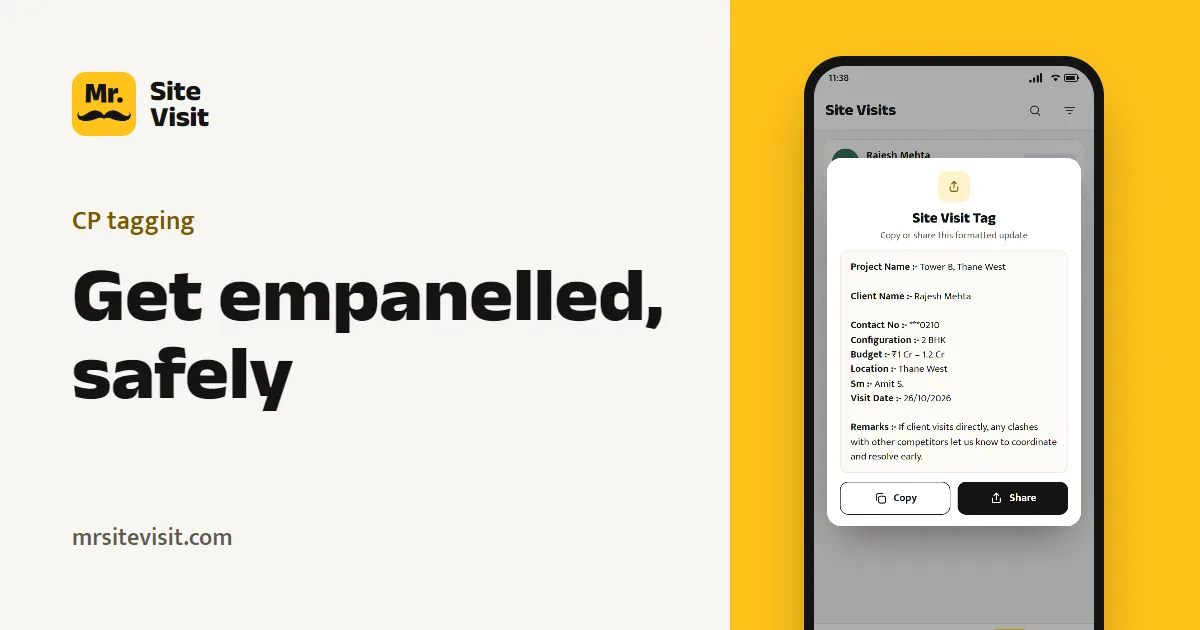
| Registration format | Exactly what to send before a visit | Your proof the buyer is yours |
| Tagging window | How long a registered buyer stays yours | Whether a late booking still pays you |
| Tie rule | Who wins when two partners claim one buyer | The dispute you’ll face at a launch |
| Cancellations | What happens to brokerage if a booking cancels | Whether paid brokerage can be taken back |
If any of these is missing, ask for it in writing before the first visit. You can send this:
Then glance at four more things. Are you exclusive? Which areas may you sell in? Who approves your ads? And how can either side end it? Our post on unpaid brokerage explains why a promise on a call is hard to enforce later. And the registration format shows what a clean registration looks like.
Get it in writing If the rate, the payout milestone or the tie rule is only said on a call, treat it as not agreed.
Start with one project, then ask for more
Don’t sign up for every project a developer offers. Start with one your team can explain well, in an area you already cover.
Give it three months. New to running a firm? Our post on starting a CP firm covers the first 90 days. Then look at what each site visit earned you, and how long payment took. Our project scorecard does the sum, with a free Excel file.
A partner with clean records and steady bookings on one project has a real case for the next one. And for a better slab.
Which firm are you?
The steps are the same. What you lead with changes:
| If you are… | Then… |
|---|---|
| A new firm of 3 to 5 people | Register first, then ask for one project in your area. Lead with how you work. |
| An established firm of 10 to 20 | Bring your bookings by project and area, and ask for a slab in writing |
| A mandate company (you sell a developer’s project on contract) empanelling sub-partners | Use the same six terms with your partners that you want from the developer |
| A developer empanelling partners | Ask for the RERA number first, and publish your six terms before the first visit |
Who shouldn’t rush? A firm that already carries more projects than it can pitch well. Add one only when you drop one.
“Big developers only empanel big firms”
Some do prefer firms with a track record. But many developers need partners who cover a local area well, and who register buyers properly.
So don’t try to look big. Show clean work. Your RERA number, a clear registration for every buyer, visits on the day you promised. I’d put that against any firm’s size.
And if a big developer says no today, start with a smaller one. Bookings you can show are the best application you’ll ever send.
What Mr. Site Visit keeps for you after you’re empanelled
We built Mr. Site Visit for real estate sales teams of three or more. It doesn’t send registrations to developers or track your agreements.
What it keeps is your record behind each booking. Visits scheduled and done, and bookings, show per person and per project. On Growth and Developer, each visit gets the time and a GPS stamp at the start and the end. The stamp is recorded, not checked against the site. Our page on site visit records explains what that helps with.
For developers, the Developer plan adds partner codes and claims. Each partner-brought buyer is tagged with the partner’s code and a tagging window, and claims go to a dispute queue.
Starter is ₹423 and Growth ₹548 a user a month, billed yearly, from three users, with no GST on top. See how it works for channel partner firms, or the plans and prices.
This week, check your RERA registration date and build the ready file. Then pick one developer, and ask their desk for the six terms in writing.
Questions teams ask
How do I become an empanelled channel partner with a developer?
Register with your state’s RERA authority first, then keep a ready file of your RERA registration, PAN, GST if registered, firm papers and bank details. Contact the developer’s channel partner desk or sourcing manager, read the CP agreement for six terms before you sign, and start with one project your team can sell well.
Is RERA registration mandatory for a channel partner?
Section 9(1) of the RERA Act says no real estate agent shall help sell or buy a plot, flat or building in a registered project without registering. So register with your state’s authority before you pitch any registered project.
What documents do developers ask for to empanel a channel partner?
Usually your RERA agent registration, PAN, GST registration if you have one, your firm’s papers such as a partnership deed or incorporation certificate, address proof and bank details. Each developer sets its own list, so ask their channel partner desk for it in writing.
What should a channel partner check in the empanelment agreement?
Six terms. The brokerage rate or slab, and the payout milestone and days. The buyer registration format and the tagging window. The rule for two partners claiming one buyer. And what happens to brokerage if a booking is cancelled.
Sources
- The Real Estate (Regulation and Development) Act, 2016, India Code (Section 9(1): no real estate agent shall facilitate the sale or purchase of a plot, apartment or building in a registered project without obtaining registration)
- Puravankara, Channel partner page (checked 31 October 2026): a channel partner is someone who has been in real estate brokerage (preferably) for at least one year