The CRM a channel partner firm actually needs
By Jayesh G, Founder · 8 min read. Published 24 October 2026.
In short
- A CP firm needs five things a generic CRM rarely does well: fast lead ownership, logged calls, visit records, kept buyers, quick numbers.
- Test those five with your own leads in a one-week trial, not in the vendor's demo data.
- Don't pay for developer features you'll never use, like inventory towers or partner management.
On this page
- A CP firm’s day breaks a generic CRM
- Every lead needs one owner the moment it arrives
- Calls should log from the phone, not from typing
- Each site visit needs a record the developer can see
- Buyers belong to the firm, not to a phone
- You should see five numbers in two minutes
- Test it with your own leads, not the vendor’s demo
- Won’t my team stop using it after a month?
- Which firm are you?
- What it costs, and when not to buy
- Questions teams ask
Leads come in from three portals and a Meta form. They land in a WhatsApp group of eight people. Visits get tagged by a message to the builder. And the sheet that’s meant to hold it all is two weeks out of date. Does that sound like your firm?
You’ve probably seen a CRM (the sales software your team logs leads in) demo already. It looked good, and it was built for someone else. The short answer: a CRM for a channel partner (CP) firm has five jobs, and general CRMs often handle some of them only as notes. Test those five with your own leads before you pay anything.
The simple rule A CRM for a CP firm must log your team’s calls and record site visits from the phone.
A CP firm’s day breaks a generic CRM
Many general CRMs are built around a desk-sales day. A CP firm works differently.
Your people are on site half the day. Leads arrive at night and on Sundays. The developer, not you, decides whether a buyer counts as yours. And your best salesperson may leave next month with half your buyers on their phone. So what should a CRM do about all that?
Here’s what a CP firm needs, against what you can skip:
What a CP firm needs
- Portal and Meta leads to one owner at once
- Calls logged from the phones you already use
- Site visits on record, with date, time and place
- Buyers that stay when staff leave
- The owner’s numbers in minutes
What you can skip
- Tower and unit inventory screens
- Managing hundreds of outside partners
- Email marketing suites
- Complex quote and invoice builders
Every lead needs one owner the moment it arrives
A lead with two owners has none. The CRM should pull leads in from 99acres, MagicBricks, Housing.com and Meta forms by itself, and give each one a single name the moment it arrives. Look for rules by project, by source, or in turn.
Then ask the most important question: what happens if that person doesn’t call? A good CRM moves the lead to the next person after a set time (ours defaults to 2 hours, and you can change it). Without that, you’ve only built a faster WhatsApp group. Our guide on calling every portal lead within an hour shows the system behind it.
Calls should log from the phone, not from typing
If staff type “called, no answer” into a CRM, you’re measuring their honesty, not their speed. The CRM should read calls from the phone itself. Then a typed note can’t hide a call that never happened.
Ask the vendor how calls are logged. Is it the phone’s own call log, a separate dialer, or a cloud number? Reading the call log keeps everyone calling the way they already do, but it works on Android. Apple’s iPhones don’t let apps read call history, so an iPhone team needs a dialer app or a cloud number instead. Ours reads the Android call log.
Each site visit needs a record the developer can see
This is where your brokerage (your commission on a sale) lives. General CRMs often leave it to a note field, so test it in the demo.
Picture the Saturday rush: five buyers at the sales office, three of yours. You need a record of every visit: who took the buyer, when the visit started and ended, and where the phone was.
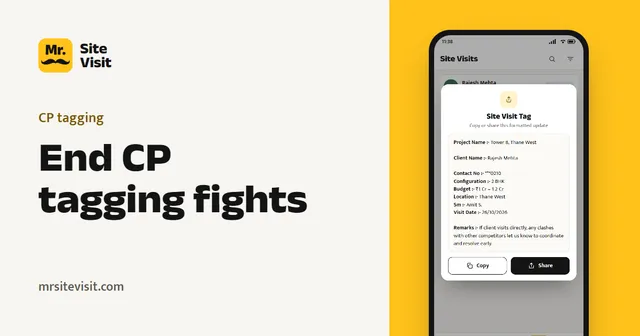
That place is the phone’s GPS position at the start and end. It shows where the phone was, not that the buyer was there. It also helps to tag the visit: a message to the developer’s team saying which buyer you brought, and when. In ours, it’s a message you copy to the builder’s WhatsApp group, with the buyer’s number masked; nothing is sent by itself.
A record gives you dated facts for the conversation. Your agreement with the developer still decides who’s paid.
RERA also expects registered agents to keep records. Section 10 of the Act asks them to “maintain and preserve such books of account, records and documents as may be prescribed”. Your state’s rules decide exactly what, so a CRM report doesn’t replace them. Our guide to settling “who brought this buyer?” fights covers the rules that go with it.
Buyers belong to the firm, not to a phone
The only safe copy of a buyer is one the firm owns. So the CRM should let you hide full numbers from staff who don’t need them. Exports should need your approval.
When someone leaves, you should be able to sign them out of every device in one step. Their leads should move to a colleague with every call and note.
India’s Digital Personal Data Protection Act, 2023 asks businesses that hold personal data to build reasonable security safeguards. Its Rules bring most duties into force from 13 May 2027, as SCC Online reported. Check with your lawyer which duties apply to your firm, and when. Our post on keeping clients when a salesperson leaves has the full checklist.
You should see five numbers in two minutes
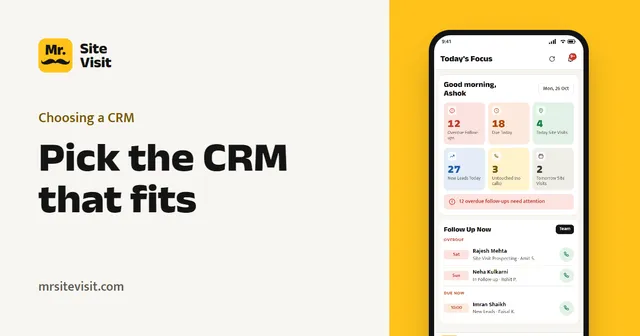
You don’t need fifty reports. You need five numbers every morning, by person and by source: leads in, calls that connected, visits fixed, visits done and bookings. If the CRM can’t show you that in two minutes, you won’t look, and the team will know you don’t. Say one person’s connected calls are low on Tuesday morning: that’s your first conversation of the day.
Test it with your own leads, not the vendor’s demo
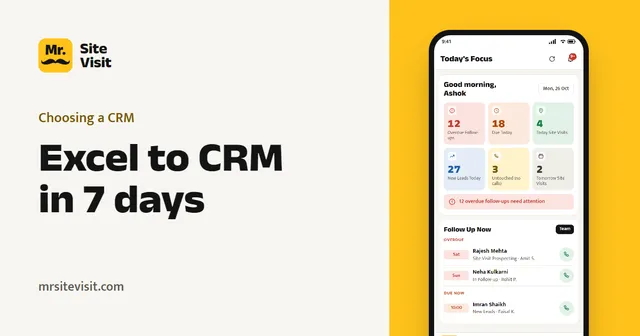
A demo with sample data proves almost nothing. Ask for a trial, or use a refund window, and run one real week through it. Here’s a week that tells you enough:
- Day 1 Import your sheet and connect one portal. Time how long it takes.
- Days 2–3 Check every new lead got one owner, and see what happened to the ones nobody called.
- Days 4–5 Tag two real site visits, and send the record to the developer’s team. (In ours, the visit record is on Growth.)
- Day 6 Pull the owner’s five numbers. Did it take two minutes?
- Day 7 Ask the team one question: would you keep using this?
Take this checklist into every demo:
- Show me a 99acres or Meta lead arriving and getting one owner
- Show me what happens when the owner doesn’t call in time
- Show me a call logged without anyone typing it
- Show me a site visit record I can send a developer
- Show me how I hide numbers and approve an export
- Show me my five numbers, by person and by source
- Tell me the price per user, the minimum users and whether GST is extra
Won’t my team stop using it after a month?
The fair objection: “We tried a CRM last year. The team used it for two weeks and went back to WhatsApp.”
That’s common, and it’s rarely the team’s fault. Usually the CRM asked for typing on top of the real work. So pick one that takes work away. Leads should arrive by themselves, and calls should log without typing.
Then do the one thing that decides adoption. Look at the numbers every morning, in front of the team, for the first month. My honest view: the owner’s habit matters more than any feature.
Which firm are you?
How much you need depends on your size:
| If you are… | Then… |
|---|---|
| One or two people, a handful of leads a week | A well-kept sheet may be enough for now |
| Three to six people, the owner still sells | Leads to one owner, logged calls and visit records matter most |
| Seven to twenty people with a manager | Add hidden numbers, export approval and the owner’s daily numbers |
| Working with many developers at once | Make sure leads and visits can be tagged by project |
What it costs, and when not to buy
When not to buy: if you’re one or two people with a handful of leads a week, a well-kept sheet will do for now. Everyone else should compare prices properly.
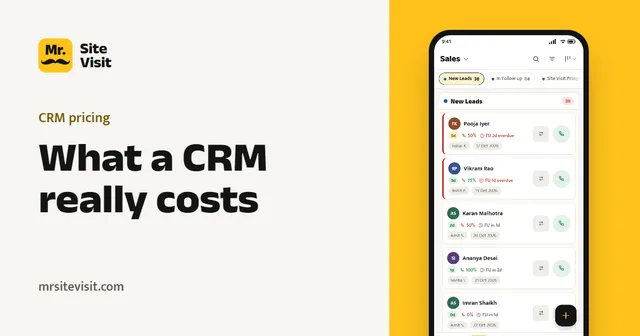
Prices vary a lot between vendors, and many don’t publish them. Ask every vendor the same four questions. What’s the price per user per month? How many users at least? Billed how often? Is GST extra? Then compare the yearly total for your team, not the headline number. Our guide to real estate CRM pricing shows how.
For comparison, here’s what we charge. Mr. Site Visit starts from three users, billed yearly, with no GST on top. The visit time and place record is on the Growth plan:
For 6 users billed yearly, that’s ₹30,456 on Starter or ₹39,456 on Growth. You pay first; if it isn’t for you, our 7-day money-back window covers the whole test week.
We built it for exactly this kind of firm. Leads get one owner and move on if nobody calls. Calls are matched to each phone’s own call log, on Android. Site visits are stamped with time and GPS location, and there’s a visit tag message for the developer’s group.
See how it works for CP firms, or the plans and prices.
Whatever you choose, run one real week before you pay. Tell your team on Monday you’re trying two tools for a week, and that you’ll read the numbers with them every morning.
Questions teams ask
Does a small channel partner firm need a CRM?
Once three or more people handle leads, usually yes. That’s when leads start getting lost between people, visits go unrecorded and nobody can show the developer who brought a buyer. With one or two people and a handful of leads a week, a well-kept sheet can be enough.
What’s the difference between a CRM for a CP firm and one for a developer?
A CP firm needs fast lead ownership, call logging, site visit records and simple owner reports. A developer’s CRM adds inventory, bookings and managing many outside partners, which a CP firm doesn’t need to pay for.
How long does it take a CP firm to start using a CRM?
With us, importing your sheet and connecting your portals usually takes a day. Getting the team to use it every day takes a few weeks of the owner checking the numbers each morning.
Can we take our data with us if we change CRM later?
Ask before you sign. A good CRM lets the owner export leads, calls and notes at any time. In ours, each export needs a one-time code sent to the owner, so only the owner can take the data out.
How much does a CRM cost for a CP firm in India?
Prices vary widely by vendor and billing. Ask for the price per user per month, the minimum number of users, the billing period, and whether GST is extra, then compare the yearly total for your team.
Sources
- Courtbook, RERA Act 2016 Section 10, functions of real estate agents (text reproduced)
- Digital Personal Data Protection Act, 2023 (Act No. 22 of 2023, assented 11 August 2023), India Code
- SCC Online, MeitY notifies the Digital Personal Data Protection Rules, 2025 (14 November 2025): most duties apply from 13 May 2027