Why your salespeople keep buyers on their own phones
By Jayesh G, Founder · 11 min read. Published 9 November 2026.
In short
- Salespeople often keep buyers on their own phones because it feels like their only protection: their proof of work and their job security.
- Rules and threats get you names in the CRM, not the real buyer. The real conversation stays on WhatsApp.
- Write down four promises first: who keeps credit, when a lead can move, what happens to incentive after someone leaves, and that their own numbers are theirs to use. Then ask for every buyer.
On this page
- Hiding buyers is their insurance
- Four fears sit behind “the client is with me”
- More rules without promises make it worse
- Write four promises before you ask for buyers
- Read the promises out at Monday’s meeting
- Set a date for the buyers already on phones
- Logged buyers protect both of you
- Which team are you?
- “If I promise credit, they’ll claim every lead”
- What I’d check this week
- Software makes the promise easy to check
- Questions teams ask

“Sir, don’t worry. The client is with me.” Have you heard that from your best people?
It sounds like loyalty. It also means the buyer lives on their phone. In their WhatsApp. Nowhere in your firm’s records.
Many owners read this as laziness or a bad attitude. I think it’s neither. That’s my reading from years on sales floors, not a study. For a salesperson, a buyer on their own phone is insurance. They’ll put buyers in the CRM (the software your team logs leads, calls and visits in) when logging is safer for them than hiding. That depends on rules only you can write: who keeps credit, when a lead can be moved, and what happens to their incentive if they leave.
The simple rule Before you ask for every buyer in the system, write down what a salesperson keeps when they log one.
Hiding buyers is their insurance
A salesperson keeps buyers on their phone to protect their income and their job. From their side of the desk, it’s a sensible choice.
Think about what they may have watched happen to someone. A hot lead handed to a manager’s favourite. A closing manager paid for a buyer someone else brought to the site. A colleague who left before the brokerage came in, and lost the incentive with it.
So they learn that the only buyers nobody can take away are the ones nobody else can see.
You usually can’t stop a salesperson joining a competitor. Section 27 of the Indian Contract Act is the rule on agreements that stop someone doing their trade. Under it, such a clause after they leave is generally void. But nothing stops you replacing them either. So they hold on to the one thing you can’t replace overnight: buyers only they know. (For what confidentiality terms you can still use, ask your lawyer.)
Four fears sit behind “the client is with me”
Each fear comes from something they may have watched happen, and each one leaves a mark in your records. These are typical examples, not one firm’s story.
| What they fear | What they may have seen | What you see in your records |
|---|---|---|
| The lead gets moved | A manager handed a hot lead to someone else | Leads logged late, after the buyer is “safe” |
| Someone else takes the credit | The closer got the incentive for their visit | Notes that only say “follow-up” |
| Incentive is lost if they leave | A colleague left before brokerage arrived | Bookings logged at the last moment |
| They become easy to replace | Feeling replaceable once the buyers are in the firm’s system | The best buyers never logged at all |
Look at the last column in your own lead list. Do you see these patterns? Then the fear is already in your firm, whether anyone says it or not.
More rules without promises make it worse
Some owners answer hiding with pressure. “Log every lead or no salary.” Daily screenshots. A manager checking WhatsApp.
Pressure gets you the minimum. A name goes in. A note says “call back”. The real buyer stays in the salesperson’s chat. Their budget, their family’s doubts, the flat they liked.
You’re not wrong to want every buyer in the firm’s records. The firm usually pays for the portal and ad leads. Under the Digital Personal Data Protection Act, 2023, the firm that decides how buyer data is used answers for it. Under the DPDP Rules, 2025, the main duties apply from 13 May 2027. You need the record. They need to feel safe handing it over.
A 2009 Destination CRM column by Jim Dickie, a partner at CSO Insights, made a similar point. Many salespeople leave a CRM unused unless managers show them the personal payback. In a CP firm (a channel partner firm that sells developers’ projects), I think the biggest payback is safety.
Write four promises before you ask for buyers
Give your team four written promises, on one page, before you ask for every buyer. They cost you little, and they remove most of the reason to hide.
- A logging promise
- A written rule that says what a salesperson keeps (credit, leads, incentive) when they put a buyer in the firm’s records.
- Credit stays with the work. Whoever logs a buyer first and does the first site visit keeps a written share if it books, even after a handover.
- Leads move only by a known rule. No call within your set time, the salesperson is on leave, or they ask for help. Never because a manager decided on the day.
- Incentive survives leaving. Say what happens to incentive on bookings that pay out after someone leaves. Match the window to how long your developers take to pay, and write it down. Have your lawyer check the wording against your appointment letter.
- Their numbers are theirs. They can see their own calls, visits and bookings any time, and use them at their appraisal.
The second promise matters most. A lead that can be taken by anyone, at any time, is a lead nobody will log early.
Why would they believe a page? Sign it yourself. Name who settles a dispute: the owner, not the team leader. Then keep the promise once in public, the first time it costs you something. For example, honour the finder’s share on a booking the closer wanted to keep. Review the page with the team after three months.
The third one costs less than it sounds. Here’s an illustrative example. A salesperson leaves with two bookings still waiting for brokerage. Their incentive on them is ₹40,000. If brokerage usually lands four months after booking, a four-month window pays it. You were going to pay that ₹40,000 anyway if they’d stayed.
The fourth one flips the fear. Today, the phone is their only proof of work. Now the firm’s record shows every call and visit they made. That record becomes their proof. It gives them something to show at their appraisal.
What share is fair? Only as an example: 30% of the incentive to the person who found the buyer, 70% to the closer. Our post on splitting incentive between the area team and the closing manager has worked options.
Read the promises out at Monday’s meeting
Read the promises out at your Monday meeting, then send them in the team group. Keep it short and in your own words.
Then ask one thing. What would make them put every buyer in? Listen to the answer. It’ll tell you which fear is strongest in your firm.
Set a date for the buyers already on phones
Give everyone a fixed date, about two weeks out, to log the buyers they already have. Before that date, no questions and no blame.
Ask each person for a list of the buyers they’re working. Check each list against the portal and ad leads assigned to that person. From now on, move buyer chats to a firm WhatsApp number. Or a group the firm owns.
After the date, a buyer who isn’t in the firm’s records earns no credit under the promises. If someone still keeps buyers off the system, talk to them alone first. If it carries on, new leads go to people who follow the rule. That may cost you, if it’s your best closer. Weigh it, but don’t make the rule theirs alone to break. Have your lawyer check how this fits your appointment letters and incentive rule before you announce it. The promises only work if they apply both ways.
Promises aren’t the answer to everything. Someone passing your leads to another firm is a different problem. That’s a breach of trust. Deal with it as one.
Logged buyers protect both of you
Same buyer, two ways: logged with the promises, or kept on a phone without them.
Logged, with the promises
- The salesperson’s work is on record, with dates
- Credit is clear before the booking, not argued after
- A handover keeps the buyer’s history
- If someone leaves, the buyer stays with the firm
On their phone, without promises
- Only they know what the buyer said
- Credit is a fight at booking time
- A handover starts from zero
- If they leave, the buyer may leave too
Our post on keeping clients when salespeople leave covers the last row: what to do on someone’s last day.
Which team are you?
The fix is the same in every firm. Who has to keep the promise changes.
- 3–6 people, owner still selling. You’re probably the biggest hider in the firm. Log your own buyers first, or the team won’t believe the rule.
- 7–20 people with team leaders. Your team leaders move leads every day. The promise has to bind them, not only you. Ask them to sign it too.
- Mandate teams (firms given a developer’s project to sell) and developers’ in-house teams. The fight is between the person who found the buyer and the closing manager. Promise one is the one to write first. Outside CPs come under your agreement with them, not an appointment letter.
“If I promise credit, they’ll claim every lead”
Some will try. That’s a fair worry. The answer is a record both sides can see.
You decide credit. The dated record is your evidence. Use the same test as promise one: who logged the buyer first, with a real call, and did the first site visit.
Two people log the same buyer? The earlier entry with a real call wins. A claim made after the booking, with no entry, gets no credit. Write that tie rule on the same page, before the first dispute. Then check the wording with your lawyer. So the promise itself makes people log early. Isn’t that what you wanted in the first place?
Is it worth it for a 3-person firm? Maybe not in writing yet. If you sit next to each other all day, a spoken promise may be enough. Once you have a team leader between you and the salespeople, write it down.
What I’d check this week
You don’t need any software for these. A lead sheet and two honest conversations will do.
- Count last month’s leads whose only note says “follow-up” or “call back”
- Ask two salespeople, one by one, what would make them log every buyer
- Read your incentive rule: does it say what happens after a handover, or after someone leaves?
- Count the leads a manager moved last month without a written reason
- Compare each person’s site visits and bookings with the leads they logged; ask about buyers who visited but were never in the sheet
- Write the four promises on one page, even as a rough draft
Software makes the promise easy to check
The promise is yours to make. A system can make it easy to keep, and easy to check.
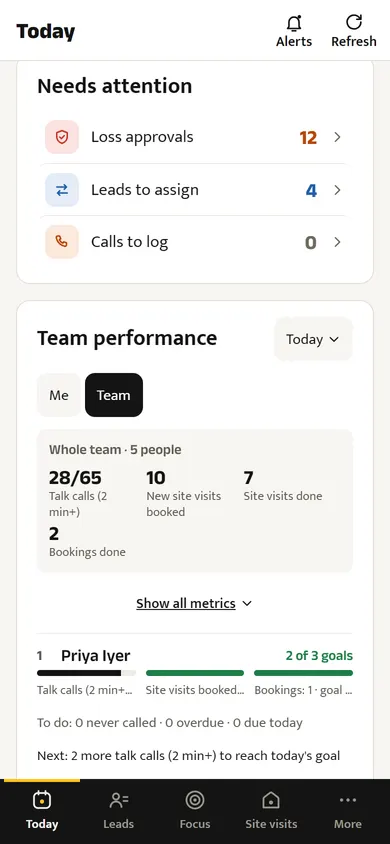
In Mr. Site Visit:
- Each salesperson sees their own talk calls (connected calls of 2 minutes or more), visits and bookings
- Calls matched from the phone’s call log show as Verified; calls typed in by hand show as Unverified and are left out of the numbers
- If nobody calls and the lead’s stage (new, visit booked and so on) doesn’t change within your set time, the lead goes to the next person; the default is 2 hours
- Phone numbers can be hidden from some roles, so people can call a buyer without seeing the full number, and exports need the owner’s OTP approval
Call matching works on Android, and it reads the phone’s call log to do it. Tell your team that up front. Get their consent in writing, and ask your lawyer to word it.
Be clear about the limits. Hiding numbers and OTP-approved exports make bulk copying harder. They don’t stop someone writing a number down. And the app can’t see WhatsApp chats. Leave, help and credit stay your own written rules. The promises are what make people log. You can see how it works for channel partner firms, or check the plans and prices.
This week, write the four promises on one page and read them out on Monday. Then ask for the buyers.
Questions teams ask
Why don’t my salespeople put all their leads in the CRM?
Usually because logging a buyer feels risky to them. Once a buyer is in the firm’s system, the lead can be moved, the credit can go to someone else, and the salesperson feels easier to replace. Fix those fears in writing, with clear rules on credit, lead moves and incentive, and most hiding stops.
Can I force salespeople to log every lead?
You can make it a rule, and you should. But force alone gets you the minimum: a name and a note saying 'follow-up'. The real conversation stays on their phone. Pair the rule with written promises about credit and lead moves, so logging is safer for them than hiding.
Who owns a buyer’s number: the firm or the salesperson?
The firm is usually the one the law holds responsible for the buyer data it collects. Who owns contacts a salesperson brought with them is a question for your lawyer, so put the firm’s position in the appointment letter. Either way, the salesperson owns their effort, so give them visible credit for the buyers they bring and work. The record and the credit are two different things, and both need to be written down.
Should a salesperson keep credit if their lead is handed to someone else?
Yes, a written share of it. If the first person logged the buyer and did the first visit, a handover shouldn’t wipe out their work. Decide the share once, put it on one page, and apply it every time. Our post on splitting incentive between the area team and the closing manager has worked options.
Sources
- iPleaders, Overview of Section 27 of the Indian Contract Act, 1872 (July 2024): agreements in restraint of trade are void
- Digital Personal Data Protection Act, 2023 (Act No. 22 of 2023), India Code: the Data Fiduciary’s duties
- Destination CRM (CSO Insights), Don’t Confuse Implementation with Adoption (2009): salespeople need to see the personal payback