One salesperson brings a third of your bookings. Now what?
By Jayesh G, Founder · 10 min read. Published 9 November 2026.
In short
- If one person brings a large share of your bookings, the firm is running on them. Measure it: a big share is a risk to manage.
- The cost isn't only what happens if they leave. It's the rules you bend for them today, and what the rest of the team learns from it.
- In one quarter: get their buyers into the firm's records, pair a junior with them, copy their best habit, and offer them a path to grow, not exceptions.
On this page
- Count how much of the firm sits with one person
- The rules you bend for them cost the rest
- Many owners get here by hiring a star to replace themselves
- Cut the risk in one quarter
- Ask what they want, and offer a path
- Which firm are you?
- “If I push, they’ll leave”
- What I’d check this week
- Software can’t keep them, but it shows the numbers
- Questions teams ask

Who in your firm, if they resigned tomorrow, would take half your bookings with them?
If a name came to mind at once, you already know the problem. You need that person. And you can’t run a firm around one person forever.
This post is about a fear owners rarely say out loud. Being afraid of your own best salesperson. Depending on one person is a risk you can measure, and shrink over one quarter, without having to push them out. The way out is to move their buyers and their best habits into the firm. Then offer them room to grow instead of exceptions to the rules.
The simple rule When one person brings more than about a third of your bookings, treat it as a business risk, not a compliment.
Count how much of the firm sits with one person
Start with one number: your best person’s share of bookings over the last six months. It takes ten minutes with your booking list.
- Dependence share
- One person’s bookings in the last six months ÷ the whole firm’s bookings in the same six months.
Here’s an illustrative 9-person CP firm (a channel partner firm that sells developers’ projects). The figures are examples, not a real firm:
Count by value too. Thirteen small bookings and thirteen large ones aren’t the same risk. So check their share of brokerage as well. And use one meaning of “booking” for everyone, such as agreement signed.
Then count three things the booking list won’t show. How many of their open buyers are only on their phone? Which developers’ CP desks call them, and not your firm? And which juniors would follow them if they left?
The “about a third” line is my rule of thumb, not a law. A firm of under six people will always lean on one or two. There, check something else: has your second-best person closed a booking alone in the last three months? If not, the firm runs on one person, whatever the share.
The rules you bend for them cost the rest
The risk includes what you allow while they stay, as well as what happens if they leave.
Make a quiet list. What have you let them do that you’d warn a junior for?
- Skip the Monday review
- Keep buyers in their own WhatsApp
- Pick their own Saturday site visits and leave the rest to juniors
- Speak to juniors in a way you’d stop from anyone else
Each exception teaches the rest of the team something: the rules are for people who don’t sell. You may see juniors stop trying, because the good leads go one way. And your team leader may stop enforcing anything, because the owner doesn’t.
The star’s missed Monday review is easy to see. Juniors who quietly stop logging their calls are the bigger cost, and nobody counts them.
So keep a few rules for everyone, the star included. Three are enough:
- Every buyer goes into the firm’s records on the day you first speak to them
- Everyone attends the weekly review
- Anyone who leaves hands over every open lead, with notes, before their last day
Many owners get here by hiring a star to replace themselves
It may have started with you. Maybe you were the best seller in the firm, and every buyer wanted you. The natural way to grow was to hire someone who could sell like you.
A business broker, First Choice Business Brokers, calls this a trap. Hiring one star to replace yourself, it writes, is “trading a dependency on you to dependence on a sales rep”.
The same page reports a finding about owners who used the Value Builder Score, a self-assessment for business owners. Firms that could easily replace their top salesperson were more than twice as likely to get an offer to buy the business.
The page gives no sample size or method. And it isn’t about CP firms or India. But the point travels well, even if you never plan to sell. A buyer for your firm is likely to weigh this. And it makes stepping back harder for you too.
Cut the risk in one quarter
One quarter is enough to shrink the risk a lot. Do it in this order, so the person never feels pushed out.
- Month 1: buyers into the firm. Every open buyer of theirs goes into the firm’s records, with credit to them written down first.
- Month 2: a second person on big buyers. A junior joins them on site visits for large bookings, and handles the follow-ups. Take the junior or a team leader to your next meeting at each developer’s CP desk, so the desk knows a second name.
- Month 3: copy the habit. Find the one step where they beat the rest, and teach that step to the team.
The first step needs a promise, or they’ll resist it. Tell them in writing that logging a buyer doesn’t move the buyer, and that their credit stays.
When a junior joins on a big buyer, write the split down before the visit. The star keeps the booking credit; the junior gets a small fixed amount for the follow-ups. That way the star loses nothing by teaching.
Not sure how to open that talk? Here’s an illustrative way, in three lines:
What if they refuse to log their buyers? Talk to them first, alone, not in front of the team. Then give a date in writing. After that date, new leads go to people who follow the rule. Check their written terms with a lawyer before you change how leads are shared.
For the third step, compare five steps from lead to booking. Our post on what your best salesperson does that the rest don’t has a free sheet for it. The gap might be one habit. Calling back faster, for example. Or booking the second visit before the buyer leaves the site.
Ask what they want, and offer a path
In my view, many top salespeople don’t really want exceptions. They want growth, and exceptions are what they get instead.
So ask them, plainly. Where do they want to be in two years? Then match the answer with something written.
| If they want… | Then offer… |
|---|---|
| More money | A higher slab (commission rate) on bookings above a target, written for the year |
| Status | Team leader, with a small share of their team’s bookings |
| A stake | A profit share after 12 months, on paper, with a CA’s (chartered accountant’s) help. It’s the biggest offer, so try the others first |
| To be left alone | Freedom in how they sell, but not from the few rules that protect the firm |
The team leader option does two jobs. They earn from other people’s bookings, so they want the juniors to get better. And their buyers and habits spread through the team. That’s the risk you wanted to cut. Before you offer any of these, check the cost. What would it have paid on your last six months of bookings?
Here’s an illustrative sum. Say each booking earns the firm ₹1,50,000 in brokerage. You offer an extra 5% of that on every booking above 10 in six months. On 13 bookings, that’s 3 × ₹7,500, or ₹22,500 for the half-year. A profit share is much bigger. It touches tax and ownership. Speak to a CA and a lawyer before you promise one.
My honest view on the law: don’t count on a contract to keep them.
Section 27 of the Indian Contract Act is the rule on agreements that stop someone doing their trade. As iPleaders explained in July 2024, a clause that stops an employee joining a competitor after they leave is generally void. Limits while they still work for you can be treated differently. Ask a lawyer what your own contracts can protect, such as confidentiality. What you can always protect is your firm’s data. Our post on keeping clients when salespeople leave covers that.
Which firm are you?
Dependence looks different at each size. So does the fix.
- 3–6 people, owner selling. The star is often you. The same share applies to you. Your first hire’s job is to close a booking alone.
- 7–15 people. One star and a few average sellers is common. The quarter plan above fits best here.
- 15+ people, or a mandate team (a firm given a developer’s project to sell). You may have one star per project or per area. Measure the share by project, and pair juniors project by project.
“If I push, they’ll leave”
They might. It’s the fear that keeps most owners stuck, so let’s look at it straight.
If they’d leave over the same rules everyone follows, they were likely to leave anyway. Better it happens after their buyers are in the firm’s records, not before. That’s why month one comes first, and the conversation comes after it.
And many won’t leave. When did your best person last hear about a written path to more money or a team from you?
If they resign anyway, have a same-day plan. Someone calls each open buyer in the firm’s name. The junior from month two takes the big ones. And talk to the juniors closest to them that week, before anyone else does. Buyer calls from a firm SIM, not a personal number, make this far easier.
What I’d check this week
You don’t need software for any of these. A booking list and one honest conversation are enough.
- Work out your best person’s share of bookings over the last six months
- Count their open buyers that aren’t in the firm’s records
- Write down every rule you’ve let them skip this year
- Pick one junior to join them on their next big site visit
- Book a one-to-one with them, and ask where they want to be in two years
Software can’t keep them, but it shows the numbers
No software will keep your best person. What it can do is show each person’s numbers, so you can work out the share yourself.
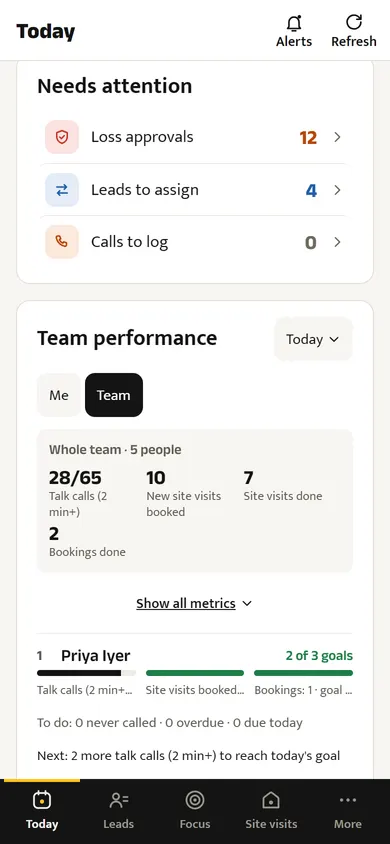
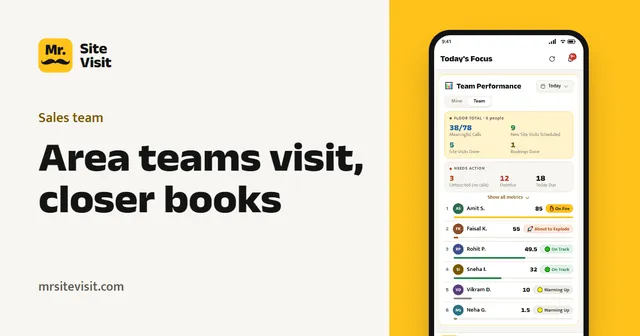
In Mr. Site Visit, you see the team’s talk calls (connected calls of 2 minutes or more), visits and bookings. Each person’s numbers sit beside them. Buyers sit in the firm’s account. A handover moves each lead with every call, note and visit.
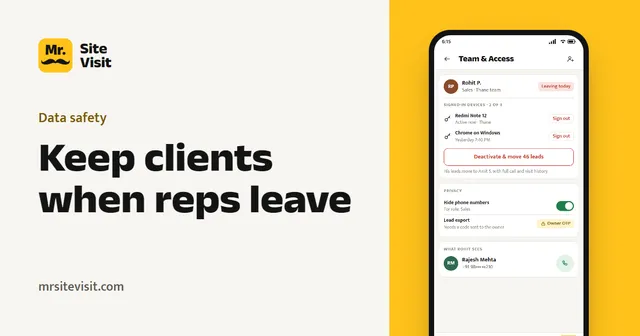
If someone leaves, you can sign them out of every device remotely. It can’t take back what someone has already copied or remembers. It does make bulk copying harder. Buyers’ phone numbers can be hidden on screen by role, and exports need the owner’s OTP approval. Pay and incentives stay with you and your CA; the software doesn’t calculate them. See how it works for channel partner firms, or check the plans and prices.
This week, work out that one number: your best person’s share of bookings. Then book the conversation.
Questions teams ask
How much of my bookings can one salesperson bring before it’s a problem?
There’s no fixed line. My rule of thumb: once one person brings more than about a third of the firm’s bookings over six months, treat it as a business risk. Measure it from your booking list, then reduce it over a quarter by moving their buyers, habits and relationships into the firm.
Should I let my best salesperson skip the rules?
No, but pick your rules carefully first. Keep the few that protect the firm, like buyers in the firm’s records and the weekly review, and apply them to everyone. Every exception teaches the rest of the team that rules are for people who don’t sell.
How do I stop my top salesperson from leaving?
You can’t guarantee it. In India, a clause that stops an employee joining a competitor after they leave is generally void, so ask a lawyer before relying on one. Ask what they want: more money, a title, a team or a share. Offer a written path to it. And keep their buyers in the firm’s records, so a resignation isn’t a crisis.
What happens to my firm’s value if it depends on one salesperson?
A buyer is likely to see it as a risk, and it makes stepping back harder for you too. A business broker wrote about owners who used the Value Builder Score, a self-assessment. Firms able to replace their top salesperson easily were more than twice as likely to get an offer to buy the business. The page gives no sample size or method.
Sources
- First Choice Business Brokers, Avoiding the superstar sales rep trap (Value Builder Score analysis; read 9 November 2026): firms that could easily replace their top salesperson were more than twice as likely to get an offer
- iPleaders, Overview of Section 27 of the Indian Contract Act, 1872 (July 2024): agreements in restraint of trade are void