The team leader’s daily checklist for a real estate sales team
By Jayesh G, Founder · 8 min read. Published 28 October 2026.
In short
- A team leader (TL) is measured on the team’s numbers, not their own sales. Their day has four parts: the morning check, listening to calls, clearing what’s stuck, and reading the evening reports.
- The morning check takes about fifteen minutes: uncalled leads, today’s visits, overdue follow-ups and who’s away.
- Print the checklist below, and add one weekly review of the numbers with the owner.
On this page
- A team leader is judged on the team, not on their own sales
- The morning: fifteen minutes before the first call
- Midday: listen to two calls
- Afternoon: clear what’s stuck with the developer
- Evening: read the reports, answer every help line
- The week: two fixed meetings
- “But my TL is my best closer”
- What a team leader should stop doing
- Which team are you?
- What I’d check this week
- Where software helps
- Questions teams ask
A team leader who spends the day selling is a salesperson with a bigger title. If your TL closes the most deals and nobody else improves, you’re paying for a manager and getting a salesperson.
Your team leader’s job is the team’s numbers, not their own. That job has a shape. A short check in the morning for what’s slipping. Listening to your team’s calls in the day. Clearing what’s stuck with the developer’s team in the afternoon. And reading the reports in the evening.
Here’s that day as a checklist you can print, and the weekly rhythm around it.
The simple rule Check the morning, unblock the day, read the evening. The team’s numbers are the TL’s numbers.
A team leader is judged on the team, not on their own sales
First, settle what your team leader is for. Start with who answers for it when a visit doesn’t happen.
- Team leader (TL)
- The person who makes the team’s calls, visits and bookings happen. They’re judged on the team’s numbers, and on whether each salesperson gets better.
Why does this one role matter so much? In a 2015 analysis, Gallup found at least 70% of the differences in engagement between teams come down to the manager. That’s not real estate data. But you’ve seen it on your own floor. In my judgement, the same people work very differently under different leaders.
The morning: fifteen minutes before the first call
Before anyone dials, your team leader checks four things. Plan on about fifteen minutes with a sheet or a CRM (the software your team logs leads, calls and visits in).
- Find yesterday’s leads that nobody called, and name who calls each one by 10
- Check today’s site visits: confirmed, pickup arranged, cost sheet current
- Count overdue follow-ups per person, and ask the highest about them, calmly
- See who is away today, and move their leads and visits to someone else
Why so early? A portal lead that waits till the afternoon may already have heard from other agents. The morning check gives your uncalled leads an owner before the day fills up. It also answers the worst surprise. That’s finding out a visit didn’t happen only when the deal is gone.
How do you know the check happened? Ask your TL for one line by 10 am. How many leads were uncalled, and who got each? When the TL is away, name one senior salesperson to do the check.
Midday: listen to two calls
Numbers show what happened. Calls show why. So your team leader listens to at least two calls a day, sitting beside the salesperson.
- Pick the person Whoever’s numbers moved most this week, up or down.
- Listen for one thing The opening, the budget question, or how the call ends.
- Give one fix Not five. One thing to try on the next call.
- Check it tomorrow Listen to one more call from the same person.
Will your team feel watched? Not if it’s the same for everyone, and the point is help, not blame. Say so on day one.
Afternoon: clear what’s stuck with the developer
Your salespeople get stuck on things only the developer’s team can answer. A unit hold, a floor-rise price, a payment plan, a revisit slot. The afternoon is when the team leader clears them. In a developer’s own team, that hour goes to the pricing desk. In a mandate team, it goes to the project head.
Each of those is a round of calls with the developer’s sales manager. In my experience, it can easily take half an hour. A salesperson with visits to run can’t give that time. That’s why it’s worth one person’s afternoon. In bigger teams, a closing manager takes this job. Our post on team structure for channel partner firms shows how your roles can split.
It’s also why your team leader shouldn’t carry a full lead list. In its 2022 survey of sales reps across industries, Salesforce found reps spend just 28% of their week actually selling. That’s about reps, not team leaders. But a TL who also carries a full list has the same problem. I’d expect even less time left to run your team.
Evening: read the reports, answer every help line
At a fixed time each evening, your team leader reads every report together. Not as they arrive. Our daily report format has the lines to ask for.
Read the help lines first, and answer each one, even if the answer is “not this week”. Then scan the gap between leads in and leads called. Check that tomorrow’s visits are confirmed. Plan on about twenty minutes for a team of six, and adjust for your floor.
The week: two fixed meetings
On top of the daily routine, roughly two hours by my estimate, two meetings a week are enough. Keep them short, and always on the same day:
| When | What | How long |
|---|---|---|
| The first working day | Review last week’s numbers per person with the owner: calls, visits, bookings, overdue | 30 minutes |
| The day before the weekend | Plan the weekend’s site visits: who, which project, pickup, cost sheets | 20 minutes |
“But my TL is my best closer”
That’s the most common worry, and it’s fair. Take your best closer off selling overnight, and bookings may dip.
My honest answer: move it over a month, not a day. Hand the TL’s hot buyers to a closing manager a few at a time. Or hand them back to the salespeople, with the TL coaching. And from the first day, judge the TL on the team’s bookings, not their own. Watch three team numbers each month: meaningful calls per person, visits done and bookings. Our post on tracking your sales team shows how.
If you can’t spare them from selling at all, keep the team small. A TL who still sells fully can run four to six people, in my judgement, not ten.
What a team leader should stop doing
Some habits feel helpful but keep the team weak. If you see one, change it:
| If the team leader… | Then… |
|---|---|
| Takes every hot buyer personally | Hand them to a closing manager, or coach the salesperson through it |
| Fills in reports for the team | Stop; the report is the salesperson’s job |
| Is the only one who talks to the developer | Introduce each salesperson to the developer’s manager for their project |
| Spends the morning on their own calls | Do the fifteen-minute check first, every day |
| Answers help lines “later” | Answer by noon the next day, or say when |
Which team are you?
| Your team | Who does this job |
|---|---|
| 3–5 people, the owner sells | The owner is the team leader; keep the morning check and evening reports |
| 6–10 people | One team leader, selling a little at most; a TL who still sells fully should run four to six |
| 10–20 people | One team leader per area team, plus a closing manager |
| A developer’s or mandate team | A team leader per project or per team of four to six |
Who shouldn’t bother with the full list? A three-person team where the owner sits with everyone all day. Keep just the morning check.
What I’d check this week
You can test your team leader’s day without changing anything yet:
- Ask your team leader what they did between 9 and 10 each morning this week
- Count how many of their own deals they closed, and how many the team closed
- Check whether every help line in the reports got an answer
- Print this checklist, and agree the four parts of the day together
Where software helps
A sheet makes the morning check possible. Software makes it fast, because the list is already waiting.
In Mr. Site Visit, follow-ups due arrive as a push at 8:30 am, and overdue ones show in red. If a new lead isn’t called within the time you set, it moves to the next person; the default is 2 hours.
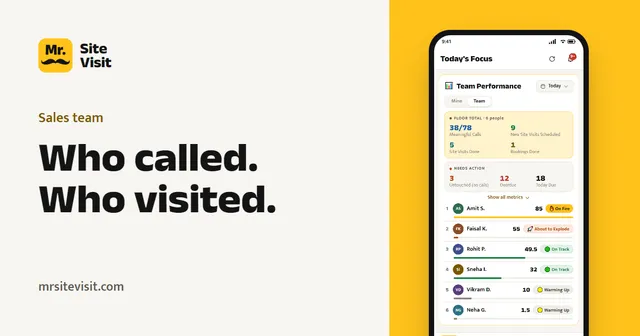
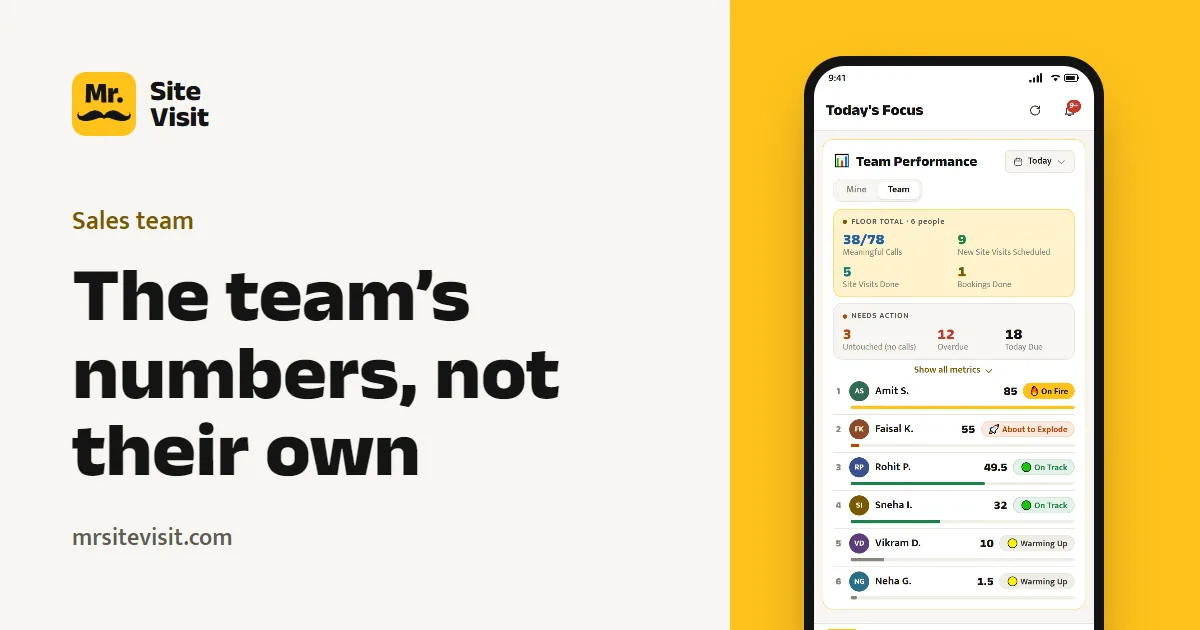
On Android, calls are matched from the phone’s call log and marked Verified, and the team view shows each person’s meaningful calls (connected calls of 2 minutes or more), visits and bookings. Follow-ups are reminders, not locks, and iPhone calls aren’t logged.
Starter is ₹423 a user a month, billed yearly, from three users, with no GST on top. There’s a 7-day money-back, and no free trial. See the plans and prices, or how it works for channel partner firms and developers.
Whatever you use, start with tomorrow morning. Sit with your team leader for the fifteen-minute check, and do it together for a week.
Questions teams ask
What does a team leader do in a real estate sales team?
A team leader makes the team’s numbers happen. Each morning they check uncalled leads, today’s site visits and overdue follow-ups. During the day they listen to calls and clear what’s stuck with the developer. In the evening they read the team’s reports and answer every request for help.
Should a real estate team leader also sell?
A little, in a small team, but their own sales shouldn’t be how they’re judged. If the team leader closes the most deals and nobody else improves, you have a salesperson with a bigger title. In larger teams, a closing manager takes the hard closings so the team leader can run the team.
How many people can one team leader manage?
It depends on how much they still sell. As a rough guide, a team leader who also sells can run about four to six people; one who doesn’t can run more. Watch whether the morning check still fits in fifteen minutes, and whether every help line gets an answer.
What should a team leader check every morning?
Four things, in about fifteen minutes. Yesterday’s leads that weren’t called. Today’s site visits, and whether each is confirmed. Overdue follow-ups per person. And who is away today, so their leads and visits move to someone else.
Sources
- Gallup, Beck and Harter, Managers Account for 70% of Variance in Employee Engagement (21 April 2015): managers account for at least 70% of the variance in engagement scores across business units
- Salesforce, State of Sales research (5th edition), 8 December 2022: reps spend 28% of their week actually selling, with most of the rest on tasks like deal management and data entry