44 property websites on a phone: what your buyer waits for
By Jayesh G, Founder · 13 min read. Published 6 November 2026.
In short
- We tested 44 Indian property home pages on a mid-range phone and slow 4G. The typical page took 7.8 seconds to show its main content. Only 1 met Google’s 2.5-second line for a good page.
- Only 10 of the 44 showed an enquiry form without a tap. 15 had no WhatsApp link and no tap-to-call number. Half the big developers covered the first screen with a disclaimer, cookie notice or alert.
- Check your own site in ten minutes: PageSpeed Insights on mobile, then your own phone on mobile data, with one thumb.
On this page
- What we found, in four numbers
- How we tested 44 home pages
- Most pages miss Google’s line for a good page
- Big developers’ pages are the heaviest
- Why a few seconds can cost you enquiries
- Half the big developers cover the first screen
- The enquiry form is hard to find
- A third give no quick way to reach anyone
- Which team are you?
- Check your own site this week
- “Our leads come from Meta forms, so the website doesn’t matter”
- Where a CRM helps, and where it doesn’t
- Questions teams ask
When a buyer taps your ad on a phone, what do they see first? Your project, or a white screen? We wanted a real answer for Indian property websites, not a guess. So we tested developer and agent home pages the way many buyers meet them. That’s a mid-range phone on a slow mobile connection.
Most made the buyer wait past Google’s line for a poor page. Few showed an enquiry form without a tap. About a third gave no WhatsApp link and no tap-to-call number. Half the big developers covered the first screen with a box to close. Below are the numbers and how we got them. Then there’s a ten-minute check for your own site.
The simple rule A buyer should see your project before you can count to three, and reach a person in one tap.
What we found, in four numbers
The typical home page took 7.8 seconds to show its main content. That’s on a mid-range phone and slow 4G.
“Typical” here means the median: half the sites were faster, half slower. And “main content” has a precise meaning in Google’s test.
- Main content time (Largest Contentful Paint)
- The moment the biggest picture or block of text on the first screen appears. Google calls 2.5 seconds or less good, and over 4 seconds poor.
Those two lines come from Google’s own guidance on Largest Contentful Paint. Google judges real visitors, though. We tested in a lab. Read the limits below before you quote us.
How we tested 44 home pages
We tested every site on three open lists, not sites we picked. Our team ran it on 6 November 2026.
- Big developers The home-selling companies in the top 20 of the 2024 GROHE-Hurun India Real Estate 100 (Hurun, 11 July 2024), plus developers in Wikipedia’s “Real estate companies of India” list.
- Map-listed firms Every estate agent in India with a website on OpenStreetMap, a free map volunteers keep.
- Speed Google’s free page test, Lighthouse, on its phone setting. Two runs, averaged.
- Phone check Each home page on a phone-sized screen, after 8 seconds: forms, WhatsApp, tap-to-call.
- By hand We checked every screenshot for popups, and re-checked every form found.
Lighthouse’s phone setting is meant to act roughly like a mid-range phone on the slower end of 4G. Plenty of your buyers have faster phones and better signal. Some don’t, and you can’t pick which ones click your ad.
Here’s how the lists became 44 tested sites. We didn’t work around any site that blocked us.
| Step | Sites |
|---|---|
| On the three lists | 62 |
| Left out before testing (broken entries, domains now owned by other businesses) | 5 |
| Domains that no longer exist | 7 |
| Blocked automated visits | 2 |
| Other failures (a certificate error, a server error, two test failures) | 4 |
| Tested: 22 big developers, 22 map-listed firms | 44 |
The limits, plainly:
- A lab test. Real buyers on 5G or Wi-Fi see these pages faster than our test phone did.
- Home pages only. Your ads may go to project pages, which can be faster or slower.
- Runs vary. A site’s two runs usually differed by about a second, so we averaged them.
- Lists, not a random sample of every property website in India.
We ran our own home page through the same test. Its main content showed in 2.3 seconds. It’s a small site with no video. We fail one check below, though. We have a WhatsApp link but no tap-to-call number.
Most pages miss Google’s line for a good page
Only 1 of 44 home pages showed its main content within 2.5 seconds. Most took over 4.
Something did appear sooner. On both lists, the first text or picture showed in about 3.4 seconds. Often that’s just a logo or a loading circle. The buyer still waits for the project.
How did the two lists compare? Big developers were slower and much heavier. Map-listed firms more often showed a form and a WhatsApp link.
| On a mid-range phone, slow 4G | Big developers (22) | Map-listed firms (22) |
|---|---|---|
| Main content shows, typical (median) | about 9.5 s | about 6.5 s |
| Over 4 seconds (poor) | 20 | 19 |
| Over 10 seconds | 10 | 8 |
| Page size, typical (median) | 9.9 MB | 2.2 MB |
| Pages over 10 MB | 10 | 1 |
| Form seen without a tap | 3 | 7 |
| WhatsApp link | 5 | 11 |
| Tap-to-call link | 10 | 13 |
| First screen covered after 8 seconds | 11 | 3 |
Big developers’ pages are the heaviest
Half the big developers’ home pages weighed nearly 10 MB or more. Half the map-listed firms’ pages stayed under 2.2 MB.
Where does the weight come from? We opened the heaviest pages’ file lists. One home page loaded a single photo of 15 MB. Another started three videos by themselves. Two pages passed 100 MB, mostly in video.
Here’s what weight means on the test connection. A 10 MB page takes about 50 seconds to arrive in full. The buyer may see the top sooner. But their phone keeps downloading the rest, on their data.
Big pages also call more outside services, like chat tools and trackers (scripts that count visits and ad clicks). The middle big developer page used 10 of them. The middle map-listed firm used 4. Each one is another wait the buyer doesn’t see.
Why a few seconds can cost you enquiries
In the largest study we know of, faster pages moved more people through the form. It wasn’t about property, and it wasn’t in India.
Google paid for the study, and two firms, 55 and Deloitte, ran it. It tracked European and American brand sites at the end of 2019. On lead generation sites, every page in the journey got a tenth of a second faster on four load measures, on mobile. Then 21.6% more users moved from the form’s first step to the submission page.
That’s a tenth of a second, on every page. Our typical page missed Google’s good line by more than 5 seconds. So we can’t tell you what a slow page costs you in enquiries. In that study, though, the direction is plain.
What does your ad report say? At Monday’s review, put last week’s paid clicks next to the website enquiries your team called. A big gap doesn’t prove a slow page is the cause. It tells you where to look first.
Half the big developers cover the first screen
On 14 of 44 home pages, a box to close covered most of the first screen. That was after 8 seconds. Among big developers, it was half.
| What covered the first screen | Home pages |
|---|---|
| A disclaimer to agree to | 7 |
| A cookie notice | 5 |
| A fraud alert | 1 |
| A chat window that opened by itself | 1 |
Several of these exist for a reason. The fraud alerts warn buyers about fake sites using the developer’s name. The question is only whether a box must cover the whole screen.
My honest view? Ask your lawyer if a short line under the header would do the same job. If it would, the buyer sees your project first. If it wouldn’t, keep the box small and quick to close.
The enquiry form is hard to find
Only 10 of 44 home pages showed an enquiry form without a tap.
On 15 more, a form was hidden until you tapped something like “Enquire now”. Only two pages had a form on the first screen. Both sat behind a disclaimer. On at least 6 of the 10, you’d scroll past 8 phone screens to reach it.
The forms themselves were short. The typical one asked for 4 or 5 things. Two asked only for a phone number.
Four forms asked for 5 things or more. Two had a captcha (the “I’m not a robot” check).
Is a hidden form wrong? Not always. A clear Enquire button works well if it stays in reach of the thumb. A button only in the menu makes the buyer hunt. So does a form far down the page.
A third give no quick way to reach anyone
Of the 44 home pages, 15 had no WhatsApp link and no tap-to-call number. Big developers did worse here than map-listed firms.
A number written as plain text still works. But the buyer must copy it, switch apps and paste it. A tap-to-call link dials it for them. Only about half the pages had one.
Who answers when they tap? That matters as much as the link. Think of the Saturday rush, when every salesperson is out on a site visit. If the call rings out at the office, the link just moves the drop somewhere new. Our post on calling portal leads in time covers that part.
Which team are you?
The fix depends on who built your site and where your buyers land. Find your row.
| If you’re… | Then check first… |
|---|---|
| A CP firm (a channel partner firm) with a template website | The tap-to-call number, the WhatsApp link and a short form. Your site is where a buyer checks you’re real. |
| A developer whose agency built the site | The main content time on mobile, the size of the top video or photo, and what covers the first screen. |
| A mandate company with project pages for each developer | The project pages your ads go to, not the home page. Test each one the same way. |
| A team of 3 to 5 with no website yet | A Google Business Profile with a tap-to-call number can cover first contact. Build the site when you run ads to it. |
Running a CP firm (a channel partner firm that earns brokerage, the commission developers pay on each sale)? Check one more thing. Of the 34 map-listed firms we tried, 9 had a website link that didn’t open for us: 7 dead domains and 2 broken sites. Is the link on your Google listing still live? And on your visiting card?
Check your own site this week
You don’t need software for this. It takes about ten minutes. Use pagespeed.web.dev, Google’s free version of the same test, and your own phone.
- Run your home page on pagespeed.web.dev, Mobile tab, twice, and note the main content time (Largest Contentful Paint)
- Run the page your ads actually go to, the same way
- Open both on your phone, on mobile data, and count until you see the project
- Find the enquiry form with one thumb, and count the taps
- Tap the phone number: does it dial? Tap WhatsApp: does it open a chat?
- Send a test enquiry, and time how long until someone calls you back
Then send your web person what you found. These are the four things I’d ask for, in this order:
- A still photo first. On phones, show a photo at the top, not a video that plays by itself.
- Photos at screen size. Resize every photo before it goes up, so a phone never downloads a poster-sized file.
- Extras after the page. Load the chat tool and trackers after the project shows, not before.
- One bar that stays. An Enquire button and a tap-to-call number at the bottom of every screen.
None of these needs a new website. Ask your agency for a price and a date for each one. On a template site, you may control only the bar, the WhatsApp link and the form. Start there.
If I could fix only one thing, it would be the bar. It’s the smallest job, and it works even on a slow page. If an agency quotes a full rebuild for these four fixes, ask why.
Who shouldn’t bother? If your page shows its project within 2.5 seconds and has the bar, leave the website alone. Spend the time on how fast your team calls back.
“Our leads come from Meta forms, so the website doesn’t matter”
That’s partly true. A Meta lead form opens inside Facebook or Instagram. It skips your website. So do portal enquiries.
But plenty of buyers still land on your pages. Your Google ads go there. So does anyone who searches your project’s name. And before a buyer confirms a Saturday site visit, where do they check you’re real?
Are most of your leads really Meta forms? Then your bigger problem may be the calls after them. Our post on why Facebook leads don’t convert starts there.
Where a CRM helps, and where it doesn’t
A CRM is the software your team logs leads, calls and visits in. It won’t make your website faster. Only your web person can fix the page.
It can make sure every enquiry the site does get reaches a salesperson. In Mr. Site Visit, your website form is one lead source, next to the portals and Meta. Each new lead goes to a salesperson at once, by your rules.
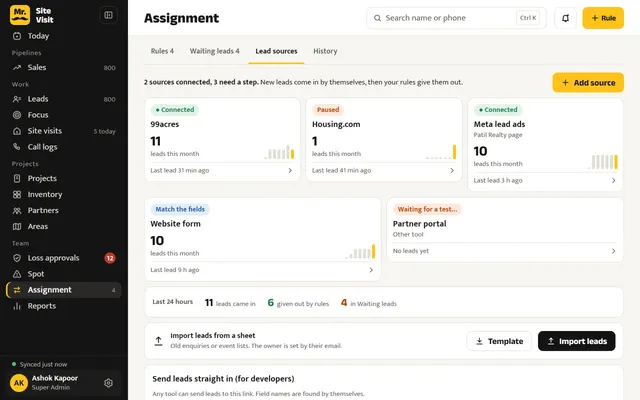
Calls are logged from your team’s Android phones, with their time and length. So you can see who called the website lead, and when. That’s the test enquiry from your checklist, answered every day. See how it fits developers or CP firms. Pricing starts from 3 users.
Open your home page on your phone tonight, on mobile data, and count. Share the number with your team on Monday. Then ask your web person what loads first.
Questions teams ask
How fast should a real estate website load on a phone?
Google calls a page good when its main content shows within 2.5 seconds, and poor when it takes over 4 seconds. In our test of 44 Indian property home pages, on a mid-range phone and slow 4G, only 1 met 2.5 seconds. The typical page took 7.8 seconds, and 39 took over 4.
How do I test my property website’s speed?
Open pagespeed.web.dev, paste your home page address and run it on the Mobile tab. Read Largest Contentful Paint: that’s when the main content shows. Run it twice and use the average, because each run moves a little. Then open the site on your own phone, on mobile data.
Why is my developer website so slow?
In our test, the usual causes were videos that play by themselves, photos uploaded at full size and many outside scripts. One home page loaded a single 15 MB photo. Ask your web person which file loads first and how big it is.
Should the enquiry form be on the home page?
A buyer should reach it in one tap. Only 10 of the 44 home pages we tested showed a form without tapping a button, and 2 had one on the first screen. A short form, or a clear Enquire button that stays in reach of a thumb, both work.
Does a faster website get more enquiries?
It did in the largest study we know of. When lead generation sites got 0.1 seconds faster on every page, 21.6% more users moved from the first form step to the submission page (55 and Deloitte for Google, end of 2019). Those were European and American brands, not Indian property sites.
Sources
- web.dev (Google), Largest Contentful Paint, Philip Walton and Barry Pollard (updated 4 Sep 2025): good is 2.5 seconds or less, poor is over 4 seconds
- web.dev (Google), Milliseconds make millions: a study by 55 and Deloitte for Google (37 European and American brand sites, end of 2019): 0.1 seconds faster on every page meant 21.6% more users moved from the first form step to the form submission page on lead generation sites
- Lighthouse (Google), throttling documentation: the mobile test simulates a 150 ms delay, 1.6 Mbps download and a 4x slower processor