A project launch plan: the first 30 days of leads and site visits
By Jayesh G, Founder · 7 min read. Published 31 October 2026.
In short
- A launch is won in the weeks after the event: every lead called within the hour, every partner registration answered the same day, every visit followed up.
- Register the project with RERA first. The Act bars advertising or booking before registration, and agents can't help sell an unregistered project.
- Publish the partner rules before launch day: the registration format, the tagging window and the tie rule.
On this page
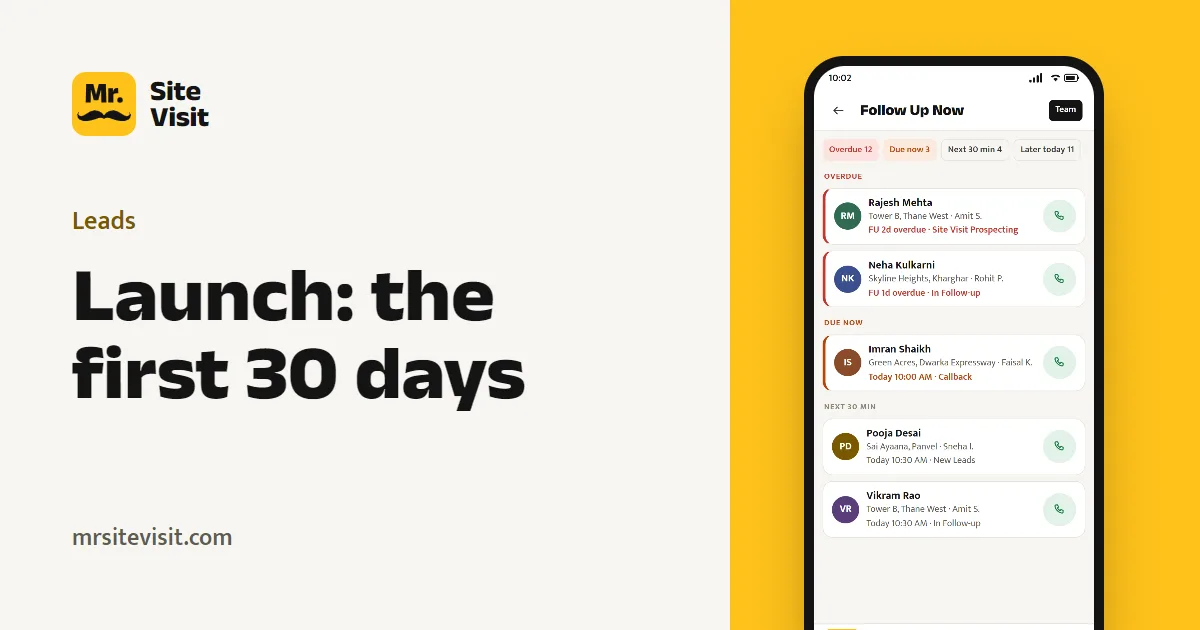
The weeks after launch day decide your launch, one lead and one site visit at a time.
Launch day brings the crowd. Then your real work starts. Enquiries need a first call. Your partners want their registrations confirmed. And families want a second visit before they decide.
So plan the whole month, not just the day. Register the project with RERA (the state’s real-estate regulator) before you advertise, market or book. Publish the partner rules before launch day. Then call every lead fast, answer every registration the same day, and count the same few numbers every evening.
The simple rule Register first, then advertise or book. After launch: every lead called within the hour, every registration answered the same day.
Register first: what RERA says
The RERA Act sets the order for you. Here’s what three of its sections say, from the Act’s own text:
| Section | What it says |
|---|---|
| 3(1) | No promoter shall advertise, market, book, sell or offer for sale, or invite people to buy, before registering the project |
| 10(a) | A registered agent shall not help sell a plot or flat in a project that isn’t registered |
| 13(1) | No more than 10% of the cost as an advance or application fee without a registered agreement for sale |
Two details catch launches out. Section 3(2) exempts small projects: land up to 500 square metres, or up to eight apartments, counting all phases. A state can set a lower limit, so check yours. And each phase needs its own registration. A phase-two launch isn’t covered by phase one.
What about EOIs (expressions of interest) before registration? The Act doesn’t name them. But one chartered accountant’s reading, published on TaxGuru, is that taking them before registration contradicts Section 3.
Ask your lawyer first Before you collect EOIs, take tokens or run ads before registration, ask your lawyer how these sections apply to your project. The same goes for any partner you brief.
CP firms collecting EOIs for your launch can follow our EOI playbook for CP firms.
Section 10(a) puts a duty on your partners too. A registered agent shouldn’t help sell a project that isn’t registered. A registered CP (channel partner) who does can be fined ₹10,000 for every day it goes on, up to 5% of the cost of what was sold (Section 62). So give every partner the project’s RERA number before they pitch. Ask for their own agent registration number too: Section 9(1) bars an agent from helping sell in a registered project without one.
Before registration, use the weeks well. Write the partner rules. Train your callers. Set up the desk. Ask your lawyer before you brief partners on the project itself.
Before launch day: put the partner rules in writing
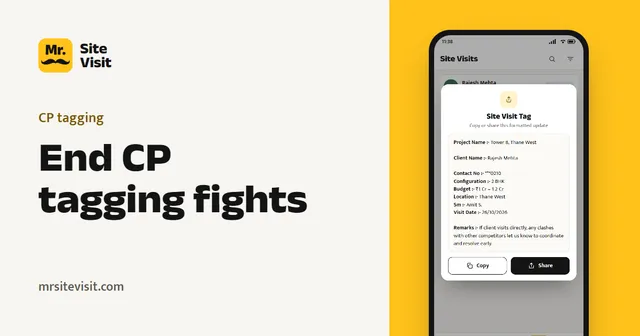
Most of your launch fights will be about one question: who brought this buyer? Get it wrong and you pay brokerage to the wrong partner, or lose a good one. Settle it on paper before the first visit.
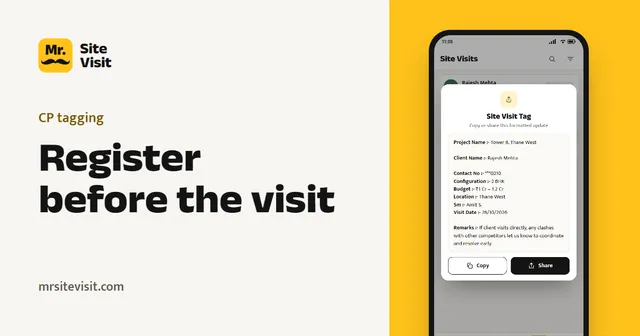
- Publish the registration format partners must send before a visit
- Promise an acknowledgement time, and keep it, even on launch day
- State the tagging window: how long a registered buyer stays a partner’s
- Write the tie rule for two partners claiming one buyer: for example, the earlier registration, with its date and time, wins
- Write the rule for a buyer who’s already in your own leads when a partner registers them
- Ask every partner for their RERA agent registration number, and keep a copy
- Share one price sheet and offer sheet with every partner
Our registration format has the fields and the acknowledgement message. And our post on settling tagging disputes explains why a written tie rule saves weeks later.
Then do the same for your own team. Who gets which leads? Who hosts which visit slots? Who answers the partner desk at 9 pm? Write it down.
Week one: speed, and nothing dropped
Your launch week is about speed and not dropping anything. Four things happen every day:
- Every new lead called within the hour By a named owner, including evenings and the weekend.
- Every partner registration answered the same day Accepted or rejected, with the reason.
- Every visit confirmed the day before With the location, the host and who’s coming.
- Every visit followed up within a day A call, and a dated next step.
On launch day, count the enquiries and the callers first. Here’s an example with made-up numbers: 240 enquiries between 10 am and 2 pm is 60 an hour. At about six minutes a lead, counting those who don’t pick up, one caller handles ten an hour. That’s six callers to keep the one-hour rule. Short? Add callers for the week. Don’t stretch the rule.
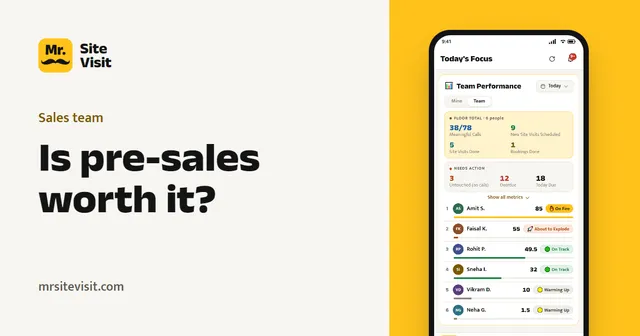
Launch week is when a pre-sales team earns its salary. Our post on pre-sales teams shows how to split first calls from site visits.
And watch the CP desk. On a busy launch day, registrations pile up on one phone. An unanswered registration is a dispute waiting to happen.
Days 8 to 30: revisits and follow-ups decide it
After the first week, the crowd thins. Your serious buyers are deciding between you and other projects. This is where a launch can lose bookings, quietly.
The buyer who visited on launch weekend needs a second visit with family. They need a cost sheet for the flat they liked, and a call on the date they gave. Nothing dramatic. Just done every time.
Count it every evening. Here’s the daily count I’d ask a launch team for:
| Every evening | Why it matters |
|---|---|
| New leads, and called within the hour | Speed in the busiest weeks |
| Visits fixed and visits done | Whether calls turn into visits |
| Revisits | Whether visits turn into serious buyers |
| Bookings | The result |
| Partner registrations: answered same day, disputed | Whether partner trust holds |
Look for the weakest line, and fix that one the next morning. Don’t try to fix five things at once. My honest view: if you count only one thing, count the registrations nobody answered.
Which team are you?
The plan is the same. Who owns which part changes:
| If you are… | Then… |
|---|---|
| A developer’s own sales team | You own the RERA order, the partner rules and the evening count |
| A mandate company (you sell a developer’s project on contract for them) | Agree the partner rules with the developer in writing, then run the desk and the count |
| A CP (channel partner) firm selling someone’s launch | Check the RERA number first, register every buyer before the visit, keep the acknowledgements |
Who shouldn’t use this? A small project sold mostly to people you already know. A notebook and a weekly call list will do.
“EOIs before registration are how the market works”
They’ve been common. Some teams see them as the way to read demand before fixing the price.
But the Act’s order is clear: registration before marketing, booking or inviting people to buy. And partners carry their own risk under Section 10(a). So if you want to read demand early, ask your lawyer what’s allowed. Until you hold the registration number, I’d take no money and no flat choice from anyone.
There’s a sales reason too. In my view, a launch that starts with a dispute about tokens or EOIs spends its first weeks on that, not on visits.
Where we fit: leads, partner claims and visits
We built Mr. Site Visit for real estate sales teams of three or more, including developers and mandate companies.
Leads from 99acres, MagicBricks, Housing.com, Meta forms and your website are assigned the moment they arrive. If nobody calls in time, the lead moves to the next person. It’s two hours by default. For launch weeks, set it shorter, to match the one-hour rule above. On Android, calls are matched from the phone’s call log. iPhone calls aren’t logged.
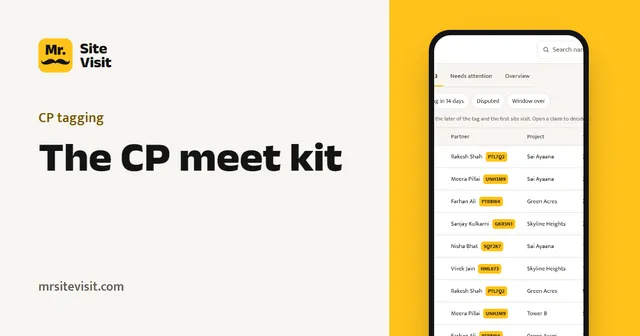
We don’t track brokerage, invoices or payouts: the partner code shows who brought the buyer, and your accounts team settles how much. The Developer plan adds partner codes and claims. Each partner-brought buyer is tagged with the partner’s code and a tagging window, and claims go to a dispute queue. On Growth and Developer, each visit gets the time and a GPS stamp at the start and the end. The stamp is recorded, not checked against the site.
Developer is ₹1,298 a user a month, billed yearly, from three users, with no GST on top. See how it works for developers and mandate companies, or the plans and prices.
Before your next launch, check one thing this week. Is the partner tie rule written down, and has every partner seen it?
Questions teams ask
What should a developer do in the first month after a project launch?
Call every new lead within the hour, answer every channel partner registration the same day, confirm every site visit the day before, and follow up every visit with a dated next step. Count leads, visits, bookings and partner claims every evening, and fix the weakest step the next morning.
Can a developer collect EOIs before RERA registration?
The RERA Act bars advertising, marketing, booking or inviting people to buy before the project is registered. EOIs aren’t named in the Act, and one chartered accountant reads pre-registration EOIs as contrary to that rule. Ask your lawyer before collecting any.
How much advance can a developer take before the agreement for sale?
Under Section 13(1), a developer can’t take more than 10% of the cost as an advance or application fee without first signing and registering a written agreement for sale. That doesn’t make early booking safe: Section 3 still bars booking before registration. Check your state’s rules and ask your lawyer.
How do you stop channel partner disputes at a launch?
Publish the rules before launch day: the registration format, how fast the desk acknowledges, the tagging window, and a written tie rule for two partners claiming one buyer. Then apply them the same way every time, and keep the acknowledgements.
Sources
- The Real Estate (Regulation and Development) Act, 2016, India Code (Section 3(1): no advertising, marketing, booking or sale before registration; 3(2): small-project exemptions; Explanation: each phase registered separately; Section 10(a): agents shall not facilitate sale in an unregistered project; Section 13(1): no more than 10% advance without a registered agreement for sale; Section 62: agent penalty up to ₹10,000 a day, up to 5% of the cost)
- TaxGuru, CA Vinay Thyagaraj, Expression of Interest under RERA advertisement guidelines (25 August 2025): EoI isn't named in the RERA Act; in the author's view, taking EoIs before registration contradicts Section 3